Search
324 results found with an empty search
- Streaming AR & VR at the Roman Baths (BBC)
Video Learn more... https://www.bbc.co.uk/rd/blog/2019-02-5g-mobile-augmented-reality-bath
- 5G-Today: 5G Broadcast in dedicated broadcast networks
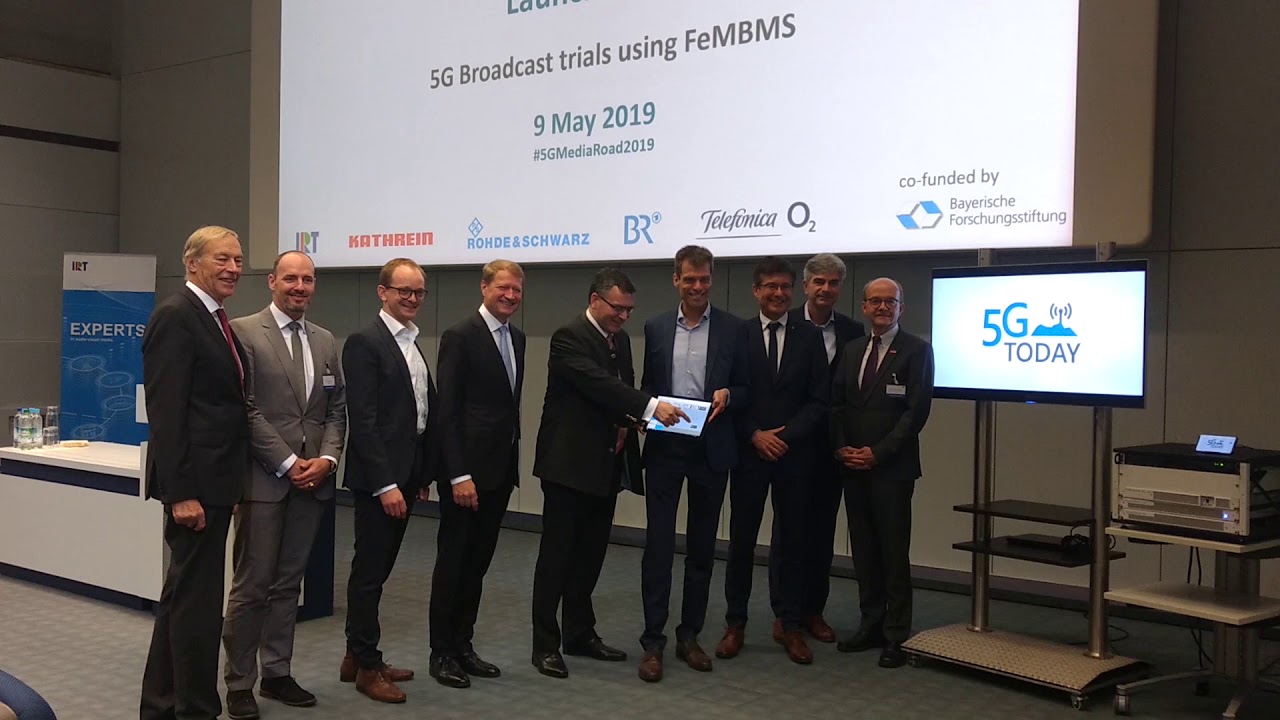
Some data... Participants: BR (Public Service Organization – TV Content Provider – Broadcast Network Operator) IRT (Broadcast Technology Institute) Kathrein Broadcast (Manufacturer of Broadcast Antennas) Rohde & Schwarz (Manufacturer of Broadcast Network and Transmitter Equipment) Telefónica Germany (Mobile Network Operator) Services: Delivery of high quality TV services to mobile devices Duration July 1st 2017 to February 29th 2020 Location Munich and Bavarian Alpine Region (Germany) Technologies FeMBMS (Release 14) Equipment and Infrastructure Two transmitter sites New antenna with circular polarization Core network and FeMBMS transmitter by Rohde & Schwarz Measurement receiver KSA LTE Scanner FeMBMS by Kathrein Broadcast Prototypical FeMBMS receiver by IRT Spectrum/Frequencies UHF 56 (750-758 MHz, center frequency 754 MHz) - 5 MHz Main Goals Development of 5G Broadcast components for end-to-end solution Evaluation of 5G Broadcast as a broadcast system Study the performance of a 5G broadcast signal for mobile reception in urban, sub-urban and rural areas Learn More... More information: https://5g-today.de/
- Radio over 5G: BBC Sounds and radio broadcasting in Mobile Networks (BBC)
Video Some data... Participants: BBC (Public Service Media - Content Provider) Cisco (Infrastructure) CloudNet (Infrastructure) Lime Microsystems (Infrastructure) University of Strathclyde (Academia and Public Institutions) Orkney Islands Council (Academia and Public Institutions) Services: "BBC ‘5G Radio’ App with 13 live BBC radio stations (broadcast on handsets) "BBC Sounds" App, with live (broadcast) and on-demand content (unicast) together seamlessly in a single App Duration May 2018 – September 2019 (17 months, 8 months of which were public user trials) Location Orkney Islands (UK) Technologies FeMBMS (Release 14) / LTE-based 5G Broadcast (Release 16) Equipment and Infrastructure "Rel-12: unicast + broadcast eMBMS; Rel-14: broadcast-only FeMBMS" "eMBMS (Rel-12): A single LimeNet base station in Orkney connected to an omni-directional antenna with a local core network providing a service to 30 broadcast-capable handsets provided to members of the public; FeMBMS (Rel-14): Demonstration of a BBC-developed 5G Broadcast hardware modem (modulator/demodulator)." Spectrum / Frequencies 700 MHz Main Goals Better understand the practicalities of using and the performance of 3GPP broadcast modes; Gain insight into audience behaviour and perceptions of the service; Explore the feasibility of enabling existing BBC applications (such as BBC Sounds) for the playback of services provided over the broadcast modes. Learn More... More information: https://www.bbc.co.uk/rd/blog/2019-03-5g-rural-first-network-orkney
- Media Production in Campus Networks (Media Broadcast)
Media Broadcast's transmitter site in Nauen, not far from Berlin, is one of the oldest broadcasting transmitters in the world. It is being modernized and upgraded with new, innovative 5G technology. On this site, we have set up a 5G campus network to function as a proof of concept. It is not just media firms and event organizers that are being offered a unique opportunity to try 5G and comprehensively test 5G applications on protected frequencies – firms from industry also have a unique opportunity to give it a go. There is a strong focus on applications which will make TV productions easier in future and make use of new features at the same time - an independent 5G solution, offering complete flexibility. The 5G infrastructure is made up of both an indoor and outdoor area. The 5G core network employed at the site, the "Open5GCore", was created by the Fraunhofer FOKUS Institute. "Open5GCore" is fully compatible with 3GPP standards. The 5G RAN (Radio Access Network) provides a solution that is independent of the core system. The indoor area consists of Nauen's large broadcasting hall, while the outdoor area covers a stretch of land surrounding a fire retention pond in front of the building. The 5G Blue-Box is the core element of the proof of concept, housing both the 5G standalone core components and the control units for the RAN. Some data... Participants: Media Broadcast GmbH Services: Live contribution Duration Trial initial setup in December 2020 Test site theoretically available for 10 years Test runs in January and February 2021 Location Nauen, Germany Technologies 5G Stand-alone (5G-SA) Release 16 Equipment and Infrastructure 5G Core: Open5GCore by Fraunhofer FOKUS Institute in Berlin 2 Indoor and 1 Outdoor radio units by HUAWEI Coverage with two HUAWEI RAN base stations for indoor and outdoor CPEs and Smartphones (HUAWEI) R&S Measurement Devices Several Industrial IoT modems LiveU LU800-Pro 5G SRT Encoders via 5G modems Main Goals Test and gain experiences with 5G Campus technology from PLAN till RUN Testing several production use cases with partners from the media industry: remote production, nomadic production, news gathering, 5G drone (planned) Create a portable 5G Campus product: The 5G Blue-Box Learn More... More information: https://www.tvtechnology.com/news/germanys-media-broadcast-to-test-5g-tv-production https://www.film-tv-video.de/business/2021/02/26/5g-campusnetz-von-media-broadcast/ https://www.media-broadcast.com/5g-proof-of-concept/en/ https://www.media-broadcast.com/5g-blue-box/en/
- 5G-TOURS: Video services for tourists, citizens and students (RAI, UPV)
LTE-based 5G Terrestrial Broadcast trials within the context of the European 5G-TOURS project. Some data... Participants: RAI (Public Service Media Organization - TV Content Provider - Broadcast Network Operator) UPV Universitat Politecnica de Valencia (Academic institution) Enensys EXPWAY (manufacturer of Broadcast Network Equipment and Test & Monitoring Equipment for digital broadcast) Services: Delivery of high-quality video services for tourists, citizens and students enriching their touristic and/or educational experiences Duration FeMBMS Rel-14 (Q4 2020), LTE-based 5G Terrestrial Broadcast Rel-16 (2021) Location Turin (Italy) Technologies FeMBMS (Release 14) / LTE-based 5G Broadcast (Release 16) Equipment and Infrastructure One HPHT transmitter site, EnTV/EPC core by Rohde & Schwarz, hardware/software defined receiver (SDR) by Rohde&Schwarz and iFN Spectrum / Frequencies VHF 11 (216-223 MHz, center frequency 219,5 MHz) Main Goals 5G Broadcast delivery to massive audiences with HPHT infrastructure Study the performance of a 5G broadcast signal in mobility (in car scenario) and urban outdoor Improved video user’s experience Distribution of audio-visual (A/V) content and services to a potentially unlimited number of users Learn More... More information: https://5gtours.eu/
- Standalone 5G Network for MotoGP™️ (BT)
These are a series of links explaining the media production trials conducted during MotoGP™️ in August 2021 by BT Sport, Dorna, Vislink and the University of Strathclyde. MotoGP: https://www.motogp.com/en/news/2021/08/31/world-s-first-stand-alone-5g-network-introduced-in-motogp/389547 Vislink: https://www.vislink.com/2021/08/31/worlds-first-standalone-5g-network-introduced-in-motogp%EF%B8%8F/
- Live video contribution for mobile journalism (RTL Deutschland)
https://www.tvbeurope.com/live-production/deutsche-telekom-rtl-deutschland-test-live-video-production-over-5g https://www.telekom.com/en/media/media-information/archive/5g-standalone-simplifies-tv-productions-648244
- Free-to-air TV and Radio in Vienna (ORS)
Assessing the performance of LTE-based 5G Broadcast (Release 14 and Release 16) in comparison with DVB-T2 and DAB+. Studying product maturity of infrastructure and receivers with close cooperation to manufacturers. Evaluating use cases and applications and evolving the 5G broadcast ecosystem. Some data... Participants: Austrian Broadcasting Corporation (ORF) – Public Broadcaster, Content Provider, TV & Radio Austrian Broadcasting Services (ORS) – Broadcast Network Operator KroneHit – Private Broadcaster, Content Provider, Radio ProSiebenSat.1 PULS 4– Private Broadcaster, Content Provider of TV for Puls24 Servus TV – Private Broadcaster, Content Provider, TV Vienna University of Technology, Institute for Telecommunications – Link Level Simulations Services: Linear TV and Radio (RTP, HLS, DASH in various configurations4 ) Emergency Warning Tests Duration Phase 1: 2020-2021 - Comparison DVB-T2 vs 5G Broadcast Phase 2: 2021 - 2023 - Investigation of applications and further development of the 5G broadcast ecosystem Location Vienna (Austria) Technologies FeMBMS (Release 14) and LTE-based 5G Terrestrial Broadcast (Release 16) Equipment and Infrastructure Commercial equipment and Infrastructure: 2 HPHT Transmitter Sites 2 Core Systems Open-source receiver (OBECA/5G-MAG Reference Tools) Open-source transmitter (5G-MAG Reference Tools) Spectrum / Frequencies 739 MHz, max bandwidth 10 MHz before 1.7.2020 667 MHz, max bandwidths [8 MHz (Kahlenberg transmitter), 10 MHz (Liesing transmitter)] from 1.7.2020 640.5 MHz, max bandwidth 5 MHz (Liesing tranmitter) from 1.2.2022 Main Goals Open testbed for Broadcast Network Operators, Mobile Network Operators, Set Top Box & chip manufacturers Study product maturity of infrastructure and receivers with close cooperation of manufacturers Support the evolution of a 5G broadcast ecosystem by developing and providing an open-source receiver for own and other trials and application developer. Phase 1: Compare simulation and measurements of FeMBMS Rel.14 (Rel.16) with DVB-T2 and DAB+ Technical evaluation of 5G Broadcast use-cases and applications Phase 2: Hybrid use-cases 5G Broadcast and Broadband Further development of the 5G Broadcast ecosystem Learn More... More information: https://www.ors.at/5g-broadcast/
- Immersive Experience with XR in Sports (BT)
EE, BT Sport “re-imagine” sports viewing with help from 5G - https://www.tvbeurope.com/live-production/ee-bt-sport-re-imagine-sports-viewing-with-help-from-5g
- Edge Computing for 4K UHD streaming (Verizon)
5G consortium explores edge computing for 4K UHD content - https://www.tvbeurope.com/media-delivery/5g-consortium-explores-edge-computing-for-4k-uhd-content
- 5G Broadcast trials during Eurovision Song Contest (Ateme, EBU, France TV, ORS, Qualcomm, RAI, SWR)
A 5G Broadcast signal was transmitted during the Eurovision Song Contest 2022 event live and in high quality from sites in 4 European cities simultaneously. At the time, only a select group of users with 5G Broadcast-enabled smartphones in Paris, Stuttgart, Turin, Vienna was able to see these transmissions. The aim is to change that, and to demonstrate, with those transmissions, the value this technology could bring to the media and millions of audience members. 5G Broadcast is a complementary distribution technology that can add value in a number of use-cases – one of which is access to live content for mass audiences on the go, with the possibility to receive free-to-air content even without a SIM card, no need to sign up to third-party services, and in a way that delivers efficiency gains for distribution infrastructures. For the purposes of the 2022 ESC 5G Broadcast trials, the EBU and its Members SWR (Stuttgart), ORS Group (Vienna), France Télévisions (Paris) and RAI (Turin) teamed up with Eurovision services for the ESC signal logistics, Ateme for the encoding and streaming, Rohde & Schwarz for the transmission equipment, and Qualcomm for the prototype 5G Broadcast-compatible handsets. Participants • Ateme • France Télévisions • ORS/ORF • Qualcomm • RAI • Rohde & Schwarz • SWR Start Date and Duration • April/May 2022 Location • Geneva • Paris • Stuttgart • Turin • Vienna Technologies • 3GPP Release 16 feature set Learn More... First Multi-site 5G Broadcast trials deliver Eurovision Song Contest in Italy, Austria, France and Germany (EBU) - https://tech.ebu.ch/news/2022/05/first-multi-site-5g-broadcast-trials-deliver-eurovision-song-contest-in-italy-austria-france-and-germany 5G BROADCASTS OF THE EUROVISION SONG CONTEST – THE WHAT, HOW AND WHY - https://tech.ebu.ch/news/2022/05/5g-broadcasts-of-the-eurovision-song-content--the-what-how-and-why ESC 2022, il 5G Broadcast al Museo della Radio e Tv della Rai (RAI) - https://www.rai.it/ufficiostampa/assets/template/us-articolo.html?ssiPath=/articoli/2022/05/ESC-2022-il-5G-Broadcast-al-Museo-della-Radio-e-Tv-della-Rai-abdff1be-7f1c-4ddd-9fd8-33cda7c61121-ssi.html SWR beteiligt sich an europaweitem 5G Broadcast-Test beim Eurovision Song Contest (SWR) - https://www.swr.de/unternehmen/kommunikation/pressemeldungen/pressemeldung-5g-esc-100.html
- 5G Video Pilot: Edge-based Media Distribution (Novelsat)
5G is set to become the content-of-the-future distribution network, revolutionizing the way we watch and experience video. Enabling ultra-fast speeds and low latency like never before, 5G is unleashing a new generation of experiences on any screen. Cellcom, Israel’s largest cellular provider, and NOVELSAT, a global leader in content connectivity, partnered on a pilot of real-time video content distribution over a 5G network infrastructure. As part of the pilot, Cellcom implements a full 5G network for delivering video content to multiple user devices. Video content of CellcomTV service is distributed in real time to 5G base stations by NOVELSAT's solution. At the cell site, NOVELSAT’s edge solution performs video processing using edge-computing capabilities and streams the video content at the highest quality and with the lowest latency to a wide range of user devices – from smartphones to TV sets. The pilot demonstrates the benefits of edge-based video delivery in terms of both video traffic efficiency and end-user experience quality (QoE). The pilot includes two phases, where phase 1 includes a controlled 5G cell at Cellcom’s lab with terrestrial core-to-edge connectivity, and phase 2 includes a live 5G cell site with satellite core-to-edge connectivity. In this world’s first trial of edge-based media delivery for mobile networks, Cellcom and NOVELSAT are delivering live channels and on-demand content to both mobile and fixed wireless users with 5G and 5G-FWA connectivity. During the month of May 2022, Cellcom and NOVELSAT have successfully completed phase 1 of the pilot, showcasing: Higher video quality Lower video latency Network congestion mitigation Multiple user devices – smartphones and TV sets Learn More... Cellcom and NOVELSAT Plan to Partner on a 5G Video Pilot (Novelsat) - https://novelsat.com/pressrelease/cellcom-and-novelsat-plan-to-partner-on-a-5g-video-pilot/