Search
318 results found with an empty search
- Live video contributions during the "Diada 2019" (CCMA)
The “Catalan Audiovisual Media Corporation” (CCMA S.A.) and the “Generalitat de Catalunya” promoted for the first time two live video transmission with 5G technology on 11th September 2019, from within the Diada demonstration event, in Plaça Espanya, Barcelona. The aim was to test and validate the benefits and possibilities of the application of 5G in the audiovisual sector and more specifically in live television broadcasts. This was the first time that a television channel was contributing live video over the commercial 5G network from a real, public, open, and crowded environment across the state. The Catalan Audiovisual Media Corporation (CCMA) made a leap forward in live broadcasts and for the first time TV3 did broadcast live video received via 5G technology from the mass demonstration convened by the sovereignist entities on September 11th. This transmission was possible thanks to the initiative of the CCMA and the Department of Digital Policies and Public Administration within the framework of the 5G Barcelona alliance. The broadcast was possible thanks to Vodafone’s 5G network, which provided the required connectivity through two of the 15 5G antennas it already had deployed in the city of Barcelona, specifically the two in Plaça Espanya. In addition to being the first time that a TV3 multi-camera broadcast included this technology for signal transport (image and sound), it was also the first time in the entire state that a television channel broadcast a live event via the commercial 5G network (i.e., already available) from a real public, open and crowded environment. A TV3 team, located at the foot of the street from Plaça Espanya, was equipped with a Samsung 5G smartphone with the intend of capturing the point of view of the protesters. The signal and the connection did not use the traditional connecting routes but through the Vodafone 5G mobile phone network. In addition, the 5G network was also used to transmit the signal from another camera that was in a room of the Hotel Catalonia Plaza. This camera was connected to the TV3 headquarters via a Samsung 5G terminal and had a backup fiber optic, which meant a change in thinking, as usually the fiber optic is the primary link, and the mobile network, the backup or secondary. Benefits of 5G Thanks to this pilot, it was possible to test and validate the benefits of the application of 5G technology in the audiovisual sector and more specifically in mass live television broadcasts. The transport of the signal by means of 5G in a real environment, as the Diada demonstration, with a great concentration of people and, therefore, of mobile devices and data traffic, allowed to guarantee the quality of the connection and the retransmission in case of saturation of other available mobile networks, such as 4G. The fact that the TV3 journalist was able to broadcast the image and sound signal from a minimal and light equipment (a state-of-the-art smartphone) gave the editor a lot of autonomy of movement and brought the retransmission to the public, as it allowed to approach the protesters in a less intrusive way. The commitment to 5G The participation of the Department of Digital Policies in TV3 first live 5G broadcast as a promoter and coordinator of the project through the “Centre de Telecommunicacions i Tecnologies de la Informació” (CTTI) was part of the commitment of the Government of Catalonia to 5G technology as an engine of transformation and digital innovation and for the promotion of its use within the Administration of the Generalitat and its public sector within the framework of the 5G strategy of Catalonia. The initiative was carried out under the umbrella of the 5G Barcelona alliance promoted by the “Generalitat de Catalunya”, Barcelona City Council, Mobile World Capital Barcelona, i2CAT, CTTC, Atos and the UPC, to transform Catalonia and the metropolitan area of Barcelona in an open and neutral urban laboratory that allows the validation and adoption of 5G technologies and applications in a real environment.
- LTE-based 5G Broadcast trials in Valle d'Aosta (RAI)
Rai is experimenting with LTE-based 5G Broadcast technology in terrestrial broadcast networks. Some data... Participants: RAI (Public Service Media Organization - TV Content Provider - Broadcast Network Operator) RaiWay (Broadcast Network Operator) Services: Provide high-quality video media content and service to mobile devices using conventional terrestrial broadcast network infrastructure Duration Noivember 2021 - June 2022 Location Aosta (Italy) Technologies LTE-based 5G Terrestrial Broadcast Equipment and Infrastructure Two HPHT transmitter sites in SFN (Single Frequency Network) mode Spectrum/Frequencies UHF channel 53 (730 MHz center frequency) Main Goals Provide 5G Broadcast delivery of live TV services to massive audiences with broadcast infrastructure Improve video user’s experience Mobile reception (in the vehicles) Distribute of audio-visual (A/V) content and services to a large number of users Learn More... More information:
- TV over Broadcast in Terrestrial Broadcast Networks (Ateme, France TV, Qualcomm)
For the 2022 Roland-Garros tournament, France Télévisions is experimenting with new ways to distribute live tennis games using 5G. For the 2022 Roland-Garros tournament, France Télévisions and a group of select companies will test new distribution modes, both in Broadcast and Multicast mode thanks to 5G. These different distribution modes allow France Televisions' channels to be received on all receivers with optimal reception quality, regardless of the number of viewers connected in the same place. They are therefore particularly well suited to broadcasting sporting events, which are attracting an ever-growing audience. 5G Broadcast : The broadcast mode of 5G will allow to broadcast France Télévisions' channels live with a good geographical coverage and a quality guarantee whatever the number of users connected at the same time on the same coverage area of the transmitter. The principle is similar to what is done today on DTT with the broadcast of a channel on the terrestrial network once for all customers, but with the advantage of being compatible with the different types of equipment supporting 5G (and not only television) and with the possibility of enjoying it on the move. The end-to-end 5G Broadcast platform set up (1)(2) guarantees a wide geographical coverage. Thus, all compatible cell phones (3) located in the transmitter's coverage area (4) can receive the tournament images without network saturation and with a stable and guaranteed image quality. This technology is of interest to France Télévisions, which is particularly concerned about the quality of service delivered to viewers, especially during events that attract an ever-growing (digital) audience. The advantages of using networks in 5G Broadcast mode are as follows: For users: - Guaranteed image quality regardless of the number of users involved at the same time in the network coverage area - A very good coverage with a low number of 5G transmitters (because we install transmitters on high points) - The service is accessible without a SIM card - Compatibility with the evolution of the 5G standard 5G Multicast The multicast mode of 5G will also allow an optimized broadcast of France Televisions' live channels. As with the broadcast mode, the video stream is broadcast only once on the network for all users. This broadcast mode can be dynamically activated on Orange 5G network transmitters to replace the traditional unicast mode used today, where two mobiles watching the same program require the broadcast of this program twice on the network. Broadcast and multicast are complementary. Multicast transport on Orange's mobile network will use higher frequencies than broadcast, despite a lower coverage, it will allow to broadcast content with a higher throughput. Like 5G Broadcast, 5G multicast has the advantage for the user to have a guaranteed image quality. For Orange, it allows to optimize and decrease the amount of data transmitted on the network, which reduces broadcasting costs, the number of antennas needed in dense areas and consequently decreases the environmental footprint related to the broadcasting of audiovisual streams. To show the interest of this technology and to imagine what could be the broadcasting of France Televisions live channels in the years to come, Orange contributes to a collaborative project called NESTED (2)(5)(6)(7)(8) which implements new standards recently published. Within this framework, we are experimenting with France Télévisions to broadcast live programs by testing : - 5G multicast if several viewers are watching the same program from the same transmitter, or 5G unicast if less than two viewers are watching the same content, - The new VVC codec which allows to reduce by four the video bitrates while offering the same quality compared to the codec used by the DTT, - The low latency mode, thanks to the Low Latency DASH (LL-DASH), to have a low delay compared to the live broadcast, - The DVB-I standard so that the viewer can receive the program on his or her terminal via the different broadcast modes (broadcast, multicast, unicast) in a transparent manner. For this project, France Télévisions and Orange will have OPPO mobiles available for demonstration on its stand at Roland Garros. The companies involved in the project with France Télévisions are (in alphabetical order): ATEME, Enensys, IETR, Orange, Qualcomm Technologies Inc., Rohde & Schwarz, towerCast, Viaccess-Orca
- TV over Multicast in Mobile Networks (Ateme, France TV)
For the 2022 Roland-Garros tournament, France Télévisions is experimenting with new ways to distribute live tennis games using 5G. For the 2022 Roland-Garros tournament, France Télévisions and a group of select companies will test new distribution modes, both in Broadcast and Multicast mode thanks to 5G. These different distribution modes allow France Televisions' channels to be received on all receivers with optimal reception quality, regardless of the number of viewers connected in the same place. They are therefore particularly well suited to broadcasting sporting events, which are attracting an ever-growing audience. 5G Broadcast : The broadcast mode of 5G will allow to broadcast France Télévisions' channels live with a good geographical coverage and a quality guarantee whatever the number of users connected at the same time on the same coverage area of the transmitter. The principle is similar to what is done today on DTT with the broadcast of a channel on the terrestrial network once for all customers, but with the advantage of being compatible with the different types of equipment supporting 5G (and not only television) and with the possibility of enjoying it on the move. The end-to-end 5G Broadcast platform set up (1)(2) guarantees a wide geographical coverage. Thus, all compatible cell phones (3) located in the transmitter's coverage area (4) can receive the tournament images without network saturation and with a stable and guaranteed image quality. This technology is of interest to France Télévisions, which is particularly concerned about the quality of service delivered to viewers, especially during events that attract an ever-growing (digital) audience. The advantages of using networks in 5G Broadcast mode are as follows: For users: - Guaranteed image quality regardless of the number of users involved at the same time in the network coverage area - A very good coverage with a low number of 5G transmitters (because we install transmitters on high points) - The service is accessible without a SIM card - Compatibility with the evolution of the 5G standard 5G Multicast The multicast mode of 5G will also allow an optimized broadcast of France Televisions' live channels. As with the broadcast mode, the video stream is broadcast only once on the network for all users. This broadcast mode can be dynamically activated on Orange 5G network transmitters to replace the traditional unicast mode used today, where two mobiles watching the same program require the broadcast of this program twice on the network. Broadcast and multicast are complementary. Multicast transport on Orange's mobile network will use higher frequencies than broadcast, despite a lower coverage, it will allow to broadcast content with a higher throughput. Like 5G Broadcast, 5G multicast has the advantage for the user to have a guaranteed image quality. For Orange, it allows to optimize and decrease the amount of data transmitted on the network, which reduces broadcasting costs, the number of antennas needed in dense areas and consequently decreases the environmental footprint related to the broadcasting of audiovisual streams. To show the interest of this technology and to imagine what could be the broadcasting of France Televisions live channels in the years to come, Orange contributes to a collaborative project called NESTED (2)(5)(6)(7)(8) which implements new standards recently published. Within this framework, we are experimenting with France Télévisions to broadcast live programs by testing : - 5G multicast if several viewers are watching the same program from the same transmitter, or 5G unicast if less than two viewers are watching the same content, - The new VVC codec which allows to reduce by four the video bitrates while offering the same quality compared to the codec used by the DTT, - The low latency mode, thanks to the Low Latency DASH (LL-DASH), to have a low delay compared to the live broadcast, - The DVB-I standard so that the viewer can receive the program on his or her terminal via the different broadcast modes (broadcast, multicast, unicast) in a transparent manner. For this project, France Télévisions and Orange will have OPPO mobiles available for demonstration on its stand at Roland Garros. The companies involved in the project with France Télévisions are (in alphabetical order): ATEME, Enensys, IETR, Orange, Qualcomm Technologies Inc., Rohde & Schwarz, towerCast, Viaccess-Orca
- Live video contribution in sport events
Vodafone, DAZN test 5G in Bundesliga broadcasts - https://www.tvbeurope.com/live-production/vodafone-dazn-test-5g-in-bundesliga-broadcasts Sky, Vodafone test live Bundesliga coverage over 5G - https://www.tvbeurope.com/media-delivery/sky-vodafone-test-5g-live-bundesliga-coverage-over-5g
- LTE-based 5G Broadcast trials in Colombia
Some data... Participants: ID:TOLÚ (R&D institution) Xiro Investment Group (telecommunications provider) Mediamane (Media services) Albavision (Media services) Javier Morgade (OpenAirInterface) Services: Linear TV and Radio Duration 01/07/2020 - 01/01/2021 Location Santiago de Tolú (Colombia) Technologies FeMBMS (Release 14) with variable MCS index Equipment and Infrastructure OpenAirInterface transmitter and receiver. TX power 60 W Spectrum/Frequencies UHF Channel 33 (584.5-589.5 MHz) Main Goals Testing the delivery of TV and Radio providing multiple channels Test cost-effective deployment of FeMBMS with OpenAirInterface in Docker Learn More... More information: www.idtolu.com
- Streaming AR & VR at the Roman Baths (BBC)
Video Learn more... https://www.bbc.co.uk/rd/blog/2019-02-5g-mobile-augmented-reality-bath
- 5G-Today: 5G Broadcast in dedicated broadcast networks
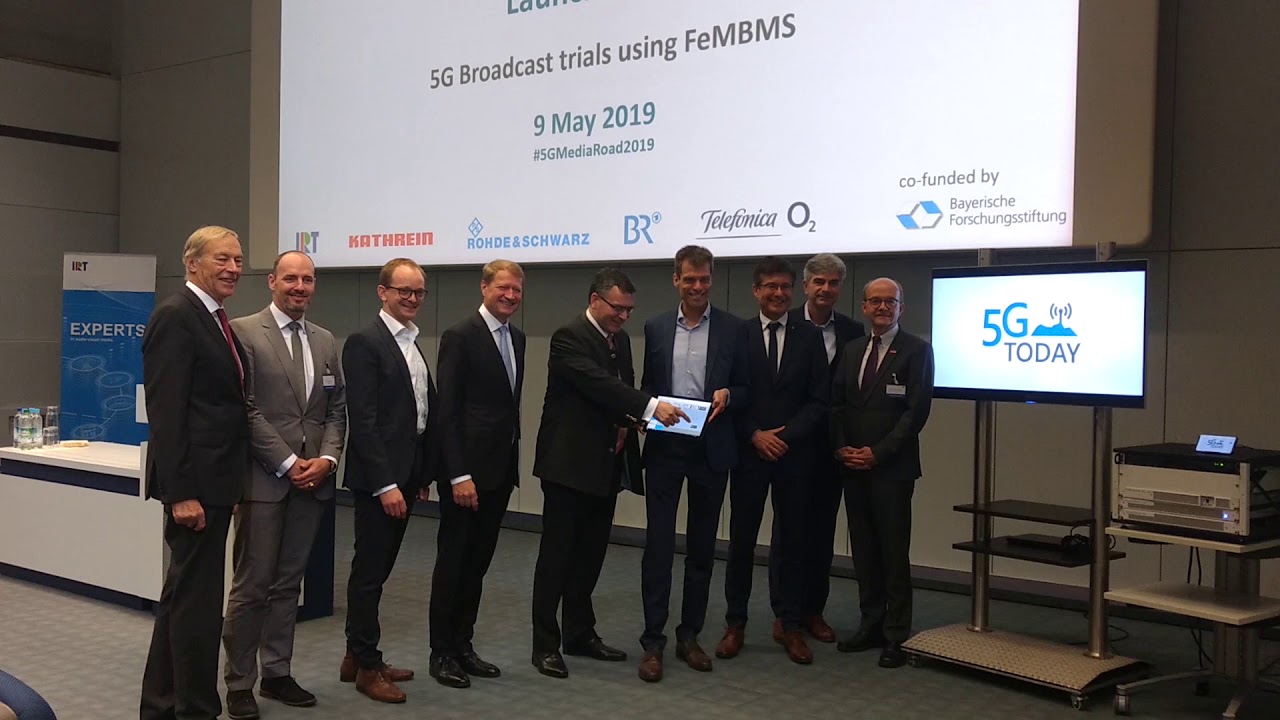
Some data... Participants: BR (Public Service Organization – TV Content Provider – Broadcast Network Operator) IRT (Broadcast Technology Institute) Kathrein Broadcast (Manufacturer of Broadcast Antennas) Rohde & Schwarz (Manufacturer of Broadcast Network and Transmitter Equipment) Telefónica Germany (Mobile Network Operator) Services: Delivery of high quality TV services to mobile devices Duration July 1st 2017 to February 29th 2020 Location Munich and Bavarian Alpine Region (Germany) Technologies FeMBMS (Release 14) Equipment and Infrastructure Two transmitter sites New antenna with circular polarization Core network and FeMBMS transmitter by Rohde & Schwarz Measurement receiver KSA LTE Scanner FeMBMS by Kathrein Broadcast Prototypical FeMBMS receiver by IRT Spectrum/Frequencies UHF 56 (750-758 MHz, center frequency 754 MHz) - 5 MHz Main Goals Development of 5G Broadcast components for end-to-end solution Evaluation of 5G Broadcast as a broadcast system Study the performance of a 5G broadcast signal for mobile reception in urban, sub-urban and rural areas Learn More... More information: https://5g-today.de/
- Radio over 5G: BBC Sounds and radio broadcasting in Mobile Networks (BBC)
Video Some data... Participants: BBC (Public Service Media - Content Provider) Cisco (Infrastructure) CloudNet (Infrastructure) Lime Microsystems (Infrastructure) University of Strathclyde (Academia and Public Institutions) Orkney Islands Council (Academia and Public Institutions) Services: "BBC ‘5G Radio’ App with 13 live BBC radio stations (broadcast on handsets) "BBC Sounds" App, with live (broadcast) and on-demand content (unicast) together seamlessly in a single App Duration May 2018 – September 2019 (17 months, 8 months of which were public user trials) Location Orkney Islands (UK) Technologies FeMBMS (Release 14) / LTE-based 5G Broadcast (Release 16) Equipment and Infrastructure "Rel-12: unicast + broadcast eMBMS; Rel-14: broadcast-only FeMBMS" "eMBMS (Rel-12): A single LimeNet base station in Orkney connected to an omni-directional antenna with a local core network providing a service to 30 broadcast-capable handsets provided to members of the public; FeMBMS (Rel-14): Demonstration of a BBC-developed 5G Broadcast hardware modem (modulator/demodulator)." Spectrum / Frequencies 700 MHz Main Goals Better understand the practicalities of using and the performance of 3GPP broadcast modes; Gain insight into audience behaviour and perceptions of the service; Explore the feasibility of enabling existing BBC applications (such as BBC Sounds) for the playback of services provided over the broadcast modes. Learn More... More information: https://www.bbc.co.uk/rd/blog/2019-03-5g-rural-first-network-orkney
- Media Production in Campus Networks (Media Broadcast)
Media Broadcast's transmitter site in Nauen, not far from Berlin, is one of the oldest broadcasting transmitters in the world. It is being modernized and upgraded with new, innovative 5G technology. On this site, we have set up a 5G campus network to function as a proof of concept. It is not just media firms and event organizers that are being offered a unique opportunity to try 5G and comprehensively test 5G applications on protected frequencies – firms from industry also have a unique opportunity to give it a go. There is a strong focus on applications which will make TV productions easier in future and make use of new features at the same time - an independent 5G solution, offering complete flexibility. The 5G infrastructure is made up of both an indoor and outdoor area. The 5G core network employed at the site, the "Open5GCore", was created by the Fraunhofer FOKUS Institute. "Open5GCore" is fully compatible with 3GPP standards. The 5G RAN (Radio Access Network) provides a solution that is independent of the core system. The indoor area consists of Nauen's large broadcasting hall, while the outdoor area covers a stretch of land surrounding a fire retention pond in front of the building. The 5G Blue-Box is the core element of the proof of concept, housing both the 5G standalone core components and the control units for the RAN. Some data... Participants: Media Broadcast GmbH Services: Live contribution Duration Trial initial setup in December 2020 Test site theoretically available for 10 years Test runs in January and February 2021 Location Nauen, Germany Technologies 5G Stand-alone (5G-SA) Release 16 Equipment and Infrastructure 5G Core: Open5GCore by Fraunhofer FOKUS Institute in Berlin 2 Indoor and 1 Outdoor radio units by HUAWEI Coverage with two HUAWEI RAN base stations for indoor and outdoor CPEs and Smartphones (HUAWEI) R&S Measurement Devices Several Industrial IoT modems LiveU LU800-Pro 5G SRT Encoders via 5G modems Main Goals Test and gain experiences with 5G Campus technology from PLAN till RUN Testing several production use cases with partners from the media industry: remote production, nomadic production, news gathering, 5G drone (planned) Create a portable 5G Campus product: The 5G Blue-Box Learn More... More information: https://www.tvtechnology.com/news/germanys-media-broadcast-to-test-5g-tv-production https://www.film-tv-video.de/business/2021/02/26/5g-campusnetz-von-media-broadcast/ https://www.media-broadcast.com/5g-proof-of-concept/en/ https://www.media-broadcast.com/5g-blue-box/en/
- 5G-TOURS: Video services for tourists, citizens and students (RAI, UPV)
LTE-based 5G Terrestrial Broadcast trials within the context of the European 5G-TOURS project. Some data... Participants: RAI (Public Service Media Organization - TV Content Provider - Broadcast Network Operator) UPV Universitat Politecnica de Valencia (Academic institution) Enensys EXPWAY (manufacturer of Broadcast Network Equipment and Test & Monitoring Equipment for digital broadcast) Services: Delivery of high-quality video services for tourists, citizens and students enriching their touristic and/or educational experiences Duration FeMBMS Rel-14 (Q4 2020), LTE-based 5G Terrestrial Broadcast Rel-16 (2021) Location Turin (Italy) Technologies FeMBMS (Release 14) / LTE-based 5G Broadcast (Release 16) Equipment and Infrastructure One HPHT transmitter site, EnTV/EPC core by Rohde & Schwarz, hardware/software defined receiver (SDR) by Rohde&Schwarz and iFN Spectrum / Frequencies VHF 11 (216-223 MHz, center frequency 219,5 MHz) Main Goals 5G Broadcast delivery to massive audiences with HPHT infrastructure Study the performance of a 5G broadcast signal in mobility (in car scenario) and urban outdoor Improved video user’s experience Distribution of audio-visual (A/V) content and services to a potentially unlimited number of users Learn More... More information: https://5gtours.eu/
- Standalone 5G Network for MotoGP™️ (BT)
These are a series of links explaining the media production trials conducted during MotoGP™️ in August 2021 by BT Sport, Dorna, Vislink and the University of Strathclyde. MotoGP: https://www.motogp.com/en/news/2021/08/31/world-s-first-stand-alone-5g-network-introduced-in-motogp/389547 Vislink: https://www.vislink.com/2021/08/31/worlds-first-standalone-5g-network-introduced-in-motogp%EF%B8%8F/