| Detail | Information |
|---|---|
| Date | Introductory session: 18 April 2024, 14:00 CEST · Main session: 2 May 2024, 15:30 CEST |
| Location | Online |
Background
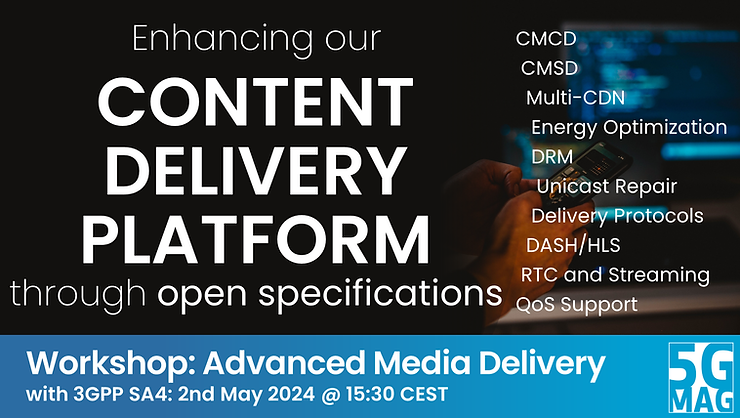
3GPP SA4 kicked off a Feasibility Study on Advanced Media Delivery, looking at potential improvements and extensions including:
- Common Client Metadata
- Common Server- and Network-Assisted Streaming
- Multi-CDN and Multi-Access Media Delivery
- Modem Usage Optimized Media Streaming
- DRM and Conditional Access
- In-session Unicast Repair for MBS Object Distribution
- MBS User Service and Delivery Protocols for eMBMS
- Selected MBMS Functionalities not supported in MBS
- DASH/HLS Interoperability
- Further harmonisation of RTC and Streaming for Advanced Media Delivery
- Improved QoS support
- Impacts and opportunities of QUIC for segmented content delivery
Issues arising from implementation of specifications under the 5G-MAG Reference Tools were also expected to be shared during the workshop, including problems tracked by 5G-MAG as a 3GPP Market Representation Partner in its Standards issue tracker.
Topics in Detail
Common Client Metadata: 3GPP and MPEG DASH support DASH metrics, but reporting is not common across players. CTA WAVE's CTA-5004 (Common Media Client Data, CMCD) was cited as a reference; the study looked at integrating already-defined metrics (rather than new ones) into 5GMS workflows, covering metric keys, player APIs, client-to-server reporting options (user plane, M5 reference point, EVEX), M3 reference point impact, and a possible common harmonised reporting framework.
Common Server- and Network-Assisted Streaming: Building on MPEG-DASH's Server and Network Assisted DASH (SAND, partly adopted in TS 26.247), the study looked at industry generalisations such as Content Steering (ETSI TS 103 998), WAVE's Common Media Server Data (CMSD), and Addressable Resource Index (ARI) Tracks in MPEG, and their integration into the Media Delivery System and MBS/MBMS workflows alongside existing QoS mechanisms.
Multi-CDN and Multi-Access Media Delivery: Covers distribution across multiple CDNs (including Coded Multisource Media Format/CMMF with Application Layer FEC, and MPEG-DASH Part 9 ReAP), plus clients using multiple access networks simultaneously, and their impact on user plane reference points M2/M4 and media session handling at M5.
Modem Usage Optimized Media Streaming: With basic Background Data Transfer support added in Rel-18, the study examined enhancements to support preload and functionality similar to the W3C Managed Media Source Extension, aiming to reduce UE battery consumption from constantly-connected radios.
DRM and Conditional Access: Looked at key management scalability for encrypted content over Unicast/Multicast and Broadcast/MBS/MBMS, integration of Content Protection interfaces (e.g. CPIX back-end interfaces), and impacts on the media plane (M2, M4) and media session handling APIs (M3, M5).
In-session Unicast Repair for MBS Object Distribution: For live/low-latency services using the Object Distribution Method in MBS, studies whether unicast repair for individual MBS clients (when object transmission fails) can be added without causing network overload or excess latency.
MBS User Service and Delivery Protocols for eMBMS: Since MBMS/eMBMS interworking with MBS is addressed at the transport level in TS 23.247 but not at the User Service level, the study identifies gaps preventing MBMS and LTE-based 5G Broadcast from leveraging MBS User Service technologies.
Selected MBMS Functionalities not supported in MBS: TS 26.502 and TS 26.517 support only a subset of MBMS functionality in Rel-17; the study catalogues which remaining MBMS features are relevant for migration to MBS User Services.
DASH/HLS Interoperability: Common CMAF segments consumable by both DASH and HLS players, guided by CTA WAVE's CTA-5005-A specification and MPEG-DASH Part 9 (ReAP), studied for impact on the 5GMS System and MBS/MBMS distribution.
Further harmonisation of RTC and Streaming: TS 26.510 (Rel-18) harmonised media delivery across the 5G Media Streaming (5GMS) System and the Real-time media Communication (RTC) System, but not all TS 26.512 functionality is yet common to both; the study looks at completing this harmonisation.
Improved QoS support: Rel-18 SA2 features in the 5G System (documented in TS 23.501) relevant to media delivery, including Explicit Congestion Notification (ECN) for L4S, PDU Set handling, and QoS Monitoring.
Impacts and opportunities of QUIC: Following IETF finalisation of QUIC in May 2021 and growing HTTP/3 deployment, the study looks at delivering segmented media over QUIC streams (including IETF MOQ), with possible relevance to SA2's ongoing FS_XRM_Ph2 study (TR 23.700-70).
Related Resources
- 3GPP SA4 meeting document S4-240518
- ottverse: Common Media Client Data (CMCD) overview
- 5G-MAG Standards issue tracker on GitHub
This workshop was organised in the context of 5G-MAG's role as a 3GPP Market Representation Partner.