| Detail | Information |
|---|---|
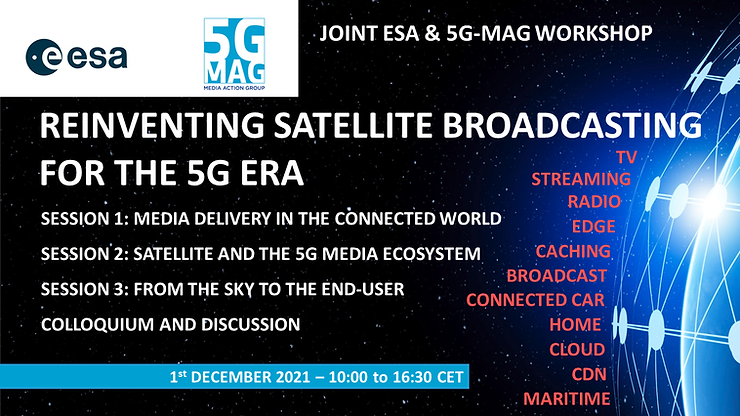
| Date | 1 December 2021, 10:00 – 16:30 CET |
| Location | Online event |
| Organisers | ESA (Telecommunications and Integrated Applications Directorate) & 5G-MAG |
About the Workshop
"Reinventing Satellite Broadcasting for the 5G era" was an interactive workshop fostering discussion between satellite, terrestrial infrastructure and service providers, media and other verticals representatives, to address the requirements and potential solutions for evolved media distribution, 5G satellite systems and service delivery chains.
Antonio Franchi (ESA) and Antonio Arcidiacono (5G-MAG Chair) opened the day, sharing perspectives on the role satellites can play in content distribution and how 5G can enable the technology (r)evolution needed to deliver new services, improve existing ones, and create opportunities for both the satellite industry and end users.
Session 1: Take the Floor!
Keynote: "Future trends in media distribution and the role of satellite": Matteo Ainardi, Arthur D. Little
Kicked off with a focus on content, identifying three key challenges (retention of large viewership content, delivery of non-linear and interactive content, reach of devices beyond the traditional screen) and three key strengths of satellite (ubiquitous coverage, cost-effective reach to large audiences, control of QoS), setting the scene for new opportunities such as 8K content, immersive experiences, content distribution to vehicles, and distribution to CDNs/edge servers.
Speakers from EBU, Globecast, SWR and Varnish Software followed:
- EBU: Opportunity to use satellite for more than broadcast and more than traditional linear TV, integrating satellite distribution within online media to reach end-users at home, in vehicles, or via CDN content caching, possibly with a decentralised architecture.
- Globecast: Unifying satellite and digital worlds via a new generation of satellite infrastructure, targeting 5G uplink contribution over satellite and the 5G Broadcast (r)evolution leveraging MEC and slicing.
- SWR: New audio experiences for the connected car with high personalisation (SWR Audio Lab). The 5GMedia2Go project proposes broadcast infrastructure and 5G Broadcast for linear media delivery in the car, combined with 5G connectivity for the Mediathek and online offer.
- Varnish: Virtualised 5G CDN solutions powered by edge computing; 5G satellite as a direct path for content caching.
Session 2: Take the Floor!
Keynote: "Collaboration Opportunities with 5G Media Streaming": Thomas Stockhammer, Qualcomm
5G Media Streaming is being developed in 3GPP as the baseline architecture for media content distribution, supporting different collaboration scenarios, new media formats and advanced network functionality use. The 5G Broadcast story is an example of how the media industry can engage with 3GPP, but building the ecosystem (reference implementations, proof-of-concepts, and the 5G-MAG Reference Tools) takes additional, sustained effort.
Speakers from Thales, SES, Eutelsat and Novelsat followed:
- Thales: From broadcast service to broadcast mode; how to integrate satellite broadcast/broadband and enable migration to 3GPP, with deployment options depending on use case, terminals, and ground/space segment.
- SES: Combining different satellite constellations (no longer just GEO) and new IP-media-adapted satellites to migrate from traditional TS video toward data/video; 5G creates favorable conditions for satellite multicast into the online ecosystem.
- Eutelsat: Evolving from Satellite Capacity as a Commodity toward Satellite Connectivity as a Network Slice, orchestrated by a Network Core assigning resources transparently to the user.
- Novelsat: End-to-end unicast congestion limits video quality; edge distribution combining broadcast/multicast with unicast from an edge CDN node may be the right tool, since broadcast-only is not a full solution either.
Session 3: Take the Floor!
Keynote: "Non-Terrestrial Network, from technology radar into the car": Oliver Wick, BMW Group
A roadmap from technology scouting to reality for the NTN case in automotive, covering the space ecosystem, services and use cases. 5G connectivity into vehicles enables autonomous driving, safety, infotainment and entertainment, including augmented reality for driver information, high-quality video conferencing, in-vehicle 4K/8K streaming, and the car as a gaming platform.
Speakers from Airbus, VirginMediaO2, Satixfy, Thales, SES, Eutelsat and ST Engineering followed:
- Airbus: NTN satellite broadcast for service continuity, ubiquitous coverage and scalability; direct access via NR, RedCap or NB-IoT, with regenerative satellite payloads as enablers.
- VirginMediaO2: From current architectures to short/mid-term convergence of satellite and terrestrial networks, starting with non-3GPP backhaul via the N3IWF, moving toward a fully NTN-based chain with NR as radio technology embedded into the 5G architecture.
- Satixfy: Devices, antennas and terminals as the key to 5G satellite reception across aeronautics, cars and residential terminals, using software-defined radio for flexibility.
- ST Engineering: OTT delivery integrating satellite into the distribution chain for video, learning, maritime entertainment and connected cars, using native IP and multicast to bring satellite content into the 5G network.
About ESA
The Telecommunications and Integrated Applications Directorate of ESA created the strategic programme line ARTES 4.0 Space for 5G/6G to enable SatCom stakeholders to integrate space into 5G and fulfil the 5G/6G promise of connectivity and services everywhere, anytime. Media is one of the industrial sectors most closely tied to satellite service delivery, with SatCom upstream and downstream industry deriving a high share of revenue from media services and related partnerships.
About 5G-MAG
5G-MAG is a cross-industry association bridging the global media and ICT industries. Its members span the entire value chain and work together to understand, shape and implement future technologies for media production, contribution and distribution.
The collaboration between ESA and 5G-MAG targets the full integration of satellite in the 5G ecosystem, aiming to accelerate 5G/6G satellite solutions in partnership with the ecosystem built around the 5G-MAG community.
Presentation slides for the keynotes and session line-ups from ESA, 5G-MAG, Arthur D. Little, EBU, Globecast, SWR, Varnish Software, Qualcomm, Thales, SES, Eutelsat, Novelsat, BMW Group, Airbus, VirginMediaO2, Satixfy and ST Engineering were shared with attendees following the event.