| Detail | Information |
|---|---|
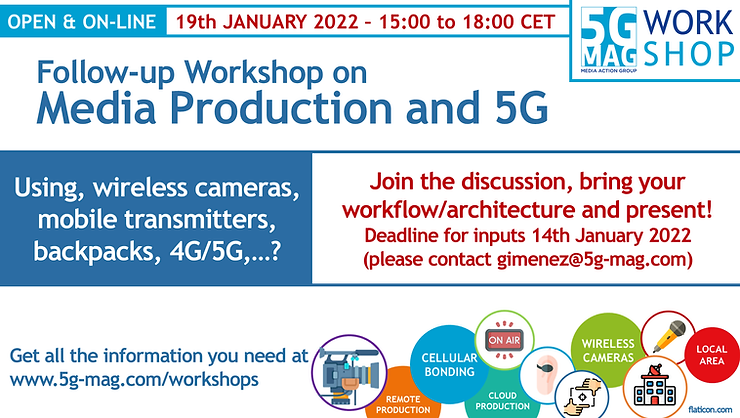
| Date | Wednesday 19 January 2022, 15:00–18:00 CET |
| Format | Interactive, hands-on workshop (not a webinar) |
The 5G Media Action Group (5G-MAG) organised this follow-up to the December workshop on "Media Production and 5G Non-Public Networks: Deep dive into media production protocols." Part I of the workshop covered the initial round of presentations and discussion.
A replay of Part II is available as an 8-video playlist.
Presentations in Part II
Vislink: David Edwards (slides)
Highlighted the critical advantages of an SNPN deployment: security, constant bandwidth availability, predictable latency, and general non-contention with other users. By contrast, adaptive bitrate is used in cellular bonding scenarios when non-contention cannot be guaranteed. A proof-of-concept comparing 5G and OFDM found similar latencies with a small (but acceptable) difference; cellular bonding systems may add several seconds of latency.
NuLink: Laurent Zwahlen (slides)
Presented several solutions integrating media production devices with 5G user equipment for deployment in private networks. The solutions integrate with NDI to provide camera/return, teleprompter, return video monitor, intercom, and PTZ camera control via joystick. Audio solutions cover microphone input, headphone output, and loudspeaker integration.
Qualcomm: Yiqing Cao (slides)
Presented a live 8K production using mmWave, focusing on mmWave uplink carrier and dual connectivity to achieve peak data rates in the range of Gbps. Qualcomm has been testing codec configurations including HEVC/AVC (sub-6 commercial bands) and JPEG XS (mmWave ranges).
NRK: Erik Vold (slides)
Trials with a proprietary solution (VideoXLink) using SRT. NDI 5, which introduces reliable UDP, will be tested in the future alongside prosumer equipment such as smartphones for video mixing.
France TV – Globecast: Jacques Donat-Bouillud and Samy Nicolas Bouchalat (slides)
A trial using 5G for uplink contribution with two 4K streams at around 35 Mbps. Ongoing tests include a single-SIM experiment with HD at 10 Mbps, 4K with six SIM cards at 90 Mbps, and 4K with two SIM cards at 35 Mbps.
Ross Video: Tom Crocker (slides)
Focused on media contribution, streaming, and file-based workflows, highlighting opportunities for automation of remote-connected workflows and gathering usage, location, and configuration metadata to optimize them.
Agile Content: Johan Bolin (slides)
Contrasted "primary production" (feeds with accurate mixing sync, bandwidth, and storage demands) with "secondary production" (streaming, personalisation, social feeds, segmentation). For primary production, Agile Content proposed enabling low-quality/low-latency and high-quality/higher-latency versions for remote mixing, via an open-source protocol called ElasticFrame.
BBC: Sam Hurst (slides)
Research on contribution transport protocols, proposing QUIC-based RTP tunneling for high-quality, low-latency media ingest over public networks.
Agenda
- Welcome
- Recap of the previous workshop
- Evaluation of responses to the questionnaire
- Open floor for discussion and presentations
Call for Participation
The workshop ran as interactively as possible, inviting participants using wireless cameras, backpacks, or mobile transmitters in their production setups, and those running trials or involved in projects testing new technology, to prepare a presentation and share their thoughts.
Related material referenced during the workshop: information about the NPN4AVProd Study Item (S4aI211261) and a community questionnaire on 5G media production experience.