This documentation is currently under development and subject to change. It reflects outcomes elaborated by 5G-MAG members. If you are interested in becoming a member of the 5G-MAG and actively participating in shaping this work, please contact the Project Office
Workflows and Requirements for Live Media Distribution
Scenarios and Use Cases describe the reference scenario. The workflows in relation to the booking and usage of network capabilities are described here with a focus on quality of service (QoS).
Live segmented audio is used here as the worked example, but the phases and requirements apply equally to segmented video distribution (for example MPEG-DASH video); only the media type and bit rates differ.
This section contains information on:
- Pre-conditions and commonalities
- Before consuming the audio streaming service
- While consuming the audio streaming service
- After having consumed the audio streaming service
- Requirements
Pre-conditions and commonalities
- A content provider wishes to stream live segmented audio over the internet, including mobile networks, to an application running on UEs (e.g. smartphones, connected cars, etc.).
- The content provider has set up an agreement with a network operator for usage of certain network capabilities made available via an API. The content provider has obtained key access tokens/keys/credentials/payment details in advance authorising their use (when available).
- The content provider has access to one or several Network API Platforms. These platforms are accessible through any device/connectivity (e.g. Internet-accessible website portal, command line tools, dedicated application, etc.).
Before consuming the audio streaming service
Phase A: Preparing the audio streaming application
- All devices are 3GPP UEs (e.g. smartphones, connected cars, etc.) with a content provider's client application (e.g. radio player app) installed.
Phase B: Network capability pre-booking
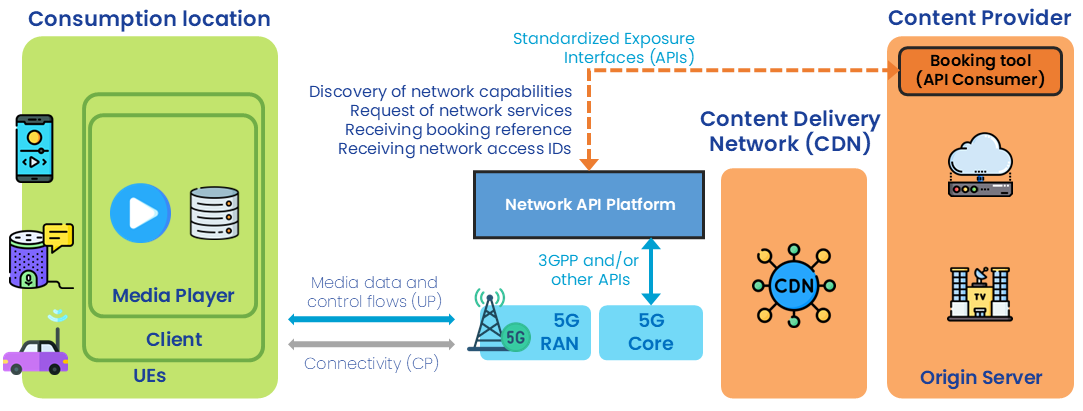
- Through the Network API Platform, the content provider requests network services for the population of client applications in one or more geographical areas. Possible services (network capabilities) are:
a. Quality-on-Demand
- Provision of reliably low-latency (e.g. latency and interruption-free audio playback similar to conventional broadcast radio).
- Ability to set quality on demand requirements for a given location b. Geofencing
- To verify and/or retrieve the location of a UE or to receive notifications from UEs entering or leaving certain locations/areas (e.g. for determining the content appropriate for the current editorial region).
Note: Booking is done based on:
- Geographical location
- Schedule
- Through the Network API Platform the content provider receives a booking reference responding to the service request.
- Through the Network API Platform the content provider accepts the service booking offer.
- Through the Network API Platform the content provider receives network access IDs to be used by the UEs to access the network capabilities in the corresponding locations.
While consuming the audio streaming service
Phase C: Setup and configuration
- The content provider configures its client application with the network access IDs delivered in step B.4.
Independent steps that can be triggered by the content provider
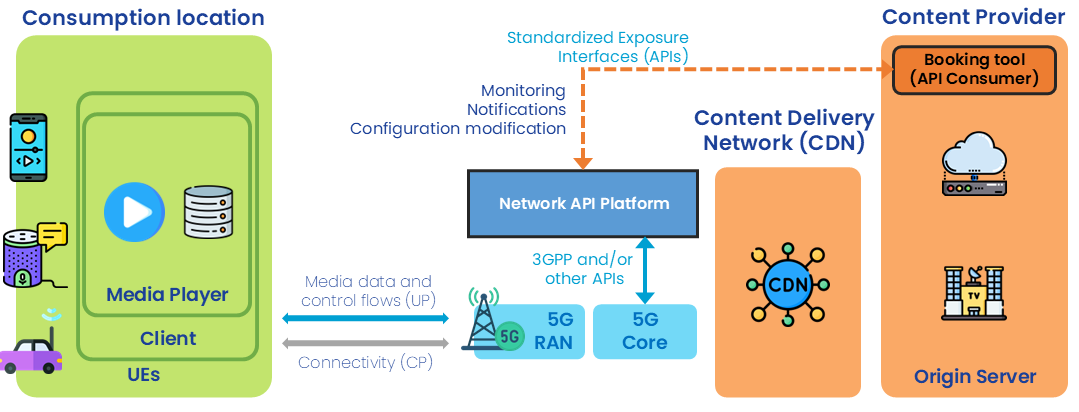
- The content provider can use the Network API Platform to monitor that the client applications are properly using the requested network capabilities.
- Notifications indicating potential issues (throughput, delay, etc.) reach the content provider through the Network API Platform.
- The content provider can also request, through the Network API Platform, a change to the current configuration. Note that the network access IDs are not expected to change when a reconfiguration occurs.
After having consumed the audio streaming service
Phase D: Teardown
- Through the Network API Platform, the content provider releases the booked network capabilities.
Requirements
Quality of Service
The following requirements are defined:
- Ability to request different QoS profiles for individual data flows being distributed across a target service area
- Ability to provision QoS profiles for reliable and consistent media segment transfer time on individual data flows to support interruption-free presentation by the media player with minimal buffering.
- Ability to configure new or re-configure existing QoS profiles to be selected during runtime
- Ability to identify the set of application data flows that fall within the scope of a particular QoS profile treatment
Information monitoring, logging and/or Network assistance
- Ability to receive information from the network
- real-time for QoS profile re-configuration
- during runtime for troubleshooting
- after the session (logging information) for post-processing
Geofencing
Geofencing matters for distribution because live media rights and editorial content are often region-specific: a service may only be licensed for, or editorially tailored to, a particular territory. Knowing whether a device is inside or outside a target area lets the content provider serve the correct regional content or restrict delivery accordingly.
- Ability to verify whether a given UE is currently located inside or outside the target service area.
- Ability to receive notifications when individual UEs enter or leave the target service area.
How the phases map onto CAMARA APIs
The four phases above map onto candidate CAMARA APIs as follows; the detailed mapping and its caveats are on the Using CAMARA APIs page.
| Phase | Requirement | Candidate CAMARA mechanism |
|---|---|---|
| A. Prepare application | Install and configure the client app on UEs | None (content-provider concern; no API interaction) |
| B. Pre-book capability | Request QoS for the client population in an area and window | Quality on Demand POST /sessions, referencing a QoS Profile |
| B. Pre-book capability | Verify or subscribe to device location (geofencing) | CAMARA Location Verification / Geofencing Subscriptions (DeviceLocation repo); not documented in this portal section |
| C. Monitor during session | One-shot check that the network can meet thresholds | Application Profiles POST /application-profiles, then Connectivity Insights POST /check-network-quality |
| C. Monitor during session | Recurring quality notifications | Connectivity Insights Subscriptions |
| D. Teardown | Release booked capability | Quality on Demand DELETE /sessions/{sessionId}, or operator teardown on expiry |
How distribution differs from contribution
These phases mirror the Content Production and Contribution workflows, and much of the QoS analysis is shared, but three differences shape the distribution case:
- Scale and direction. Contribution serves a few uplink devices; distribution serves a large downlink population of client apps across one or more service areas. The per-device QoS-session model of Quality on Demand does not obviously scale to a population, which is recorded as an open point.
- Geofencing is first-class. Because live media rights and editorial variants are region-specific, verifying whether a device is inside a target area (and being notified when it enters or leaves) is a genuine workflow requirement here, not an edge case. The relevant CAMARA APIs live in the DeviceLocation repository and are not part of this portal section.
- Monitoring is the primary purpose, not a side channel. For distribution the whole motivation is closing the visibility gap, so the Application Profiles plus Connectivity Insights path is central rather than auxiliary.
Underlying 3GPP mechanisms
QoS for downlink segment delivery is realised the same way as for contribution: a Quality on Demand session drives the Network Exposure Function (NEF, TS 29.522) Nnef_AFsessionWithQoS service, which the Policy Control Function authorises (Npcf_PolicyAuthorization, TS 29.514) to install a downlink QoS Flow on the client's PDU session, matched to a 5QI (TS 23.501 V20.3.0 clause 5.7.4). The monitoring and information-sharing path relies on network capability exposure through the NEF and, at the application-enabling layer, the Service Enabler Architecture Layer for Verticals (SEAL), TS 23.434, whose network resource management and location management enabling services are candidates for carrying the shared performance data. See Network API Initiatives.
Related
- Content Production workflows: the shared QoS workflow, from the uplink side.
- Network API Initiatives: the CAMARA APIs and the 3GPP interfaces.