This documentation is currently under development and subject to change. It reflects outcomes elaborated by 5G-MAG members. If you are interested in becoming a member of the 5G-MAG and actively participating in shaping this work, please contact the Project Office
Workflows and Requirements for Content Production & Contribution
Scenarios and Use Cases describe two reference scenarios. The workflows in relation to the booking and usage of network capabilities are described here with a focus on quality of service (QoS).
This section contains information on:
- Pre-conditions and commonalities
- Workflow for Single-device Connectivity
- Workflow for Multi-device Connectivity
- Dynamic management of network capabilities during runtime
- Requirements
Pre-conditions and commonalities
- The production crew has a set of credentials (SIM/eSIM) for the network device nodes will connect to.
- By default, the network provides "best-effort" connectivity and devices can already exploit "best-effort" connectivity.
- The production company has set up an agreement with a network operator for usage of certain network capabilities made available via an API. The production crew has obtained key access tokens/keys/credentials/payment details in advance authorising their use (when available).
- The production crew (on location or located in the production centre) has access to one or more Network API Platforms. These platforms are accessible by any device/connectivity (e.g. Internet-accessible website portal, command line tools, dedicated application, etc.).
- API Consumers will be able to select from available profiles, service areas, and parameters offered by the API Provider.
Collaboration scenarios for the provisioning of network capabilities
Collaboration scenario #1: Direct invoking Network APIs
The Network API Platform of a Network Operator is accessed directly from API Consumers, either deployed with the Studio Production or the Location Production functions. The API consumer can be a Web Portal, e.g. offered by the CSP. Alternatively, the API consumers can be embedded production devices like a Vision Mixer or a production orchestration solution (NMOS concept). The API consumer functions can be integrated in media servers, responsible for receiving the video stream from the application client.
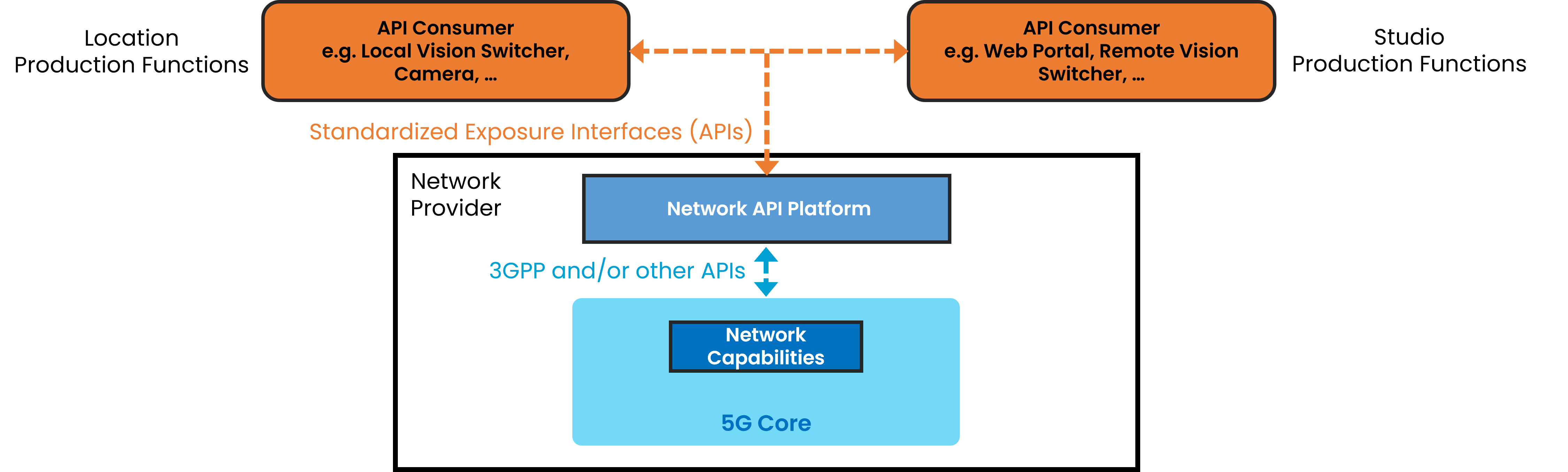
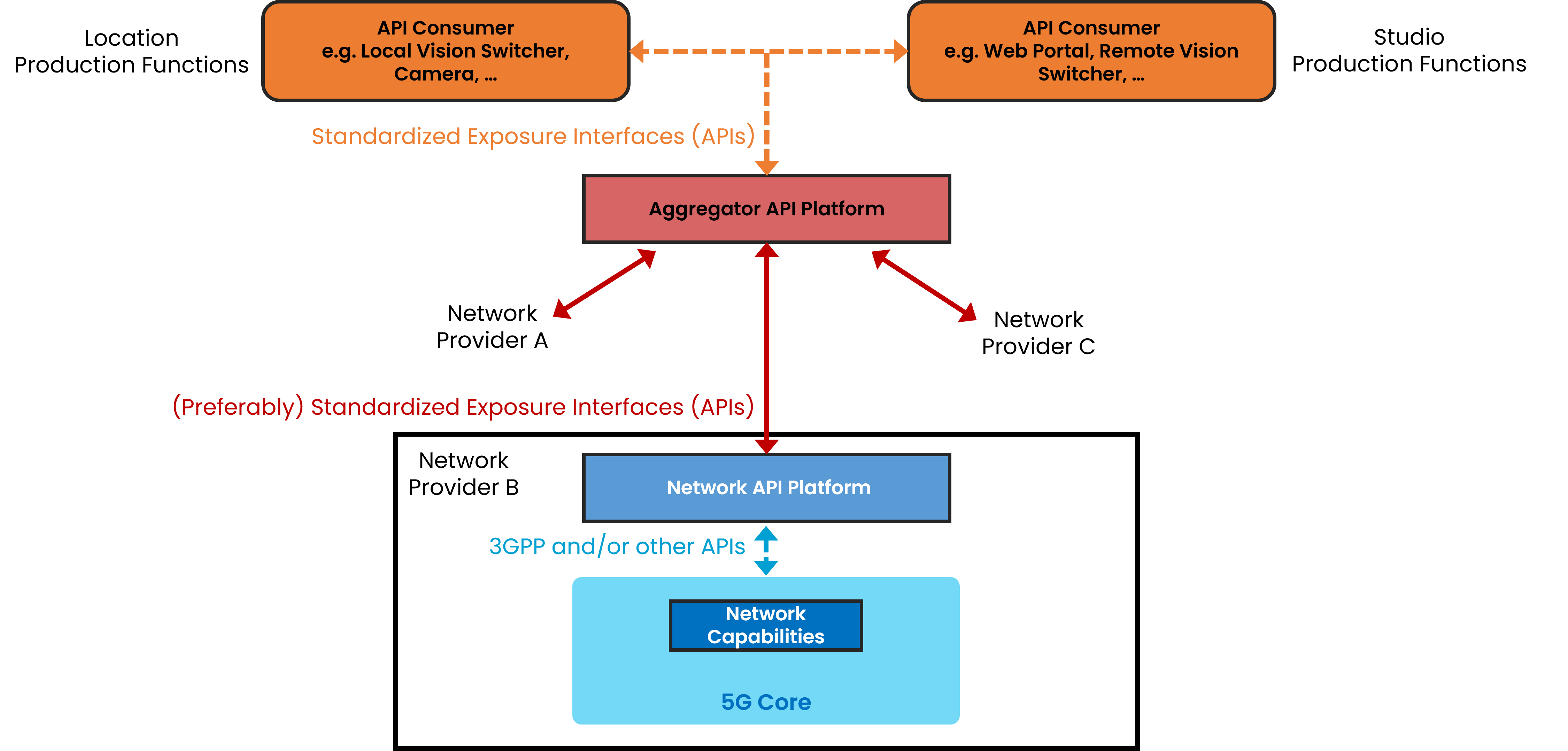
Collaboration scenario #2: Invoking Network APIs via an Aggregator
The Network API Platform of a Network Operator is accessed via an Aggregator API Platform. The Aggregator Platforms harmonise capabilities offered by different Network Providers and routes customer requests to them.
Consolidation of requirements on network interactions
The basic requirements for this scenario are:
Precondition to specify SERVICE AREA, to identify a location.
- This step is required so the user is able to identify the service area in which network resources are available. The user should be able to indicate the location where the network resources are to be used by means of coordinates for an area (array of points) or a single point.
- It is unlikely that the user-defined area corresponds to the operator-defined area.
- A more general API could be invoked with the user-defined area as input and an operator-defined area identifier as output.
SERVICE AREA API
This API should be invoked by passing an arbitrarily large area defined by the user on the location where network resources are intended to be requested.
Response: an identifier of the area defined by the network operator which matches the area identified by the user, or alternatively a list of areas within the original boundaries specified by the user, or areas in the proximity of the original input.
Ability to DISCOVER network resources, at a given location and time/duration.
- This step is required to obtain information about the ability or not to reserve (and use) network resources for the intended location and time/duration.
- A QoS template may be used to define the required QoS parameters between the application (device) and application server.
- It should be able to indicate an aggregate of network resources corresponding to the number of devices with the same QoS requirements. For a single device, the aggregate would be just one device.
DISCOVERY API
This API should be invoked with the location/area, time/duration.
Response: the available QoS profiles in the area that can be reserved for the specified duration, and an indication of whether such resources can in fact be reserved.
Ability to RESERVE network resources, by indicating location and time/duration.
- Network resources can be reserved for the intended location and time/duration.
- A QoS template may be used to define the required QoS parameters between the application (device) and application server.
- It should be able to reserve an aggregate of network resources corresponding to the number of devices with the same QoS requirements. For a single device, the aggregate would be just one device.
RESERVATION API
Invoked with: QoS profile, location, time/duration, number of devices intended to use resources concurrently.
Response: Confirmation of the reservation of resources for the specified location and duration. A range of reservation IDs corresponding to the number of devices which can concurrently use such resources.
Ability to ASSIGN the device to the reserved network resources, by linking a reservation ID with a device ID.
- The devices for which resources are reserved are known in advance, but more flexibility would be given if the resources were not linked to a specific device at reservation, since the device that ends up using the network resources may change between reservation and actual use (for example, if it needs to be replaced by a back-up device during operation).
ASSIGNMENT API
Invoked with: Reservation ID and Device ID.
Response: ACK and an assignment ID per device.
Ability to activate/deactivate the USAGE of the network resources, either automatically when the device is connected to the network or manually.
- Activating the usage of network resources just when the device obtains connectivity is not ideal. For instance, a device should use best-effort connectivity in the event of a problem (need to exchange a device) while a new device is assigned the network resources.
USAGE API
Invoked with the Assignment ID.
Response: ACK the activation of the resources for the current assignment.
Ability to activate/deactivate NOTIFICATIONS on the usage of the network resources.
NOTIFICATIONS API
Invoked with: Assignment ID, periodicity of notifications, sink for notifications
Response: ACK the activation of the notification
Single-device Connectivity (Single Camera Live Video Production, Mobile Journalism (MoJo), Newsgathering, Uplink Video)
Before the Event
Phase A: Preparing devices, configuring application clients and servers, and configuring client/server flows
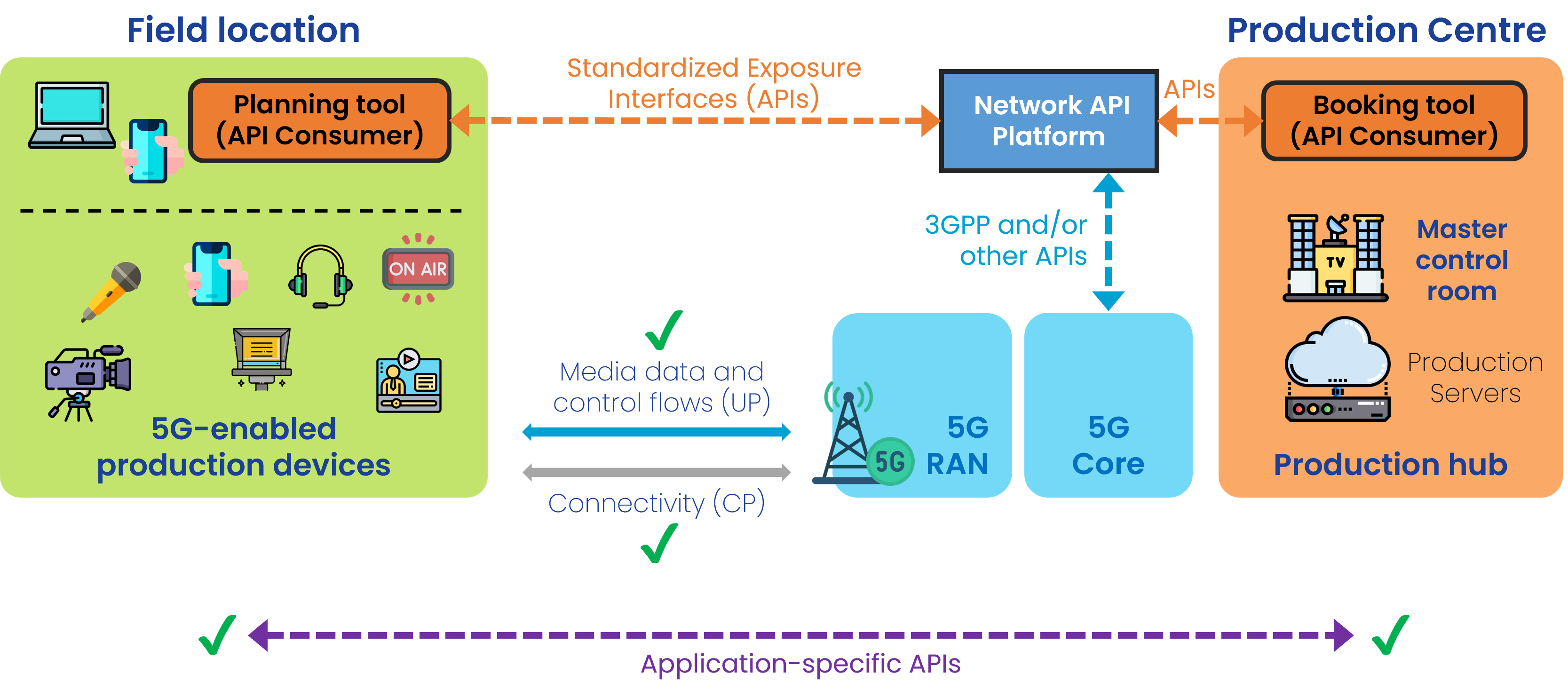
- Production device nodes are generally UEs which establish connectivity to servers in the Data Network.
- An application-specific API (e.g. from the media equipment provider) enables client/server communication to configure media-related parameters and procedures.
Practical example
A typical setup can consist of a smartphone used to capture video which is then sent to a server in the cloud for uplink streaming. The provider of such a service, or the user, would have configured the IP addresses, ports, and other parameters between the user application and the application server through such application-specific API. For a cellular backpack, a similar configuration should be followed.
Phase B: Event planning and pre-booking
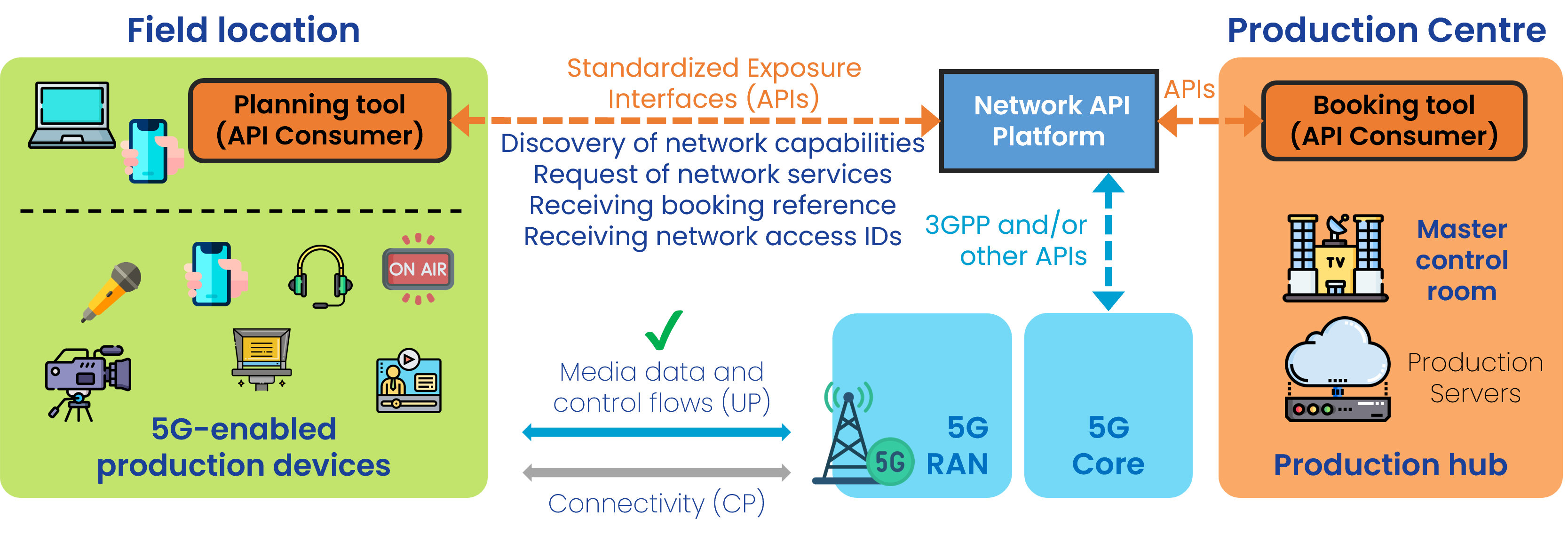
Through the Network API Platform:
- The production crew (already on location or while traveling to the event) can discover the capabilities/resources the network can offer in a particular location and time.
Requirement to invoke DISCOVERY API. See details above.
- The production crew requests network resources in advance for a given location and time.
Requirement to invoke RESERVATION API. See details above.
- The production manager receives a booking reference responding to the service request.
- The production manager accepts the service booking offer (involving payment).
- The production manager receives network access IDs to be used by the production device UEs to access the network and the requested capabilities for the specified location and duration.
- Each network access ID ultimately resolves to a Data Network Name (DNN) and optionally a network slice identifier (S-NSSAI).
Practical example
This should be seen as nothing very different to going to the portal of your network operator to e.g. add a bonus for more data, activate/deactivate roaming options, and other services within your existing contract. If the contract includes the ability to select extra connectivity services (e.g. Quality of Service) those should be selectable from such or a similar portal.
During the event
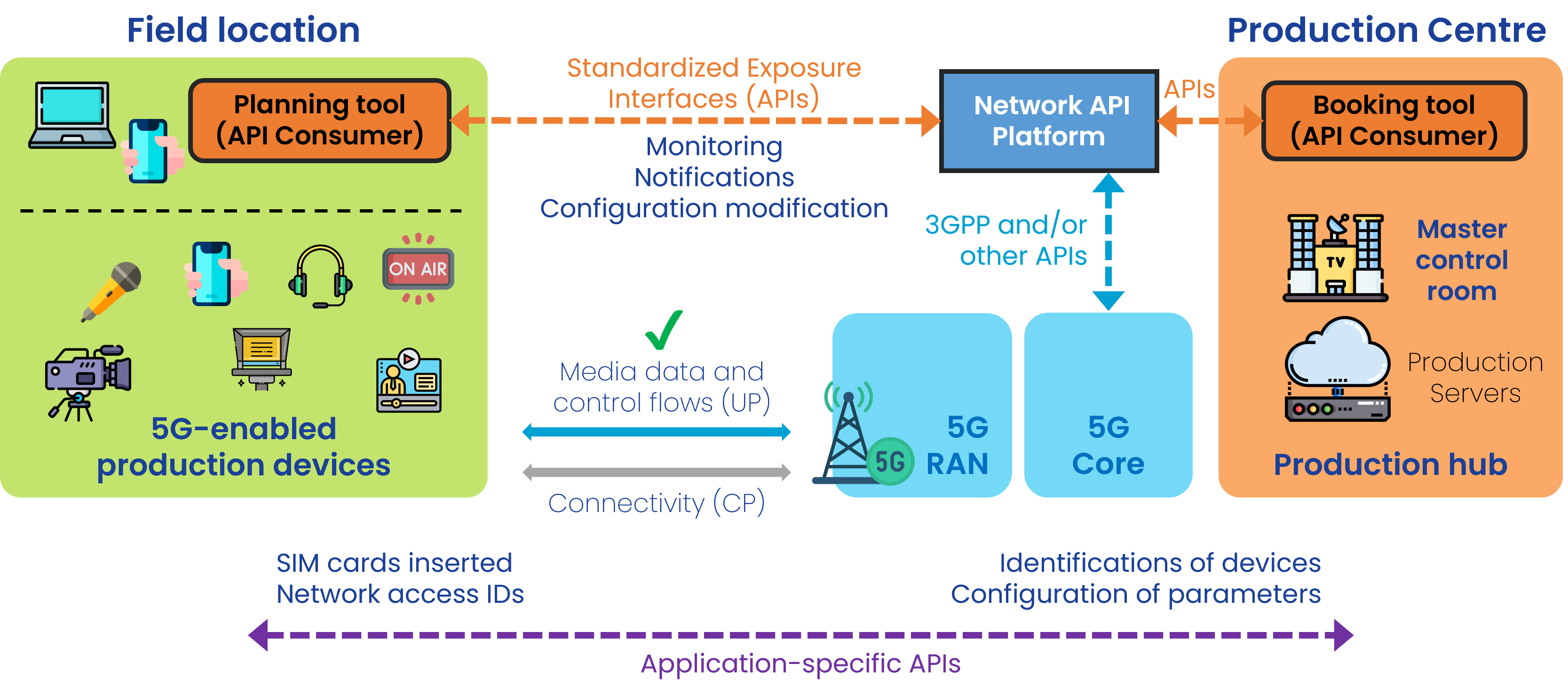
Phase C: Configuration and Usage of the network capabilities
- The production crew arrives at the event and can start using the booked network resources (See phase B). The network resources are assigned to devices.
Requirement to invoke ASSIGNMENT API. See details above.
- The production device makes use of the network capabilities according to the network access IDs received. The media related parameters can be adapted using an application-specific API, citing the network access IDs delivered in step B.5).
Requirement to invoke USAGE API. See details above.
Practical example
In a typical scenario, the journalist arrives at the location where the uplink video contribution should start. The desired network conditions can be checked and booked on the spot so the transmission can start with the desired QoS. If known in advance, the booking may have been done before arriving at the event. If network conditions are guaranteed (i.e. the booked service is being used), the media flow can be optimised by passing the details to the media application. For instance, if the network is able to guarantee X Mbps, the user can configure an encoder so it stays within margins avoiding packet loss.
After the event
Phase D: Location teardown
- Through the Network API Platform, the production crew releases the booked resources when the event finishes.
Requirement to invoke RESERVATION API. See details above.
Multi-device connectivity (Outside Broadcast, Small-Scale Video Production, Remote Production)
Before the Event
Phase A: Preparing devices, configuring application clients and servers, and configuring client/server flows
- Some production device nodes are UEs; others are connected to the Data Network:
- Example production device nodes connected to the RAN: wireless cameras, wireless camera control units, wireless microphones, wireless talkback intercom, etc.
- Example production device nodes connected to the Data Network: vision mixer, sound mixer, etc.
- An application-specific API (e.g. from the media equipment provider) enables communication between the production network orchestrator and the production device nodes to configure media-related parameters and procedures.
Practical example
A typical setup can consist of several cameras, intercom, video return, mixers,... all interconnected and/or providing content to e.g. a vision mixer in the cloud. Connectivity should be established for all the equipment, which configuration is done via the application-specific API.
Phase B: Event planning and pre-booking
Through the Network API Platform:
- The production crew (on location or from the production centre) can discover the capabilities the network can offer in a particular location and at a particular time.
Requirement to invoke DISCOVERY API. See details above.
-
The production crew requests network services for the devices (identified by their SIM cards) in advance. Possible services (network capabilities) are:
- Quality-on-Demand
- One or several QoS profiles for each SIM card (QoS profiles map to 5G QoS Identifiers, or 5QIs, the standardised 3GPP QoS behaviours)
- Example: A sim may be pre booked for one uplink video / one uplink audio / one downlink data / etc.
- Time-as-a-service
- Multi-camera productions need a shared, precise time reference so that feeds from different devices can be aligned and mixed. This timing can be provided either by the access stratum or by the Precision Time Protocol (PTP).
The booking of resources is done based on:
- Geographical area
- Schedule (starting time and closing time, or duration, of the event)
- Quality-on-Demand
Requirement to invoke RESERVATION API. See details above.
- The production manager receives a booking reference responding to the service request.
- The production manager accepts the service booking offer (involving payment/contract/SLA aspects).
- The production manager receives network access IDs to be used by the production device UEs to access the network and the requested capabilities for the specified location and duration.
- Each network access ID ultimately resolves to a Data Network Name (DNN) and optionally a network slice identifier (S-NSSAI).
Practical example
This should be seen as nothing very different to going to the portal of your network operator to e.g. add a bonus for more data, activate/deactivate roaming options, and other services within your existing contract. If the contract includes the ability to select extra connectivity services (e.g. Quality of Service) those should be selectable from such or a similar portal. For a planned event taking place at a known location and for a given duration, the booking of network resources can be done beforehand by indicating the requirements, number of devices, QoS requirements for each of the devices or a group of them,...
During the event
Phase C: Configuration and Usage of the network capabilities
- The production crew arrives in the venue, plugs the SIM cards and turns on the devices, connectivity is enabled based on the booked network services (See phase B).
Requirement to invoke ASSIGNMENT API. See details above.
-
The production crew initiates the setup of the location production by interacting with the production network orchestrator.
-
The production network orchestrator configures the production device nodes using an application-specific API, citing the network access IDs delivered in step B.5).
- Example: QoD service: A camera for which one video + one audio is pre-booked. The application-specific API is used to properly configure the bitrate of the audio and video output, and the provided IDs.
- Example: Time Sync service: A camera for which access to global clock is requested. The application-specific API is used to properly configure the time parameters and the provided IDs.
-
The production device makes use of the network capabilities according to the network access IDs received.
Requirement to invoke USAGE API. See details above.
- In addition, it is possible to subscribe to receive notifications while network resources are in use.
Requirement to invoke NOTIFICATIONS API. See details above.
Practical example
Once at the location, connectivity needs to be established among the devices. Once this is ready, the setup will have the ability to exploit the pre-booked network resources.
Note: the steps in phase C are repeated whenever a service is added and created from scratch.
After the event
Phase D: Location teardown
- Through the Network API Platform, the production crew releases the booked resources when the event finishes.
Dynamic management of network capabilities during runtime
A series of actions can be expected "During the Event" as changes, reconfiguration or additional requests may need to be processed.
Monitoring and notifications
- The production crew should use the Network API Platform to monitor that the flows are coming in and are properly using the reserved resources.
- Notifications indicating potential issues (throughput, delay, etc.) should reach the crew through the Network API Platform.
Requirement to invoke NOTIFICATIONS API. See details above.
Reconfiguration for a given device
- Through the Network API Platform, the production crew should be able to request a change of the current configuration assigned to a device.
- The production crew should also be able to request an update or modification of the originally booked resources (e.g. increase or decrease the throughput associated with an existing profile). The same validation steps as from B.2 to B.5 will be conducted after requesting the change. Note that the network access IDs are not expected to change when a reconfiguration occurs.
Requirement to invoke RESERVATION API. See details above.
Back-up devices
- Using the Network API Platform, the production crew should be able to switch or update a device while still using the original booking made for a different device.
Requirement to invoke ASSIGNMENT API. See details above.
Dynamic prioritisation of QoS for different media flows
In a setup with multiple cameras, the media producer would like to ensure that a subset of them is always prioritised with the highest QoS profile. Each individual camera should be entitled to use that high QoS profile (i.e. the original booking should take into account that X devices will be requesting QoS profile Y), but not all of them will be using it concurrently. Therefore:
- Through the Network API Platform, the production crew should be able to dynamically attach or detach a device to a QoS profile.
Requirement to invoke ASSIGNMENT API
- The network operator should secure that a subset of devices can concurrently request a given QoS profile and that all other devices remain eligible to access such profile when it is no longer used.
Basic example: Definition of QoS Profiles
A media production requires 4 devices (e.g. cameras, smartphones). The output video quality of the cameras can switch from being "On Air" (high quality video), "Preview" (lower quality video which can quickly scale up when needed to be "On Air"), "Standby" (a minimum quality video for monitoring a scene in a video gallery).
Therefore, first step is to define such QoS profiles which cameras can use.
| QoS Profile name | Parameters |
|---|---|
| QoS_OnAir - QoS Profile for High Quality Video | Uplink throughput = 10 Mbps |
| QoS_Preview - QoS Profile for Preview Quality Video | Uplink throughput = 5 Mbps |
| QoS_Standby - QoS Profile for Standby | Uplink throughput = 2 Mbps |
Basic example: Identification of eligible devices-profiles
Among the 4 devices:
- Only one device is expected to use the QoS_OnAir profile during runtime. The rest will be either in QoS_Preview or QoS_Standby. When the media producer decides to switch the On-Air camera, there are temporarily two devices assigned with a QoS_OnAir profile.
- Only one device is expected to use the QoS_Preview profile during runtime. The QoS_Preview profile is used for devices, which are about to be switched to the OnAir profile. Typically, the camera operator gets notified with the Preview selection, that its camera is next to be on air.
- Cameras, which are providing their video “just” to the production gallery, are assigned with QoS_Standby profile.
| Device | Eligible QoS Profiles |
|---|---|
| Device C1 | QoS_OnAir, QoS_Preview and QoS_Standby |
| Device C2 | QoS_OnAir, QoS_Preview and QoS_Standby |
| Device C3 | QoS_OnAir, QoS_Preview and QoS_Standby |
| Device C4 | QoS_OnAir, QoS_Preview and QoS_Standby |
Note that the intention of this pre-booking is to make sure that 4 devices can be attached to 3 different QoS profiles during runtime. However not all the devices and profiles are used concurrently.
Basic example: Assignment of QoS Profile during runtime
With the assumptions above:
- The production crew through the Network API Platform should request a change of the assigned device from one QoS profile to another.
From the network resources point of view, there will be:
- A maximum of 2 devices concurrently assigned a QoS_OnAir profile (20 Mbps) plus 2 other devices with the QoS_Standby profile (4 Mbps) - peak throughput is 24 Mbps.
- Most of the time a maximum of 1 device will be assigned a QoS_OnAir profile (10 Mbps) plus 3 other devices with the QoS_Standby profile (6 Mbps) - peak throughput is 16 Mbps.
- Only when the camera is about to be assigned QoS_OnAir there will be a transition by the QoS_Preview profile - 1 QoS_OnAir (10 Mbps) + 1 QoS_Preview (5 Mbps) + 2 QoS_Standby (4 Mbps) - peak throughput is 19 Mbps.
The same figures as a summary of the aggregate throughput states:
| State | OnAir devices | Preview devices | Standby devices | Peak uplink throughput |
|---|---|---|---|---|
| Typical | 1 (10 Mbps) | 0 | 3 (6 Mbps) | 16 Mbps |
| On-air transition | 1 (10 Mbps) | 1 (5 Mbps) | 2 (4 Mbps) | 19 Mbps |
| Worst case | 2 (20 Mbps) | 0 | 2 (4 Mbps) | 24 Mbps |
Requirements
The categories below (Service Area, Discovery, Reservation, Assignment, Usage, Notifications) are 5G-MAG requirement categories, not CAMARA APIs. They describe what an ideal set of network interactions would need to provide. The Using CAMARA APIs page maps these categories onto the actual CAMARA APIs.
In the requirement tables that follow, the API column is intentionally left blank where the mapping to a concrete CAMARA API is documented separately; see Using CAMARA APIs for the mapping. The column is filled where a specific mechanism is already known.
Media delivery with Quality of Service (QoS)
| Requirement | API |
|---|---|
| Ability to request different QoS profiles for individual data flows coming from the same production device node | |
| Ability to separate media/data flows coming from the same production device node | |
| Delivery to endpoint (Application Media Server) may be identified by security/protocol/IP/port | |
| Ability to configure new or re-configure existing QoS profiles to be selected during runtime | |
| Ability to select at runtime a QoS profile for a media flow | |
| Ability to receive ACK (success/fail) |
Information monitoring, logging and/or Network assistance
| Requirement | API |
|---|---|
| Ability to receive information from the network | |
| Real-time information for QoS profile re-selection and/or e.g. codec reconfiguration, bitrate reconfiguration | |
| Information during runtime for troubleshooting | |
| Information after the session (logging information) for post-processing |
Time Synchronisation
| Requirement | API |
|---|---|
| Ability to enable distribution of timing information |
Voice service for Intercom
| Requirement | API |
|---|---|
| Ability to establish a voice service across the intercom devices deployed at the production location or between the production centre and the production location |
Focus on the QoS for Intercom - a voice service offered by the network may not be so relevant (alternative solutions, WebRTC). But multicast, Mission Critical Push To Talk (MCPTT) may be of use.
Considerations on Devices
Identification of devices
| Requirement | API |
|---|---|
| Devices should be uniquely identifiable during operation | |
| Devices should be dynamically added or deleted during operation and attachable to given network capabilities | |
| Each device should only access the network capabilities which have been assigned during booking |
Device on-boarding and API consumer on-boarding
| Requirement | API |
|---|---|
API consumers must authenticate before invoking CAMARA APIs. CAMARA uses OAuth 2.0 with the network operator's authorisation server, either the client credentials flow or CIBA (Client Initiated Backchannel Authentication) for user-consent flows. The authentication mechanism is defined by the CAMARA Security and Interoperability Profile (in the IdentityAndConsentManagement repository). The API consumer obtains an access token from the operator's authorisation server before making any API call, with OAuth scopes that depend on the API being called (for example quality-on-demand:sessions:create for QoD). | Operator authorisation server (OAuth 2.0 / CIBA); no dedicated CAMARA API for credential issuance; credentials are provisioned through the operator's developer portal or Network API Platform. |
Discovery of network capabilities
| Requirement | API |
|---|---|
CAMARA does not define a separate "capability discovery" API. An API consumer determines the QoS profiles available in the network via the QoS Profiles API (returns profile parameters for the whole network). The operator-defined service areas where resources can be reserved, along with their associated network and QoS profiles, can be discovered via the Dedicated Networks - Network Service Areas API (POST /retrieve-service-areas). Available dedicated network profiles (capacity, throughput targets, max devices) are listed via the Dedicated Networks - Network Profiles API (GET /profiles). The Connectivity Insights API can be used to query current network conditions before making a QoS request. No CAMARA API currently provides pre-booking availability information for a given location and time. | QoS Profiles API; Dedicated Networks API (Service Areas and Network Profiles sub-APIs); Connectivity Insights API |
How the requirement categories map onto CAMARA phases
The six requirement categories above (Service Area, Discovery, Reservation, Assignment, Usage, Notifications) are 5G-MAG's idealised view of what a complete set of network interactions would provide. They do not correspond one-to-one to CAMARA APIs. The Using CAMARA APIs page performs the detailed mapping; the summary is:
| Requirement category | Nearest CAMARA mechanism | Gap |
|---|---|---|
| Service Area | Dedicated Networks POST /retrieve-service-areas returns operator-defined areas matching a user location or geometry. | Only the Dedicated Networks API separates area discovery from reservation; the QoS-session APIs do not. |
| Discovery | QoS Profiles GET /qos-profiles; Dedicated Networks GET /profiles. | Profiles are listed for the whole network, not per location or time; availability is known only at booking time. |
| Reservation | Dedicated Networks POST /networks; Network Slice Booking; QoS Booking POST /qos-bookings. | Quality on Demand and QoS Provisioning have no advance, area-scoped reservation. |
| Assignment | Dedicated Networks POST /accesses; QoS Booking and Assignment POST /qos-bookings/{id}/devices/assign. | Device-bound APIs (QoS Booking, Quality on Demand, QoS Provisioning) fix the device at creation, so re-assignment means delete and re-create with no guarantee of resources. |
| Usage | Automatic once a booked or assigned device connects within the area and window. | It is often unclear how a device signals which booking it is exercising. |
| Notifications | Application Profiles plus Connectivity Insights / Connectivity Insights Subscriptions. | Monitoring uses a separate Application Profile rather than the QoS Profile that was booked. |
Two design themes run through the analysis. First, separating the booking of resources from the assignment of a device (as Dedicated Networks and QoS Booking and Assignment do) is what enables back-up devices and dynamic on-air/standby prioritisation without losing the reservation. Second, advance, area-scoped reservation is what distinguishes planned multi-device productions from short-notice single-device contribution; the APIs that lack it (Quality on Demand, QoS Provisioning) are usable only at the point of use.
Underlying 3GPP mechanisms
The requirement categories rest on 3GPP capability exposure. A reservation or QoS-session request ultimately drives the Network Exposure Function (NEF) northbound APIs (TS 29.522): Nnef_AFsessionWithQoS for an immediate QoS session and, for advance reservation of a future window, background data transfer negotiation (Nnef_BDTPNegotiation, TS 29.522; the underlying BDT policies are handled by the PCF, TS 29.554). The NEF forwards policy to the Policy Control Function (PCF) via Npcf_PolicyAuthorization (TS 29.514), which installs the QoS Flow on the relevant PDU session. The named QoS profiles map to standardised or operator-defined 5G QoS Identifiers (5QIs) whose characteristics are tabulated in TS 23.501 V20.3.0 clause 5.7.4. The "time-as-a-service" requirement for multi-camera alignment corresponds to 3GPP support for time synchronisation over 5G, either time distribution across the access stratum or Precision Time Protocol (PTP) as specified in the 5G System enablers for time-sensitive communication and time synchronisation (TS 23.501 V20.3.0 clause 5.27, with the corresponding procedures in TS 23.502, clause 4.15.9, as referenced by TS 23.501 V20.3.0 clause 5.27). See Network API Initiatives for the NEF and PCF service detail.
Related
- Network API Initiatives: the CAMARA APIs, the QoS parameters and the 3GPP interfaces.