This documentation is currently under development and subject to change. It reflects outcomes elaborated by 5G-MAG members. If you are interested in becoming a member of the 5G-MAG and actively participating in shaping this work, please contact the Project Office
Using CAMARA APIs: Quality on Demand for Content Production & Contribution
Find more information about Quality on Demand API.
Purpose
This API lets a media application request a QoS session for the connection between a device and an application server.
Workflow and Architecture
This is a high-level figure with the entities involving APIs and the devices involved:
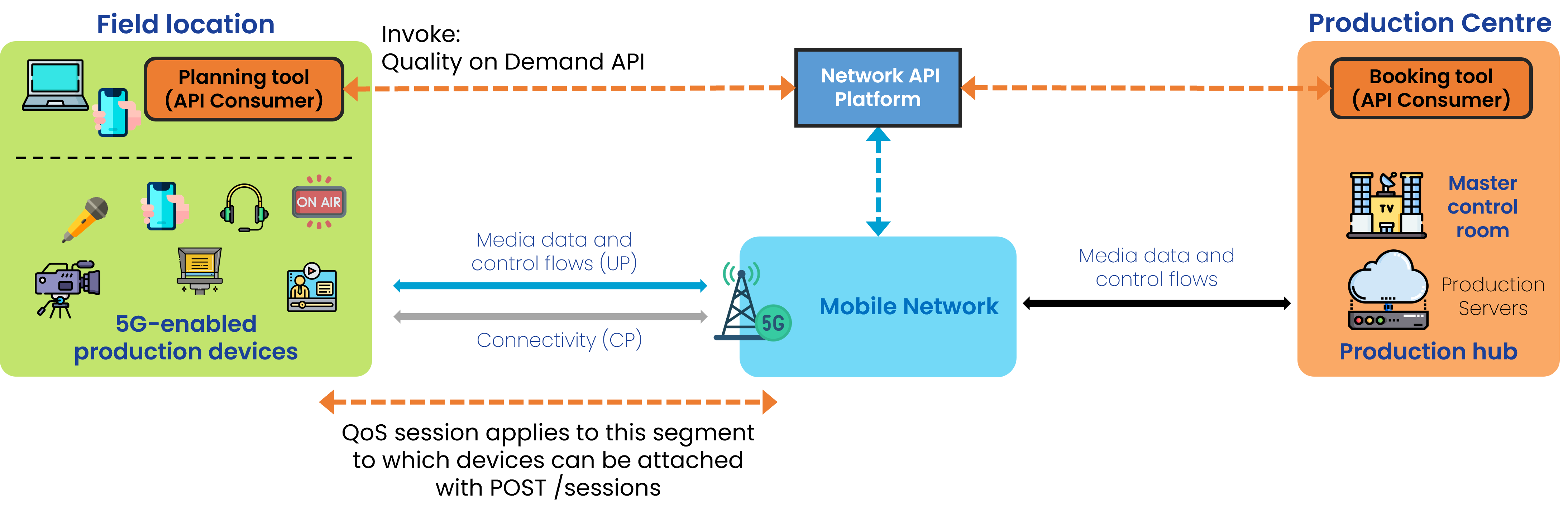
General Workflow
In the procedure flow below, each step is tagged with the actor that performs it: ASP (Application Service Provider, the media application side) or CSP (Communication Service Provider, the network operator side). Coloured bands group the steps into the phases Pre-conditions, Before using the network, During operation, and Dismantling.
Quality on Demand has no separate reservation phase. Unlike the booking-based APIs, the QoS session is created at the point of use (see step 2.1 under "During operation"), at the device's current location; resources cannot be reserved in advance for a future time or area.
On-boarding of the ASP and Negotiation
- Sign up and access credentials
- Selection / Request for QoS Profiles
Step 0: Pre-conditions
- The API invoker needs to have signed up with the API provider.
- qosProfiles have already been defined and made available by the network operator.
- Names of such qosProfiles have been disclosed to the user so they can be used when invoking APIs.
Step 1: Before using the network
Details of the already arranged QoS Profile can be retrieved with GET /qos-profiles/{name}, using the QoS Profiles API. For the profile structure and an explanation of the fields, see Using CAMARA APIs: QoS Profiles.
Step 2: During operation
2.1 Requests creation of QoS session
With POST /sessions passing the device object, applicationServer IP, applicationServerPorts, devicePorts, qosProfile and duration.
2.2 Device establishes connection
2.3 Usage of API capabilities
A series of operations to delete the QoS session or extending its duration are available:
GET /sessions/{sessionId} - Get QoS session information
DELETE /sessions/{sessionId} - Delete a QoS session
POST /sessions/{sessionId}/extend - Extend the duration of an active session
POST /retrieve-sessions - Get QoS session information for a device
Step 3: Dismantling
When reaching the duration the QoS session may be torn down. A graceful way of tearing down will delete the QoS session by id.
DELETE /sessions/{sessionId} deletes a QoS session
5G-MAG's Self-Assessment
- A session may be created by establishing a level of QoS between the device and the application server for a given duration.
- It is assumed that the QoD API is invoked with the complete knowledge of device, application server, and at the given location.
- No information is given to the user on the availability of resources in an area.
- It is not possible to ensure availability of the QoS session before invoking it at the location, since a service area cannot be defined or requested in advance: whether the request succeeds remains unclear until then.
- On device failure, the QoS session needs to be deleted with no guarantee that a new one can be created.
Potential improvements:
- There is no information about the location or service area.
- Understanding opportunities to book QoS sessions in terms of duration and location/area would be useful as the user may be able to move and find a better coverage spot rather than being denied the establishment of QoS at the time and location in which it is requested.
When to use this API
Quality on Demand is the point-of-use API: it creates a QoS session at the device's current location, for a device and application server both known at request time, with no advance reservation and no service-area parameter. That makes it the natural fit for short-notice single-device contribution (a journalist arriving at a breaking-news location and starting an uplink there and then), and the counterpart to it, for a device with no fixed session end, is the indefinite QoS Provisioning API.
Because there is no reservation phase, availability is discovered only when POST /sessions is attempted. If the network cannot honour the request at that location, the session is refused; the API gives no prior indication and no alternative area. For a planned event where success needs to be assured ahead of time, an advance, area-scoped reservation API is more appropriate: QoS Booking (device-bound), QoS Booking and Assignment (device count, assign later) or Dedicated Networks (with area discovery). The trade-off between point-of-use and advance reservation is set out on the Using CAMARA APIs page.
Session lifecycle
A Quality on Demand session has a simple lifecycle that maps onto the "During operation" phase only:
- Create with
POST /sessions, passing thedevice,applicationServer,applicationServerPorts,devicePorts,qosProfileandduration. - Inspect with
GET /sessions/{sessionId}, or find sessions for a device withPOST /retrieve-sessions. - Extend an active session with
POST /sessions/{sessionId}/extend, which avoids the gap that deleting and re-creating would introduce. - Delete with
DELETE /sessions/{sessionId}, or let the operator tear the session down when thedurationexpires.
The ability to extend a session is a useful feature that the booking APIs do not all offer: an overrunning contribution can keep its QoS without a re-request.
How this maps to 3GPP
Creating a QoS session drives the Network Exposure Function (NEF) northbound Nnef_AFsessionWithQoS service (TS 29.522); the NEF requests the Policy Control Function to authorise and install the corresponding QoS Flow on the device's PDU session (Npcf_PolicyAuthorization, TS 29.514). Because the session is created at the point of use, no background data transfer negotiation is involved, unlike the advance-reservation APIs. The referenced QoS profile maps to a 5QI whose characteristics are tabulated in TS 23.501 V20.3.0 clause 5.7.4. See Network API Initiatives.
Related
- Quality on Demand API: the API reference and CAMARA source.