This documentation is currently under development and subject to change. It reflects outcomes elaborated by 5G-MAG members. If you are interested in becoming a member of the 5G-MAG and actively participating in shaping this work, please contact the Project Office
CAMARA: Quality on Demand API
Description
The "Quality-On-Demand" (QoD) API gives developers a programmable interface to request stable latency or prioritized throughput managed by networks. It abstracts the complexity of underlying network technologies (such as mobile, fiber, cable, and other broadband networks), so developers can focus on enhancing user experiences for applications that demand high-quality network communication.
QoD requests QoS for the duration of a single session. It depends on the QoS Profiles API: the qosProfile name passed to POST /sessions must be one the operator offers. For a persistent assignment (applied every time the device connects) see QoS Provisioning; to reserve capacity ahead of an event see QoS Booking.
Information: Quality on Demand project page and GitHub repository
The API definitions can be obtained here: QualityOnDemand API_definitions folder
The Quality on Demand API definition (YAML) is available at: quality-on-demand.yaml
Operations and dependencies
Quality on Demand API
- POST /sessions with the request body including a
deviceobject,applicationServerIP,applicationServerPorts,devicePorts,qosProfileandduration, it is used to create a QoS session to manage latency/throughput priorities. The response includes information about the creation of the session, with asessionId.- Dependency: Requires
qosProfileswhich can be retrieved from a previous call to the QoS Profiles API.
- Dependency: Requires
GET /sessions/{sessionId}- Get QoS session informationDELETE /sessions/{sessionId}- Delete a QoS sessionPOST /sessions/{sessionId}/extend- Extend the duration of an active session- POST /retrieve-sessions - Get QoS session information for a device
Standardisation context
Quality on Demand is the flagship QoS API of the CAMARA QualityOnDemand repository (OpenAPI 3.0.3, Commonalities-conformant). Of the CAMARA APIs 5G-MAG analyses it is the most mature: its notification event type is at v1 (org.camaraproject.quality-on-demand.v1.qos-status-changed), where most of the others are still v0. It consumes a named profile from the QoS Profiles API.
Mapping to 3GPP
QoD is the canonical example of a CAMARA API mapping onto 3GPP northbound exposure:
- The API provider (acting as, or on behalf of, an Application Function) calls the NEF
AsSessionWithQoSAPI in TS 29.522 (the RESTful form of theNnef_AFSessionWithQoSservice). The QoD request already carries what that API needs: thedevice(mapped to a subscriber identifier), theapplicationServeraddress and thedevicePorts/applicationServerPorts(which define the flow descriptors), and theqosProfilename (mapped to a QoS reference). - The NEF forwards the request to the Policy Control Function via
Npcf_PolicyAuthorization(TS 29.514). The PCF authorises it and installs policy on the subscriber's PDU session, enforced by the SMF and UPF. - When the network can no longer sustain the QoS (or the session ends), the NEF raises a notification event, which the QoD provider surfaces to the consumer as a CloudEvent (see Event notifications). In 4G/EPC the same flow runs through an SCEF instead of a NEF.
CAMARA does not mandate this realisation; it is the common correspondence, and an operator may implement QoD against a different southbound interface.
Session lifecycle
A session moves through the qosStatus values REQUESTED (accepted, not yet applied), AVAILABLE (QoS is being applied) and UNAVAILABLE (no longer applied). It is created with POST /sessions for a bounded duration, can be prolonged with POST /sessions/{sessionId}/extend (passing requestedAdditionalDuration in seconds), read with GET /sessions/{sessionId}, looked up per device with POST /retrieve-sessions, and torn down with DELETE /sessions/{sessionId}. Because there is no reservation phase, availability is only known when the session is requested; for a scheduled event where capacity must be guaranteed ahead of time, QoS Booking fits better, and for a profile that should apply on every connection, QoS Provisioning is the persistent option.
For a live media flow QoD is the most direct API: it is invoked at the moment the boost is needed, runs for a bounded duration that can be extended, and reports back through the sink when the network can no longer sustain the requested QoS so the application can adapt.
Workflow: Media application requesting a QoS session
A user of a media application wants a QoS boost for the duration of a media flow. The following steps are executed:
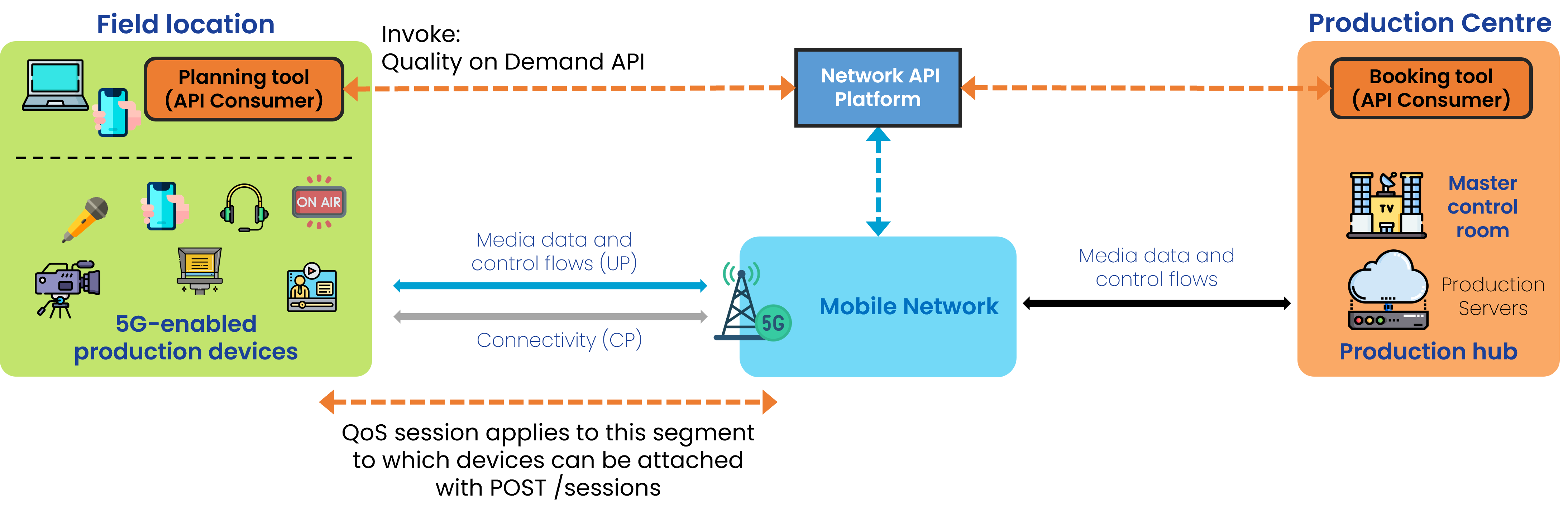
Step 0: Pre-conditions
- The API invoker has signed up with the API provider.
- A
qosProfilename has been obtained via the QoS Profiles API. Unlike Provisioning or Booking, there is no pre-booking phase; the session is created directly during operation.
Step 1: Create the session
- POST /sessions passing the
device,applicationServer, ports, the chosenqosProfileand aduration. The response returns asessionIdused to query, extend or delete the session.
5G-MAG's Self-Assessment
This section records 5G-MAG's practical reading of the API and the open points it raises for media use.
- QoD is the most direct of the QoS APIs for a live media flow: it is invoked at the moment the boost is needed and runs for a bounded
duration, which can be extended withPOST /sessions/{sessionId}/extend. - Because there is no reservation phase, availability is only known at request time; for a scheduled event where capacity must be guaranteed in advance, QoS Booking may be more appropriate.
- The
sink/notification mechanism (see Event notifications) lets the application react when the network can no longer sustain the requested QoS.
Quality-On-Demand (QoD) API Usage
Request the creation of a session
With POST /sessions, to manage latency/throughput priorities. The request specifies the device, the application server and ports, the chosen QoS profile, a sink for notifications and a duration:
{
  "device": {
    "phoneNumber": "+123456789",
    "networkAccessIdentifier": "123456789@domain.com",
    "ipv4Address": {
      "publicAddress": "203.0.113.0",
      "publicPort": 59765
    },
    "ipv6Address": "2001:db8:85a3:8d3:1319:8a2e:370:7344"
  },
  "applicationServer": {
    "ipv4Address": "198.51.100.0/24",
    "ipv6Address": "2001:db8:85a3:8d3:1319:8a2e:370:7344"
  },
  "devicePorts": {
    "ranges": [
      {
        "from": 5010,
        "to": 5020
      }
    ],
    "ports": [5060, 5070]
  },
  "applicationServerPorts": {
    "ranges": [
      {
        "from": 5010,
        "to": 5020
      }
    ],
    "ports": [5060, 5070]
  },
  "qosProfile": "voice",
  "sink": "https://endpoint.example.com/sink",
  "sinkCredential": {
    "credentialType": "PLAIN"
  },
  "duration": 3600
}
Type of response: Information about the status of the request, including the assigned sessionId and the initial qosStatus:
{
  "applicationServer": {
    "ipv4Address": "198.51.100.0/24"
  },
  "qosProfile": "QOS_L",
  "sink": "https://application-server.com/notifications",
  "sessionId": "3fa85f64-5717-4562-b3fc-2c963f66afa6",
  "duration": 3600,
  "qosStatus": "REQUESTED"
}
Request QoS session information for a device
With POST /retrieve-sessions and device object. The request identifies the device whose sessions are queried:
{
  "device": {
    "phoneNumber": "+123456789",
    "networkAccessIdentifier": "123456789@domain.com",
    "ipv4Address": {
      "publicAddress": "203.0.113.0",
      "publicPort": 59765
    },
    "ipv6Address": "2001:db8:85a3:8d3:1319:8a2e:370:7344"
  }
}
Type of response: QoS sessions information, returned as an array (a device may have more than one session):
[
  {
    "applicationServer": {
      "ipv4Address": "0.0.0.0/0"
    },
    "qosProfile": "QOS_L",
    "sink": "https://application-server.com/notifications",
    "sessionId": "3fa85f64-5717-4562-b3fc-2c963f66afa6",
    "duration": 3600,
    "startedAt": "2024-06-01T12:00:00Z",
    "expiresAt": "2024-06-01T13:00:00Z",
    "qosStatus": "AVAILABLE"
  }
]
Request duration extension of an active QoS session
With POST /sessions/{sessionId}/extend and the requested additional duration (in seconds):
{
  "requestedAdditionalDuration": 1800
}
Obtain QoS session information
With GET /sessions/{sessionId}. The response returns the full current state of the session:
{
  "duration": 3600,
  "device": {
    "ipv4Address": {
      "publicAddress": "203.0.113.0",
      "publicPort": 59765
    }
  },
  "applicationServer": {
    "ipv4Address": "198.51.100.0/24"
  },
  "qosProfile": "QOS_L",
  "sink": "https://application-server.com/notifications",
  "sessionId": "3fa85f64-5717-4562-b3fc-2c963f66afa6",
  "startedAt": "2024-06-01T12:00:00Z",
  "expiresAt": "2024-06-01T13:00:00Z",
  "qosStatus": "AVAILABLE"
}
Event notifications
The QoD API can notify the API consumer asynchronously when the status of a session changes (for example, when prioritised resources become available, expire, or are terminated by the network). This avoids the need to poll GET /sessions/{sessionId}.
Mechanism
Notifications are delivered to the callback URL supplied as the sink parameter when the session is created with POST /sessions (see the request example above). Where present, sinkCredential describes the credential the API provider uses to authenticate against that endpoint. The consumer's sink must accept HTTP POST requests carrying the notification payload.
The payload follows the CloudEvents 1.0 specification (JSON format).
Event types
The Quality on Demand API defines a single notification event type:
| Event type | Meaning |
|---|---|
org.camaraproject.quality-on-demand.v1.qos-status-changed | The QoS status of the session changed. |
The change itself is conveyed in the data object:
| Parameter | Description |
|---|---|
qosStatus | Indicates the new status. In notifications the value is AVAILABLE or UNAVAILABLE. |
statusInfo | Is included when qosStatus is UNAVAILABLE and gives the reason. Documented values are DURATION_EXPIRED, NETWORK_TERMINATED and DELETE_REQUESTED. |
Example notification payload
A CloudEvent sent to the sink when a session becomes unavailable because its duration expired:
{
  "id": "83a0d986-0866-4f38-b8c0-fc65bfcda452",
  "source": "https://api.example.com/qod/v1/sessions/3fa85f64-5717-4562-b3fc-2c963f66afa6",
  "specversion": "1.0",
  "type": "org.camaraproject.quality-on-demand.v1.qos-status-changed",
  "time": "2024-06-01T13:00:00Z",
  "data": {
    "sessionId": "3fa85f64-5717-4562-b3fc-2c963f66afa6",
    "qosStatus": "UNAVAILABLE",
    "statusInfo": "DURATION_EXPIRED"
  }
}
Event type and enum values above are taken from the CAMARA Quality on Demand API definition. Confirm the exact values against the quality-on-demand.yaml for the API version you are integrating against, as they can change between releases.