This documentation is currently under development and subject to change. It reflects outcomes elaborated by 5G-MAG members. If you are interested in becoming a member of the 5G-MAG and actively participating in shaping this work, please contact the Project Office
CAMARA: Connectivity Insights Subscriptions API
Description
The "Connectivity Insights Subscriptions" API lets application developers receive continuous updates about network quality through event notifications. This allows developers to monitor network performance for their application users and receive alerts when network conditions change, helping them take informed decisions related to optimizing the application's end user experience.
This API is the continuous counterpart to the one-shot Connectivity Insights API: instead of a single check, the consumer subscribes once and the network pushes notifications when quality changes.
Information: Connectivity Insights Subscriptions project page and GitHub repository
The API definitions can be obtained here: ConnectivityInsights API_definitions folder
The Connectivity Insights Subscriptions API definition (YAML) is available at: connectivity-insights-subscriptions.yaml
Operations and dependencies
Connectivity Insights Subscriptions API
- POST /subscriptions with the request body containing a
device,applicationServer (IP:port),applicationProfileIdand an indication of expiration time and maximum number of events. Response contains asubscriptionId.- Dependency: Requires
applicationProfileIdfrom a previous call to the Application Profiles API.
- Dependency: Requires
- GET /subscriptions - Operation to list subscriptions authorized to be retrieved by the provided access token.
GET /subscriptions/{subscriptionId}- Retrieve a given subscription by ID.DELETE /subscriptions/{subscriptionId}- Delete a given subscription by ID
Standardisation context
This API is the event-driven counterpart of the one-shot Connectivity Insights check. It follows the CAMARA "explicit subscription" pattern defined by the Commonalities working group: the consumer creates a subscription resource with POST /subscriptions, supplies a sink callback URL and the types of event it wants, and the provider then pushes notifications instead of the consumer polling. This is the same subscription/notification model used by the other event-bearing APIs on this portal (for example Quality on Demand and QoS Booking and Assignment), and it maps conceptually onto the NEF monitoring-event subscription mechanism in the 5G Core (TS 29.522), where an Application Function subscribes to be notified of network events rather than querying repeatedly.
Notifications are CloudEvents 1.0 JSON documents. The subscription carries a lifetime and a cap: subscriptionExpireTime bounds how long it remains active and subscriptionMaxEvents bounds how many events are delivered before it closes. initialEvent: true requests one event immediately on creation so the consumer has a baseline reading. Where present, sinkCredential describes how the provider authenticates to the consumer's sink.
As with the one-shot API, the payload is qualitative (per-threshold indications against the referenced application profile), so the same media limitation applies: the consumer learns that quality changed but not the measured value. For a media workflow the value of the subscription form is timeliness. A production can react (drop resolution, switch bonding path, request a QoS boost) at the moment quality degrades, without polling. The trade-off is that delivery depends on the consumer's sink being reachable and correctly authenticated.
Workflow: Media application subscribing to Connectivity Insights events
A user of a media application would like to obtain Connectivity Insights events. An example figure is shown in the context of using Application Profiles and Connectivity Insights. The following steps are executed:
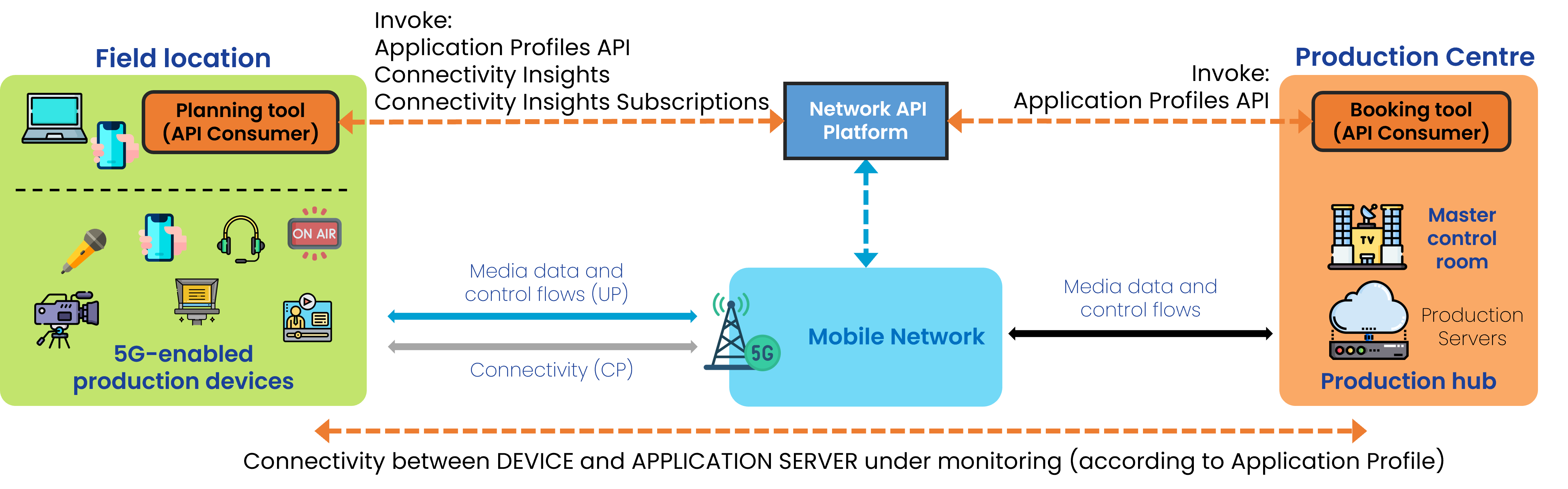
Step 0: Pre-conditions
- Create an application profile using the Application Profiles API (with the relevant application requirements).
- Create a device object for the device which media flow is to be monitored.
- Obtain IP address and port of the application server (Ingest Server of Production).
Step 1: Subscribe to recurrent events/notifications on network quality
- POST /subscriptions, passing the applicationProfileId obtained in step 0, the address/port of an application server, and a device object. Indicate expiration time and maximum number of events.
5G-MAG's Self-Assessment
This section records 5G-MAG's practical reading of the API and the open points it raises for media use.
The APIs are likely to be invoked to obtain information about the ability of the network to meet the requirements during operation. However:
- The information received is qualitative (e.g.
"targetMinDownstreamRate": "meets the application requirements"). An application would be unable to understand which parameters to be adapted in order to revert a situation in which requirements cannot be met.
Potential improvements:
- If used to monitor resources for which QoS was requested (via a different API) harmonization of Application Profile and QoS Profile for consistency.
- an indication of the actual performance parameters (quantitative) for those defined in the Application Profile may provide better insight for potential remedies. E.g. latency cannot be fulfilled, but please respond with the actual latency the link device-AS is experiencing.
Application Profiles API Usage
Check: Application Profiles API. The type of parameters that an applicationProfile defines is shown below.
{
  "networkQualityThresholds": {
    "packetDelayBudget": {
      "value": 12,
      "unit": "Milliseconds"
    },
    "targetMinDownstreamRate": {
      "value": 10,
      "unit": "Bps"
    },
    "targetMinUpstreamRate": {
      "value": 10,
      "unit": "Bps"
    },
    "packetLossErrorRate": 3,
    "jitter": {
      "value": 12,
      "unit": "Milliseconds"
    }
  },
  "computeResources": {
    "targetMinCPU": 0.5,
    "targetMinMemory": {
      "value": 10,
      "unit": "Kb"
    },
    "gpuVendorType": "Nvidia",
    "gpuModelName": "string",
    "targetMinGPU": 1,
    "targetMinGPUMemory": {
      "value": 10,
      "unit": "Kb"
    },
    "targetMinEphemeralStorage": {
      "value": 10,
      "unit": "Kb"
    },
    "targetMinPersistentStorage": {
      "value": 10,
      "unit": "Kb"
    }
  }
}
Device object
This is how a device is defined:
{
  "device": {
    "phoneNumber": "123456789",
    "networkAccessIdentifier": "123456789@domain.com",
    "ipv4Address": {
      "publicAddress": "84.125.93.10",
      "publicPort": 59765
    },
    "ipv6Address": "2001:db8:85a3:8d3:1319:8a2e:370:7344"
  }
}
Connectivity Insights Subscriptions API Usage
Create a subscription for a device
With POST /subscriptions
The request below creates a subscription. The key fields are:
| Parameter | Description |
|---|---|
sink | the callback URL to which the network delivers notifications (the consumer's endpoint must accept HTTP POST). |
sinkCredential | the credential the API provider uses to authenticate against that endpoint (empty here). |
types | the event types the consumer subscribes to (here, network-quality change events). |
initialEvent | when true, an event is sent immediately on subscription so the consumer has a baseline before any change occurs. |
{
  "protocol": "HTTP",
  "sink": "https://endpoint.example.com/sink",
  "sinkCredential": {},
  "types": ["org.camaraproject.connectivity-insights-subscriptions.v0.network-quality"],
  "config": {
    "subscriptionDetail": {
      "device": {
        "phoneNumber": "123456789",
        "networkAccessIdentifier": "123456789@domain.com",
        "ipv4Address": {
          "publicAddress": "84.125.93.10",
          "publicPort": 59765
        },
        "ipv6Address": "2001:db8:85a3:8d3:1319:8a2e:370:7344"
      },
      "applicationServer": {
        "ipv4Address": "192.168.0.1/24",
        "ipv6Address": "2001:db8:85a3:8d3:1319:8a2e:370:7344"
      },
      "applicationServerPorts": {
        "ranges": [
          {
            "from": 5010,
            "to": 5020
          }
        ],
        "ports": [5060, 5070]
      },
      "applicationProfileId": "3fa85f64-5717-4562-b3fc-2c963f66afa6"
    },
    "subscriptionExpireTime": "2023-07-03T12:27:08.312Z",
    "subscriptionMaxEvents": 5,
    "initialEvent": true
  }
}
Type of response: A subscriptionId. The response echoes the subscription configuration and adds the assigned subscriptionId, startsAt/expiresAt window, and current status:
{
  "sink": "https://endpoint.example.com/sink",
  "types": ["string"],
  "config": {
    "subscriptionDetail": {
      "device": {
        "phoneNumber": "123456789",
        "networkAccessIdentifier": "123456789@domain.com",
        "ipv4Address": {
          "publicAddress": "84.125.93.10",
          "publicPort": 59765
        },
        "ipv6Address": "2001:db8:85a3:8d3:1319:8a2e:370:7344"
      },
      "applicationServer": {
        "ipv4Address": "192.168.0.1/24",
        "ipv6Address": "2001:db8:85a3:8d3:1319:8a2e:370:7344"
      },
      "applicationServerPorts": {
        "ranges": [
          {
            "from": 5010,
            "to": 5020
          }
        ],
        "ports": [5060, 5070]
      },
      "applicationProfileId": "3fa85f64-5717-4562-b3fc-2c963f66afa6"
    },
    "subscriptionExpireTime": "2023-07-03T12:27:08.312Z",
    "subscriptionMaxEvents": 5,
    "initialEvent": true
  },
  "subscriptionId": "1119920371",
  "startsAt": "2023-07-03T12:27:08.312Z",
  "expiresAt": "2023-07-03T12:27:08.312Z",
  "status": "ACTIVATION_REQUESTED"
}
Event notifications
The whole point of this API is asynchronous delivery: once a subscription is created, the network pushes an event to the consumer whenever network quality changes (and, if initialEvent is true, once immediately as a baseline), rather than the consumer polling.
Mechanism
Notifications are delivered to the callback URL supplied as the sink parameter when the subscription is created with POST /subscriptions (see the request example above). Where present, sinkCredential describes the credential the API provider uses to authenticate against that endpoint. The consumer's sink must accept HTTP POST requests carrying the notification payload. The subscription stops delivering when it expires (subscriptionExpireTime) or reaches its event cap (subscriptionMaxEvents).
The payload follows the CloudEvents 1.0 specification (JSON format).
Event types
| Event type | Meaning |
|---|---|
org.camaraproject.connectivity-insights-subscriptions.v0.network-quality | The network quality relative to the subscribed application profile changed. |
The data object carries the network-quality assessment (the same qualitative per-threshold indications returned by the one-shot Connectivity Insights check). Note the v0 segment in the event type, indicating the API is at an early version.
The event type and payload structure above are taken from the CAMARA Connectivity Insights Subscriptions API definition. Confirm the exact values against the connectivity-insights-subscriptions.yaml for the version you are integrating against, as they can change between releases.