- Two parts: MBS User Services (MBSF and MBSTF), and MBS in the 5G System and NG-RAN (MB-SMF, MB-UPF and NR radio bearers).
- Two services: broadcast, for all UEs in a geographical area, and multicast, for a dedicated set of UEs.
- Delivery: 5GC Shared or Individual delivery to NG-RAN, PTM or PTP over the radio; the MBSF and MBSTF are optional.
What MBS is
3GPP Release 17 brings Multicast-Broadcast Services (MBS) to the 5G System, based on 5G Core and New Radio (TS 23.247 V17.0.0 clause 1; TS 38.300 V19.4.0 clause 16.10.1). MBS allows the network to select the most suitable among point-to-multipoint (PTM) or point-to-point (PTP) delivery based on requirements set by either service providers or network operators and/or taking into account concurrent user demand (TS 23.247 V20.0.0 clause 4.1; TS 38.300 V19.4.0 clause 16.10.5.4).
MBS is a point-to-multipoint service: data is transmitted from a single source to multiple recipients, either to all users in a broadcast service area or to the users in a multicast group. TS 23.247 states what its architecture provides:
- efficient usage of radio access and core network resources, with an emphasis on radio interface efficiency; (TS 23.247 V20.0.0 clause 4.1)
- efficient transport for a variety of multicast and broadcast services (TS 23.247 V20.0.0 clause 4.1).
The architecture follows the 5G System principles of TS 23.501. It distributes MBS data from the 5G System ingress to the NG-RAN nodes and then to the UE. TS 38.300 states that the NR system enables resource efficient delivery of multicast and broadcast services.
Broadcast
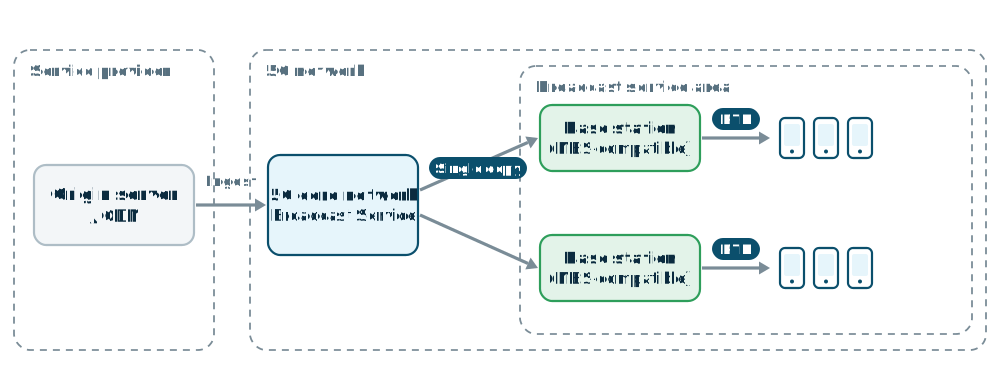
Broadcast communication service: the same content is provided at the same time to all UEs in a geographical area. The content provider and the network may not be aware whether the UEs are actually receiving it. A UE can receive it in RRC_IDLE, RRC_INACTIVE and RRC_CONNECTED (TS 23.247 V20.0.0 clause 3.1 (definition and note 1); TS 38.300 V19.4.0 clause 16.10.1).
A Broadcast Service uses only the PTM delivery method to transport traffic from a single source to multiple UEs within a broadcast service area (TS 23.247 V20.0.0 clause 4.1; TS 38.300 V19.4.0 clause 16.10.6.5A). Any UE within the broadcast service area can receive Broadcast Services (TS 23.247 V20.0.0 clause 3.1; TS 38.300 V19.4.0 clause 16.10.1).
A single copy of the MBS traffic is efficiently transported over the 5G core network to each MBS-compatible base station in the service area using the shared traffic delivery method (TS 23.247 V20.0.0 clause 4.1, 3.1 (MB-SMF service area)).
Multicast
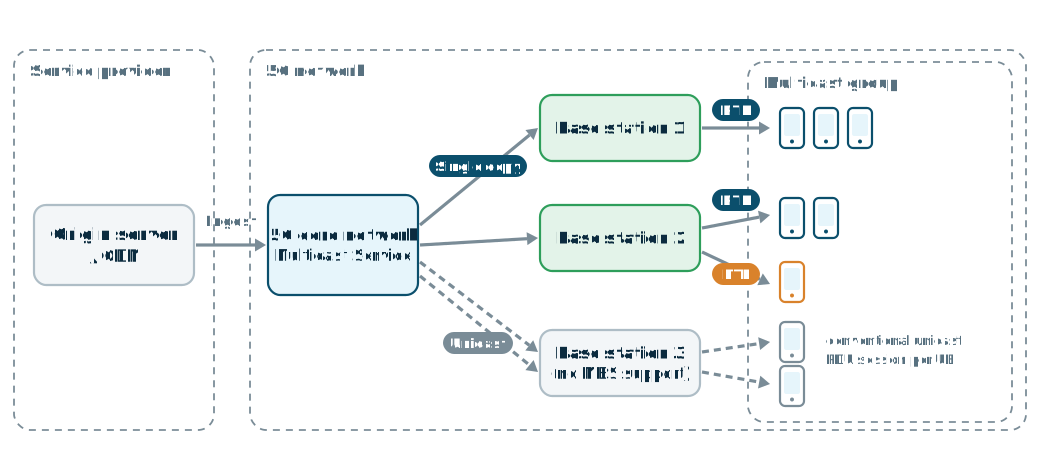
Multicast communication service: the same content is provided at the same time to a dedicated set of UEs. The content provider and the network can be aware whether the UEs are actually receiving it. A UE can receive it in RRC_CONNECTED, with PTP and/or PTM delivery, and in RRC_INACTIVE, with PTM delivery (TS 23.247 V20.0.0 clause 3.1 (definition and note 3); TS 38.300 V19.4.0 clause 16.10.1).
A Multicast Service uses PTM and/or PTP delivery methods to transport traffic from a single source to User Equipment (UE) terminals within a multicast service area that have subscribed to the service (TS 23.247 V20.0.0 clause 3.1, 4.1, 6.1.2; TS 38.300 V19.4.0 clause 16.10.1). Multicast traffic is efficiently and reliably transported over the 5G core network to compatible base stations using the shared traffic delivery method (TS 23.247 V20.0.0 clause 4.1). The individual traffic delivery method can serve multicast traffic to legacy base stations that do not support MBS (TS 23.247 V20.0.0 clause 4.1, 6.3.1).
MBS-enabled base stations autonomously decide whether to use PTM or PTP delivery methods at the radio access network based on the number of concurrent subscriptions and the quality of the radio channel (TS 23.247 V20.0.0 clause 4.1; TS 38.300 V19.4.0 clause 16.10.5.4).
Background
3GPP identified a number of services across different industry verticals that share the requirement of conveying common data to multiple recipients at the same time - for example public safety, group communications and internet of things (IoT) (TR 23.757 V17.0.0 clause 1 and history).
As multicast and broadcast have the potential to deliver 'common data' services more efficiently than unicast 3GPP has since standardised these capabilities in the 5G system as 5G New Radio Multicast and Broadcast Services (5G-NR MBS) (TS 23.247 V20.0.0 clause 4.1; TS 38.300 V19.4.0 clause 16.10.1). 5G-NR MBS was substantially complete in Release 17 (Rel-17), with some (mainly service) aspects carrying over to Rel-18 (TS 23.247 V18.8.0 clause 6.17, which is not in V17.0.0).
Media services, for example linear/live radio and TV, concurrently requested by a number of users, have many characteristics in common with the use cases that were identified, and so may also benefit from 5G-NR MBS (TR 23.757 V17.0.0 clause 1 (IPTV); TS 26.502 V19.6.0 clause 1).
What kinds of service could be offered with 5G MBS?
MBS supports the delivery of both operator and third-party media content (TS 26.502 V19.6.0 clause 1, 4.2.2).
- Broadcast is suitable for localized services at the granularity of individual cells (TS 23.247 V20.0.0 clause 3.1 (MBS service area, note 2), 6.2.2 (note 1)).
- Multicast allows the efficient and scalable delivery of popular services while ensuring a similar quality of service (QoS) and reliability to that of unicast distribution (TS 23.247 V20.0.0 clause 4.1; TS 38.300 V19.4.0 clause 16.10.5.4). Multicast allows a group of UEs to receive services according to QoS requirements and/or prevailing channel conditions (TS 38.300 V19.4.0 clause 16.10.5.4).
Explainer and videos
5G-MAG material on this technology:
- Media distribution with 5G Multicast-Broadcast Services, the 5G-MAG Explainer (PDF, April 2023).
- Time and Frequency Interleaving for broadcast services in 3GPP Systems, a 5G-MAG report (PDF): analysis of time-frequency interleaving for 5G Multicast Broadcast Services.
User Services for the 5G Multicast-Broadcast Service (3GPP Release 17) - Technology Exchange
Connecting MBSTF to the MBS System - Developer Exchange
MBS User Services for 5G MBS (Release 18) - Developer Exchange
End-to-End setup with 5GC, NG-RAN and UE for MBS Broadcast Services - Developer Exchange
Demonstrating MBS User Service Announcement mechanisms - Developer Exchange
Demonstrating the OBJECT_CAROUSEL operating mode - Developer Exchange
Basic implementation of MBS Function (MBSF) - Developer Exchange
Basic implementation of MBS Transport Function - Developer Exchange
Initial support of 5MBS core network functions - Developer Exchange
Sources for this page
- Specifications: 3GPP TS 26.502 and TS 26.517 (MBS User Services), TS 23.247 (MBS in the 5G System) and TS 38.300 (NG-RAN); the clause is in brackets in the text.
- 5G-MAG material: the Explainer "Media distribution with 5G Multicast-Broadcast Services" (April 2023) and the 5G-MAG Tech pages "MBS Overview" and "5G Multicast Broadcast Services (MBS)".
- Figures: the two concept figures are drawn by 5G-MAG after the Explainer.