- MBS User Services: the MBSF (control plane) and MBSTF (user plane) in the network, the optional MBS AF, MBS AS and MBSSF, and the MBS Client in the UE. TS 26.502 adds reference points MBS-1 to MBS-11 to the Nmb reference points of TS 23.247.
- APIs: Nmbsf (TS 29.580) at Nmb10 and Nmb5, Nmbstf (TS 29.581) at Nmb2; the announcement, repair and key retrieval protocols at MBS-1, MBS-5, MBS-4-UC and MBS-10 are in TS 26.517.
Functions
- MBSF: receives provisioning and control from the MBS Application Provider, directly at Nmb10 or through the NEF at Nmb5. It invokes MBS Session operations on the MB-SMF at Nmb1 and configures the MBSTF at Nmb2. It compiles the User Service Announcement for each MBS User Data Ingest Session and manages its updates.
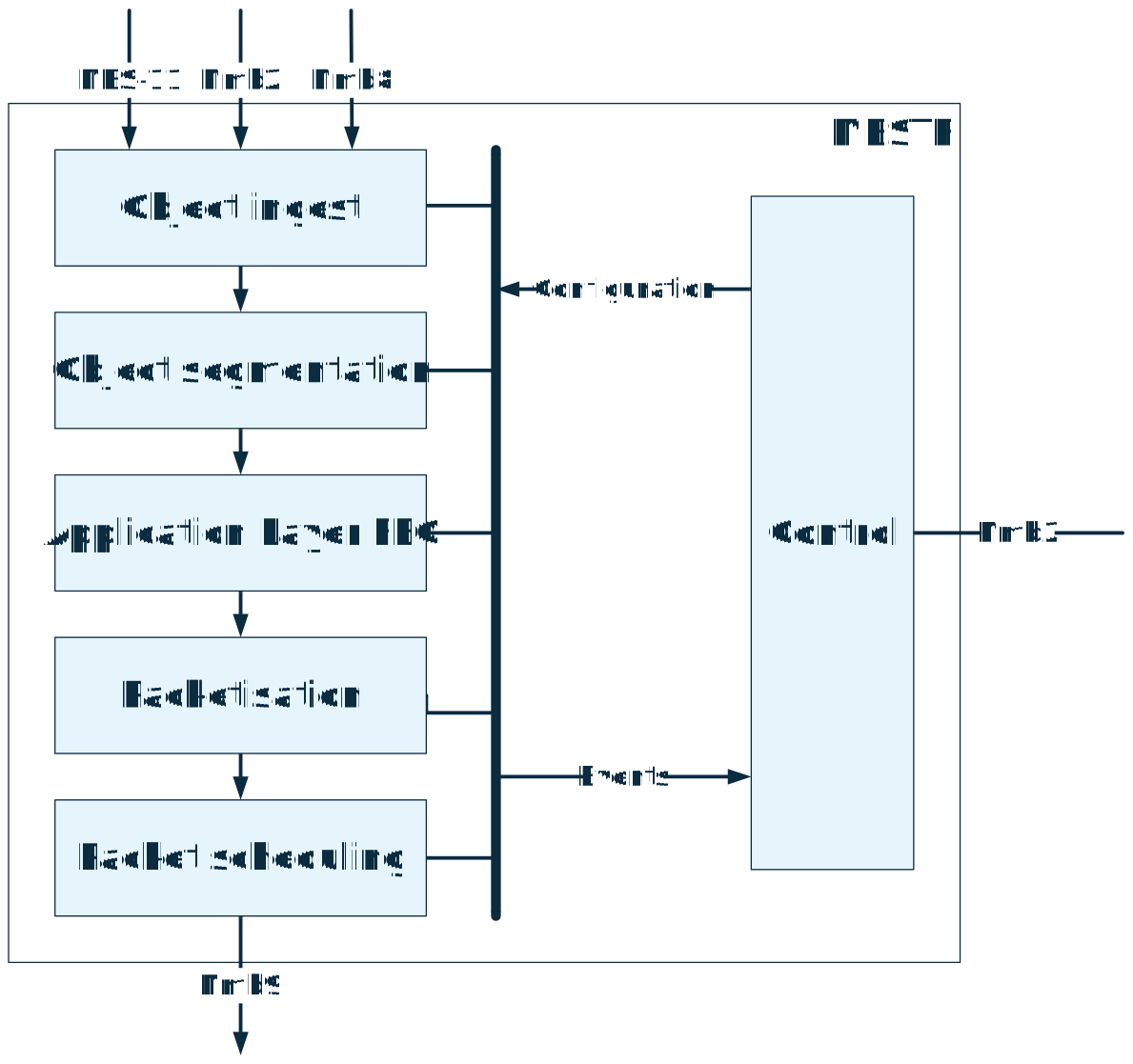
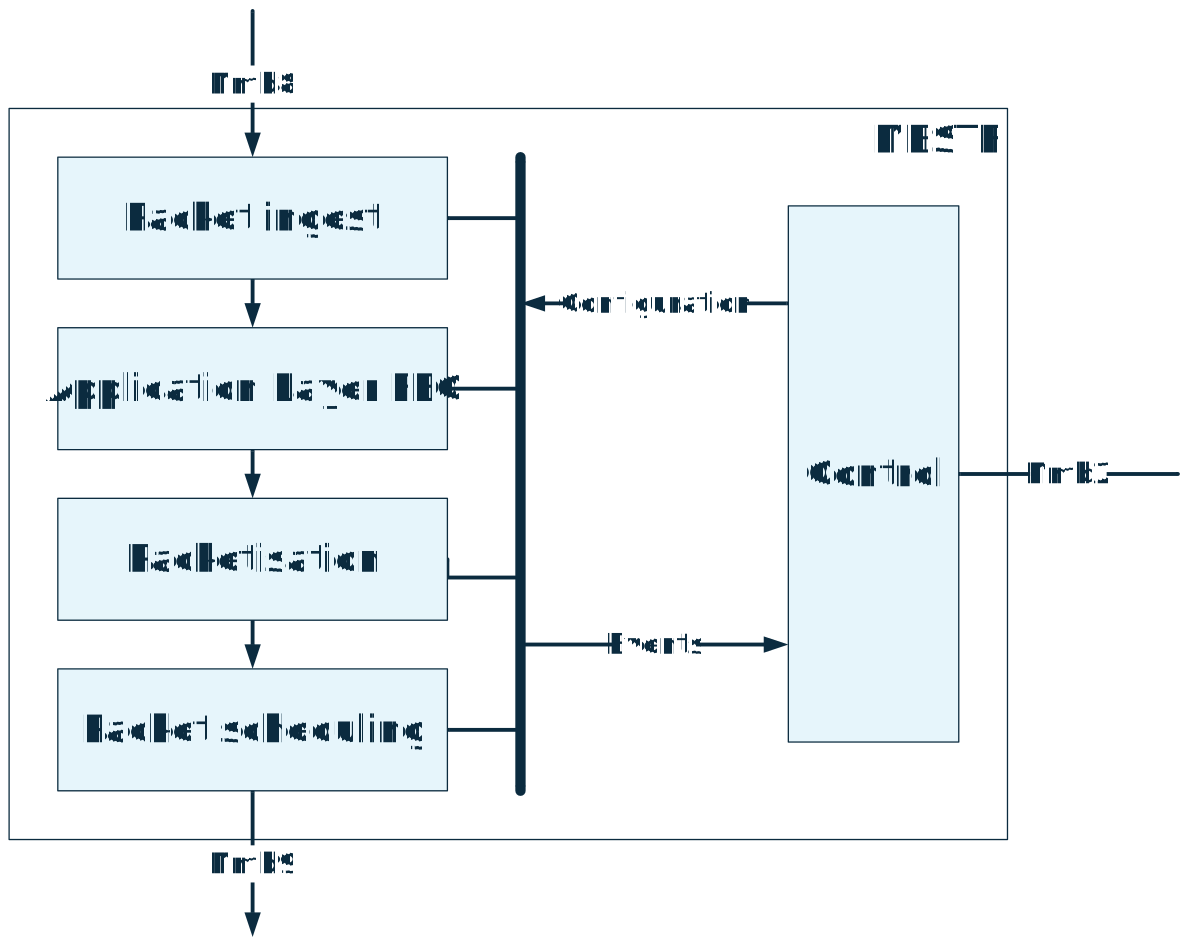
- MBSTF: receives user plane data at Nmb8 and sends MBS data packets to the MB-UPF at Nmb9. It acts as a user plane anchor when it sources IP multicast traffic. It receives its Distribution Session configurations from the MBSF at Nmb2 and sends notification events back, for example data ingest failure, session terminated or delivery started. For the Object Distribution Method its subfunctions are object ingest, object segmentation into payload units, optional Application Layer FEC (AL-FEC), packetisation and packet scheduling to a target bit rate.
- MBS AF (optional): serves User Service Announcements to the MBSF Client by unicast at MBS-5, and object manifests and announcements to the MBSTF at MBS-11. The MBSF configures it at MBS-3, an interaction TS 26.502 does not define further.
- MBS AS (optional): provides a byte-range file repair service to the MBSTF Client at MBS-4-UC, for the Object Distribution Method. It may stand alone or be co-located with the MBSTF or with a 5GMS AS.
- MBSSF (optional): the MBS Security Function. It provides a security anchor at MBS-10, realising the user plane security procedure of TS 33.501, and may be co-located with the MBSF or the MBSTF.
- MBS Client, in the UE, split into two subfunctions. The MBSF Client communicates with the MBS AF at MBS-5 on User Service control, and with the MBSSF at MBS-10. The MBSTF Client receives from the MBSTF at MBS-4-MC and from the MBS AS at MBS-4-UC, and provides an MBS Application Data Session to the application.
- MBS-Aware Application: uses the MBS Client at MBS-6 and MBS-7.
- MBS Application Provider: plays the role of the AF/AS. Outside the trusted data network it reaches the MBSF through the NEF at N33 instead of Nmb10.
The functions are shown as standalone. In deployments they may be co-located with other functions.
Reference points
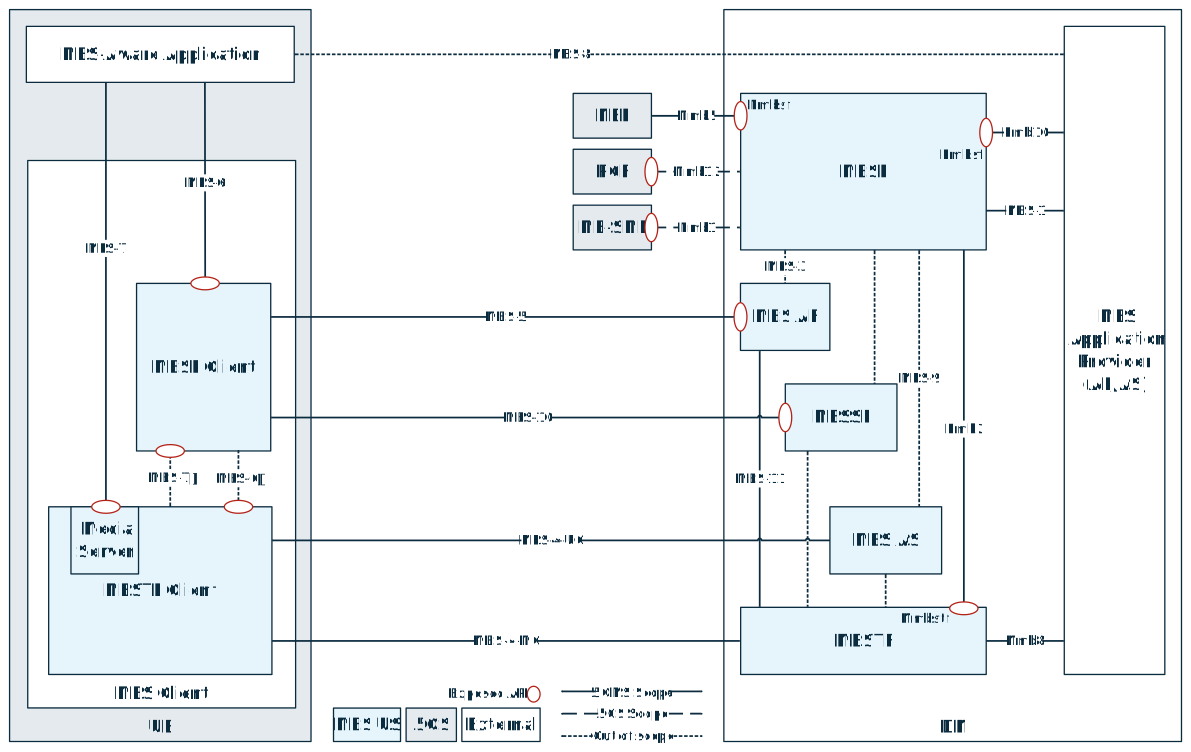
TS 26.502 reuses seven reference points of TS 23.247 (Nmb1, Nmb2, Nmb5, Nmb8, Nmb9, Nmb10 and Nmb12) and adds its own.
Reference points of MBS User Services
| Reference point | Between | Purpose | Specified |
|---|---|---|---|
| Nmb10 | MBS Application Provider (AF/AS) and MBSF | Provisioning of MBS User Services, by invoking the Nmbsf service | TS 26.502 cl. 7.2; TS 29.580 |
| Nmb5 | NEF and MBSF | The same Nmbsf service, for an AF/AS outside the trusted domain | TS 26.502 cl. 7.2; TS 29.580 |
| Nmb1 | MBSF and MB-SMF | MBS Session operations (Nmbsmf) | TS 23.247 cl. 9.1 |
| Nmb2 | MBSF and MBSTF | Configuration and control of the distribution methods (Nmbstf); push of object manifests | TS 26.502 cl. 7.3; TS 29.581 |
| Nmb8 | MBS Application Provider and MBSTF | Content ingest by the MBSTF, pull or push | TS 26.502 cl. 4.3.3 |
| Nmb9 | MBSTF and MB-UPF | MBS data packets towards the MB-UPF | TS 23.247 cl. 5.3.1 |
| Nmb12 | MBSF and PCF | QoS for the MBS Session, set from the provisioned 5QI | TS 26.502 table 4.5.6-1 |
| MBS-1 | MBSF and MBS Application Provider | Exposure of the User Service Announcement for private advertisement at MBS-8 | TS 26.517 cl. 8A |
| MBS-3 | MBSF and MBS AF | Configuration of the MBS AF and publication of announcements to it. Not described further | none |
| MBS-4-MC | MBSTF and MBS Client | Unidirectional multicast distribution of content | TS 26.517 cl. 6 and 7 |
| MBS-4-UC | MBSTF Client and MBS AS | File-based unicast repair | TS 26.517 cl. 10 |
| MBS-5 | MBSF Client and MBS AF | User plane interactions for control and service handling | TS 26.517 cl. 9 |
| MBS-6 | MBS-Aware Application and MBSF Client | API to manage and control MBS User Services | none |
| MBS-7 | MBS-Aware Application and MBSTF Client | API to receive the distributed user data | none |
| MBS-8 | MBS Application Provider and MBS-Aware Application | Announcement of MBS User Services. Beyond the scope of 3GPP | none |
| MBS-9 | MBSF and MBS AS | Configuration of the MBS AS. Not described further | none |
| MBS-10 | MBSF Client and MBSSF | Authorisation of access to security-protected MBS data | TS 26.517 cl. 11 |
| MBS-11 | MBSTF and MBS AF | Retrieval of object manifests and the announcements they list | TS 26.502 cl. 4.3.3.2 |
Two more reference points, MBS-6′ and MBS-7′, sit inside the MBS Client between the MBSF Client and the MBSTF Client. They are outside the scope of MBS User Services.
Services and APIs
The MBSF exposes two services and the MBSTF one. An MBS Application Provider outside the trusted data network reaches the MBSF services through the NEF, as Nnef_MBSUserService and Nnef_MBSUserDataIngestSession. The protocol and data model of each service are specified in TS 29.580 (Nmbsf) and TS 29.581 (Nmbstf); TS 29.580 calls the Destroy operation of TS 26.502 "Delete".
Services, operations and resources
| Service | Operations (TS 26.502) | Consumer | Resources (stage 3) |
|---|---|---|---|
| Nmbsf_MBSUserService | Create, Retrieve, Update, Destroy | AF, NEF | TS 29.580 cl. 6.1: /mbs-user-services, /mbs-user-services/{mbsUserServId} |
| Nmbsf_MBSUserDataIngestSession | Create, Retrieve, Update, Destroy, StatusSubscribe, StatusUnsubscribe, StatusNotify, StatusSubscribeMod | AF, NEF | TS 29.580 cl. 6.2: /sessions, /sessions/{sessionId}, /status-subscriptions, /status-subscriptions/{subscriptionId} |
| Nmbstf_MBSDistributionSession | Create, Retrieve, Update, Destroy, StatusSubscribe, StatusUnsubscribe, StatusNotify, StatusSubscribeMod | MBSF | TS 29.581 cl. 6.1: /dist-sessions, /dist-sessions/{distSessionRef}, /dist-sessions/{distSessionRef}/subscriptions |
| Reference point | API or protocol | TS 26.517 |
|---|---|---|
| MBS-1 | User Service Description retrieval API, exposed by the MBSF | cl. 8A |
| MBS-5 | User Service Description retrieval API, exposed by the MBS AF, base path {apiRoot}/3gpp-mbs-user-service-discovery/{apiVersion}/ | cl. 9 |
| MBS-4-UC | Unicast Object Repair protocol, between the MBSTF Client and the MBS AS | cl. 10 |
| MBS-10 | MBS Service Key retrieval from the MBSSF, using the protocol of TS 33.246 clause 6.3 | cl. 11 |
| Nmb8 | General HTTP provisions for the MBSTF endpoint that receives pushed objects | cl. 8.2.1.3 |
Distribution methods
| Method | What it delivers | Operating modes (TS 26.502 tables 6.1-1 and 6.2-1) |
|---|---|---|
| Object Distribution Method | Discrete binary objects, in real time or not, including media segments | OBJECT_SINGLE: each ingested object is distributed once. OBJECT_COLLECTION: a set of objects described by a manifest, distributed once. OBJECT_CAROUSEL: a set of objects repeated as the manifest specifies, with changes reflected at the next opportunity. OBJECT_STREAMING: a sequence of objects streamed in real time, for example on the schedule of a DASH MPD |
| Packet Distribution Method | Application Data Units, delivered transparently | PACKET_FORWARD_ONLY: the payloads of ingested IP packets are forwarded to the MB-UPF in new IP packets (Layer 3 proxying). PACKET_PROXY: the payloads of ingested UDP packets are forwarded in new UDP packets (Layer 4 proxying). RTP packets can be distributed in either mode |
When FLUTE realises the Object Distribution Method, the MBS Distribution Session conforms to the MBMS Download Profile of TS 26.346 clause L.4, with the additions of TS 26.517 clause 6.2. TS 26.517 recommends the OBJECT_STREAMING mode for streaming DASH or HLS content to a Media Player in the UE. The Packet Distribution Method combines three delivery methods of TS 26.346, the MBMS Streaming, Group Communication and Transparent Delivery Methods, with modifications.
For the Object Distribution Method, ingest at Nmb8 is pull-based (the MBSTF fetches objects from the MBS Application Provider) or push-based (the MBS Application Provider sends them).
Sessions and their life cycle
An MBS Application Provider provisions an MBS User Service, and within it time-bound MBS User Data Ingest Sessions. Each ingest session has one or more MBS Distribution Sessions; an ingest session without any is not valid. A Distribution Session uses an MBS Session for delivery, identified by a TMGI or a Source-Specific Multicast (SSM) address. It has one MBS Session Context, unless several target service areas are specified.
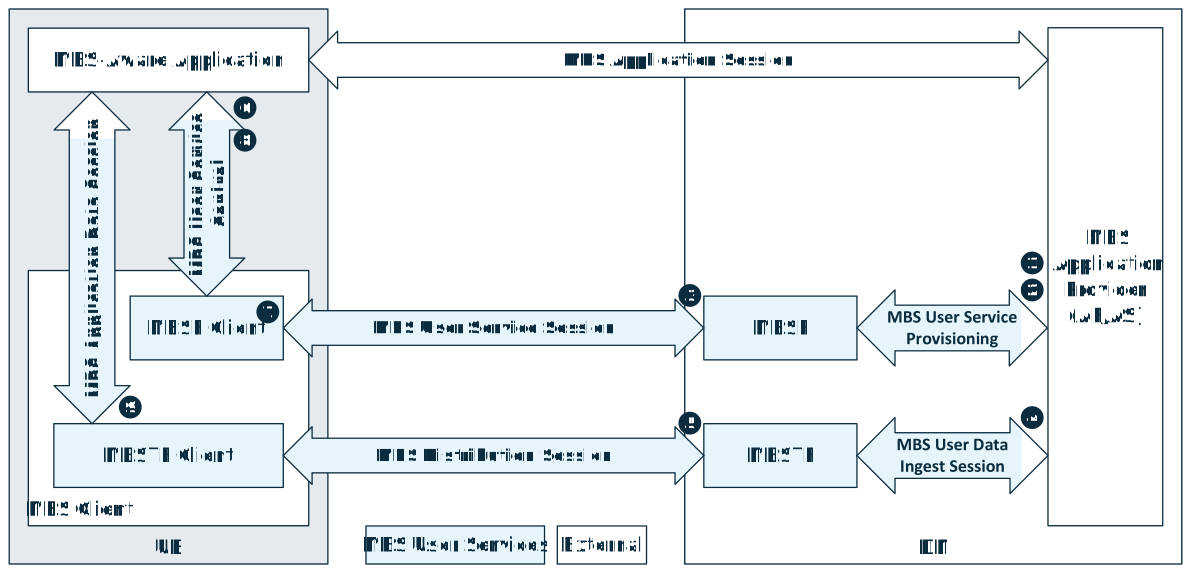
An ingest session may carry a set of active periods. If none is given, it and its Distribution Sessions are active until further notice. The Service type (multicast or broadcast) of an MBS User Service cannot be changed; the other parameters assigned by the provider can be updated at any time.
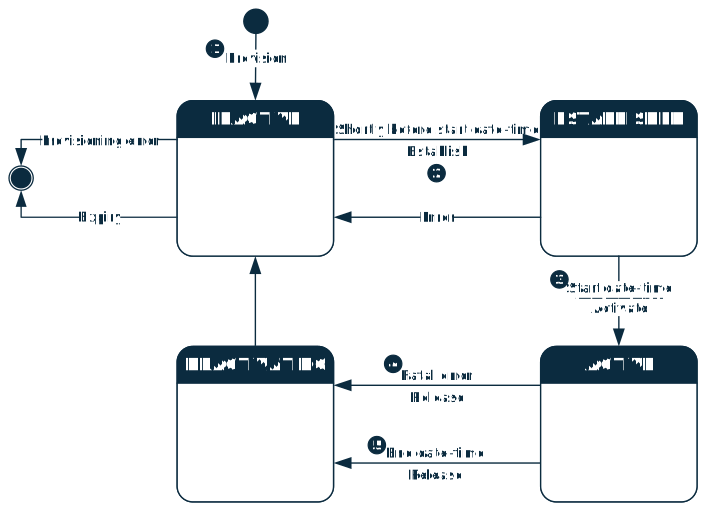
| State of a Distribution Session | What happens (TS 26.502 clause 4.6.1) |
|---|---|
| INACTIVE | The state when the session is first provisioned in the MBSF, and its replica in the MBSTF |
| ESTABLISHED | Shortly before the start of the active period, the MBSF reserves resources with the MB-SMF and establishes the session in the MBSTF, which may start ingesting data but not distributing it. The MBSF advertises the session |
| ACTIVE | At the start time, the MBSTF starts sending MBS data packets to the MB-UPF at Nmb9, and MBS Clients that activated reception start receiving at MBS-4-MC |
| DEACTIVATING | At the end time, or on a severe error, the MBSF stops advertising the session, deactivates and releases it in the MBSTF, and releases the resources with the MB-SMF |
How a User Service is provisioned and announced
TS 26.502 clauses 5.3 to 5.5, condensed, with the step numbers:
- Optional TMGI pre-allocation (step 1). The MBS Application Provider may pre-allocate a TMGI with Nmbsmf_TMGI_Allocate on the MB-SMF at Nmb13 (or N33+N29mb through the NEF).
- User Service (step 2). It invokes Nmbsf_MBSUserService_Create at Nmb10 (or N33+Nmb5).
- Ingest session (steps 3 and 4). It invokes Nmbsf_MBSUserDataIngestSession_Create, with the details of one or more Distribution Sessions, and subscribes to its status events.
- MBS Session (steps 6 to 9). Shortly before the active period, the MBSF may allocate a TMGI, then invokes Nmbsmf_MBSSession_Create on the MB-SMF at Nmb1. The MB-SMF can allocate the TMGI as a side effect.
- Distribution Session in the MBSTF (steps 10 to 15). The MBSF invokes Nmbstf_MBSDistributionSession_Create at Nmb2, a mirror of its own entity. The MBSTF tries to establish content ingest at Nmb8; on success the session becomes ESTABLISHED.
- Announcement (clause 5.4). The MBSF compiles an MBS User Service Announcement describing the current Distribution Sessions. It is delivered by unicast at MBS-5, in the MBS User Service Announcement Channel at MBS-4-MC (an MBS Distribution Session in OBJECT_CAROUSEL mode), or passed back to the provider for private advertisement at MBS-8.
- Activation (clause 5.5.1). At the start time, for a multicast service, the MBSF activates the Multicast MBS Session in the MB-SMF so that UEs can join. It then sets the Distribution Session to ACTIVE in the MBSTF with Nmbstf_MBSDistributionSession_Update.
- Reception (clause 5.5.2). The MBS-Aware Application asks the MBSF Client at MBS-6 to activate the User Service; the MBSTF Client receives the MBS data at MBS-4-MC.
- Deactivation (clause 5.5.4). At the end time, the MBSF tears down the MBS Session for a broadcast service, or for the last period. For a multicast service with further periods, it only deactivates the MBS Session.
Sources for this page
- MBS User Services, functions and reference points: TS 26.502 V18.6.0, clauses 4.2.1, 4.2.2, 4.3.1 to 4.3.6 and 4.4.1, table 4.5.6-1.
- Services and APIs: TS 26.502 V18.6.0, clause 7 and tables 7.2-1 and 7.3-1; TS 29.580 V18.8.0, clauses 1, 5.2, 5.3, 6.1.3 and 6.2.3; TS 29.581 V18.6.0, clauses 1, 4.1 and 6.1.3; TS 26.517 V18.6.0, clauses 8.2.1.3, 8A, 9, 10 and 11.
- Distribution methods: TS 26.502 V18.6.0, clauses 3.1, 4.3.3.2, 6.1 and 6.2; TS 26.517 V18.6.0, clauses 6.2.1, 6.2.3.5 and 7.2.1.
- Sessions and their life cycle; provisioning and announcement: TS 26.502 V18.6.0, clauses 3.1, 4.5.2 to 4.5.6, 4.6.1, 5.3, 5.3A, 5.4, 5.5.1, 5.5.2 and 5.5.4.
- Figures: TS 26.502 V18.6.0, figures 4.3.1-1 (the second of the two drawings above its caption), 4.3.3.2-1, 4.3.3.3-1, 4.5.1-1 and 4.6.1-1.