This page contains information such as the specifications within the scope of the tools and high-level architectures that bring context to their applicability.
Objectives
This project provides reference tools for delivering DVB-I (Digital Video Broadcasting - Internet) services over 5G networks. DVB-I defines a common service discovery and selection framework that lets internet-connected devices find and access sets of linear TV services, along with their programme metadata, independently of the underlying access network.
The work focuses on combining DVB-I with 5G delivery so that the same service can reach devices over different paths:
- Unicast delivery using 5G Media Streaming (5GMS)
- Broadcast delivery using the LTE-based 5G Broadcast System
- Concurrent or hybrid delivery over both paths
The DVB / 5G-MAG Joint Task Force documented the reference architecture and deployment guidance for these scenarios in DVB A178, published as ETSI TR 103 972 (DVB-I service delivery over 5G Systems; Deployment Guidelines).
Specifications in scope
- DVB A177 (ETSI TS 103 770) - Service Discovery and Programme Metadata for DVB-I, the main DVB-I specification
- DVB A178 (ETSI TR 103 972) - DVB-I service delivery over 5G Systems; Deployment Guidelines
- ETSI TS 103 720 - 5G Broadcast System for linear TV and radio services (broadcast delivery path)
- 3GPP 5G Media Streaming (5GMS) specifications (unicast delivery path)
The full list of relevant specifications is linked further down this page.
What the specifications provide
For a developer, the specifications split into a discovery layer, a media-format layer, and a transport layer:
| Layer | Specification | What the tools use it for |
|---|---|---|
| Discovery / selection | DVB A177 (ETSI TS 103 770) | Parsing service lists, resolving service instances, querying a Service List Registry, reading programme metadata |
| Deployment guidance | DVB A178 (ETSI TR 103 972) | The reference architecture and per-scenario workflows the tools implement |
| Unicast media format | DVB-DASH (ETSI TS 103 285), profiling MPEG-DASH (ISO/IEC 23009-1) | The DASH presentation played on the unicast path |
| Multicast media delivery | DVB-MABR (ETSI TS 103 769) | Scalable delivery reconstructed into DASH on the broadcast/multicast leg |
| Unicast transport | 3GPP 5GMS: TS 26.501, TS 26.512, TS 26.511 | Session handling and delivery on the 5GMS downlink |
| Broadcast transport | ETSI TS 103 720 (LTE-based 5G Broadcast) | Receiving the broadcast bearer |
DVB A178 (ETSI TR 103 972) is a technical report, so it describes the reference architecture and recommended integration rather than a normative conformance target. The normative behaviour the tools implement comes from the individual DVB, ETSI and 3GPP specifications above.
Reference tools
The reference tools cover DVB-I service discovery and selection, bootstrap procedures, and integration with both the 5GMS unicast path and the 5G Broadcast path, so that a hybrid broadcast and broadband TV experience can be demonstrated end to end. See the Resources page for the available repositories and the Resources for planned work.
How the tools map to the standard
The DVB-I over 5G tools implement the discovery and selection layer and glue it to the transport that 5G-MAG's other reference tools provide:
- Service discovery and selection (DVB A177 / ETSI TS 103 770): fetching and parsing a service list, evaluating the service instances on each service, and choosing a delivery instance. This includes the bootstrap flow via a Service List Registry where one is used.
- Programme metadata: retrieving and presenting content-guide data for the selected services.
- Unicast delivery: handing a DVB-DASH service instance to the 5G Media Streaming client path. The 5GMS behaviour itself lives in the 5G Media Streaming reference tools.
- Broadcast delivery: acquiring a broadcast service instance over the LTE-based 5G Broadcast path. The receiver/modem behaviour lives in the 5G Broadcast reference tools.
- Concurrent / hybrid operation: presenting both instances for a service so the client can select or switch between broadcast and unicast.
This mapping mirrors the DVB-I-over-5G reference architecture in DVB A178 (ETSI TR 103 972): DVB-I stays the service layer, the DVB delivery formats (DVB-DASH, DVB-MABR) stay the media layer, and the 3GPP/ETSI systems stay the transport layer.
Getting started
- Read the Standards: DVB-I Services over 5G Systems page for the specification landscape, and the Tech: DVB-I Services over 5G Systems page for the architecture and procedures.
- Review the reference architecture diagram below to see which component repositories provide each part of the chain.
- Pick a scenario (unicast via 5GMS, broadcast via 5G Broadcast, or concurrent/hybrid) and clone the relevant repositories from the Resources page.
- Check the Tutorials page for demo videos and repository pointers, and the Resources page for versioned builds.
Technical documentation providing context to this project can be found in the link below.
Tech: 5G Broadcast: TV, Radio and Emergency Alerts
A list of relevant specifications can be found in the link below.
Standards: DVB-I Services over 5G Systems
High-level architectures
DVB-I Services over 5G Systems: 5GMSd with 5G Broadcast
The diagram below shows the DVB-I over 5G reference architecture combining a 5G Media Streaming downlink (5GMSd) unicast path with a 5G Broadcast path, so the same service can be delivered over either or both.
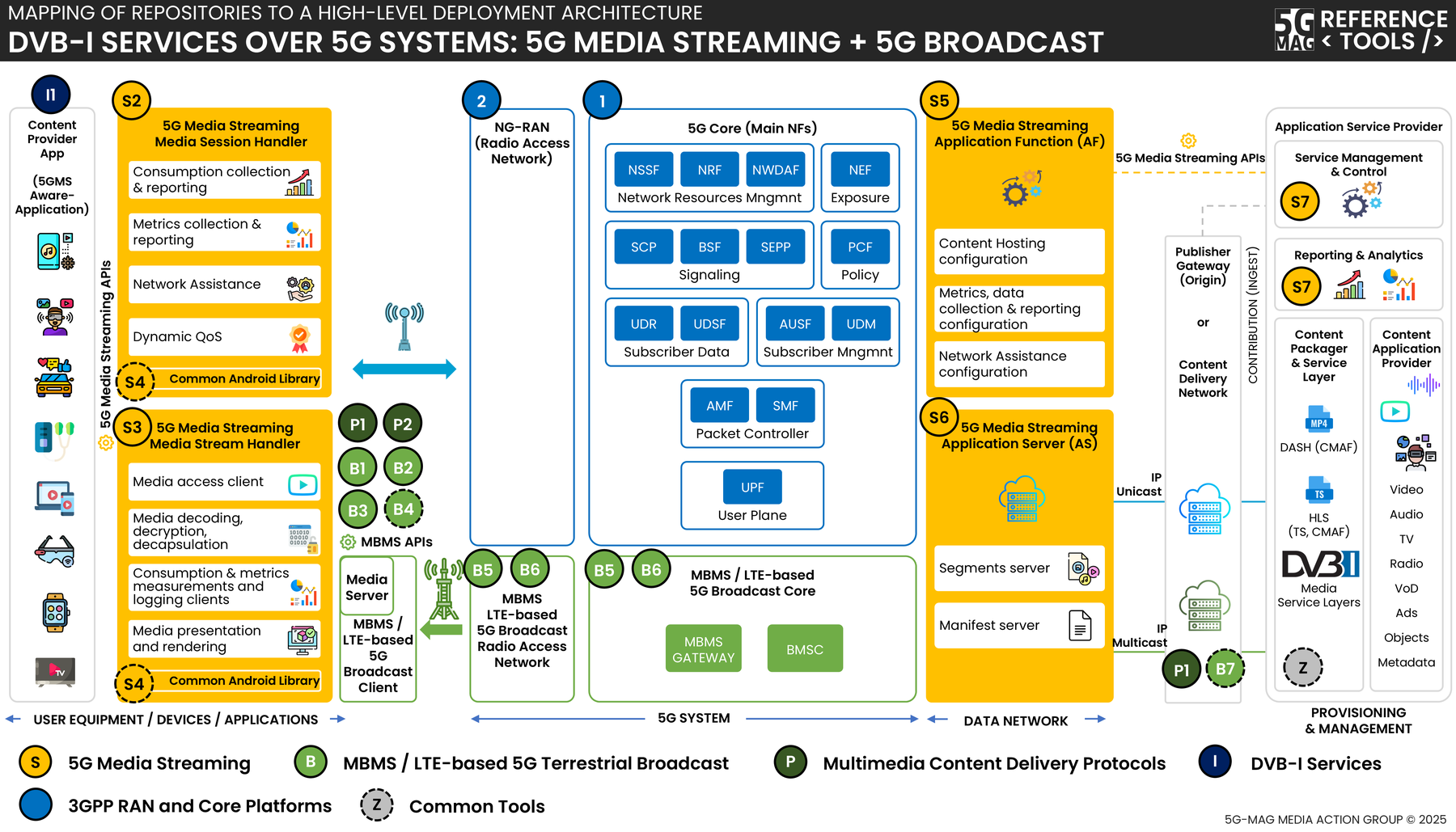
5G Media Streaming: Resources DVB-I Services: Resources 5G Broadcast: Resources Multimedia content delivery protocols: Resources 3GPP RAN and Core Platforms: Resources Common Tools
These identifiers on this page were not confirmed against a primary source (the 3GPP/ETSI portals block automated access): 3GPP TS 26.512 (5GMS Protocols) and TS 26.511 (5GMS Profiles, codecs and formats) as the exact companions used, and their Release placement. The DVB and ETSI document numbers/titles (A177/TS 103 770, A178/TR 103 972, TS 103 720, TS 103 285, TS 103 769) were confirmed against DVB/ETSI sources; DASH = ISO/IEC 23009-1 is established. Verify the 3GPP identifiers against the 3GPP work plan before publication.
Related
- Resources: Roadmap - planned work
- Resources: Repositories - the source repositories for these tools
- Tutorials - demo videos and repository pointers
Refer to the DVB-I repositories on GitHub to use or contribute to these Reference Tools.