See also: Developer Exchange.
Category: 3GPP Implementations
What This Project Implements
This page contains information such as the specifications within the scope of the tools and high-level architectures that bring context to their applicability.
This project provides reference tools for delivering DVB-I (Digital Video Broadcasting - Internet) services over 5G networks. DVB-I defines a common service discovery and selection framework that lets internet-connected devices find and access sets of linear TV services, along with their programme metadata, independently of the underlying access network.
The work focuses on combining DVB-I with 5G delivery so that the same service can reach devices over different paths:
- Unicast delivery using 5G Media Streaming (5GMS)
- Broadcast delivery using the LTE-based 5G Broadcast System
- Concurrent or hybrid delivery over both paths
The DVB / 5G-MAG Joint Task Force documented the reference architecture and deployment guidance for these scenarios in DVB A178, published as ETSI TR 103 972 (DVB-I service delivery over 5G Systems; Deployment Guidelines).
Deployment Configurations
DVB-I Services over 5G Systems: 5GMSd with 5G Broadcast
The diagram below shows the DVB-I over 5G reference architecture combining a 5G Media Streaming downlink (5GMSd) unicast path with a 5G Broadcast path, so the same service can be delivered over either or both.
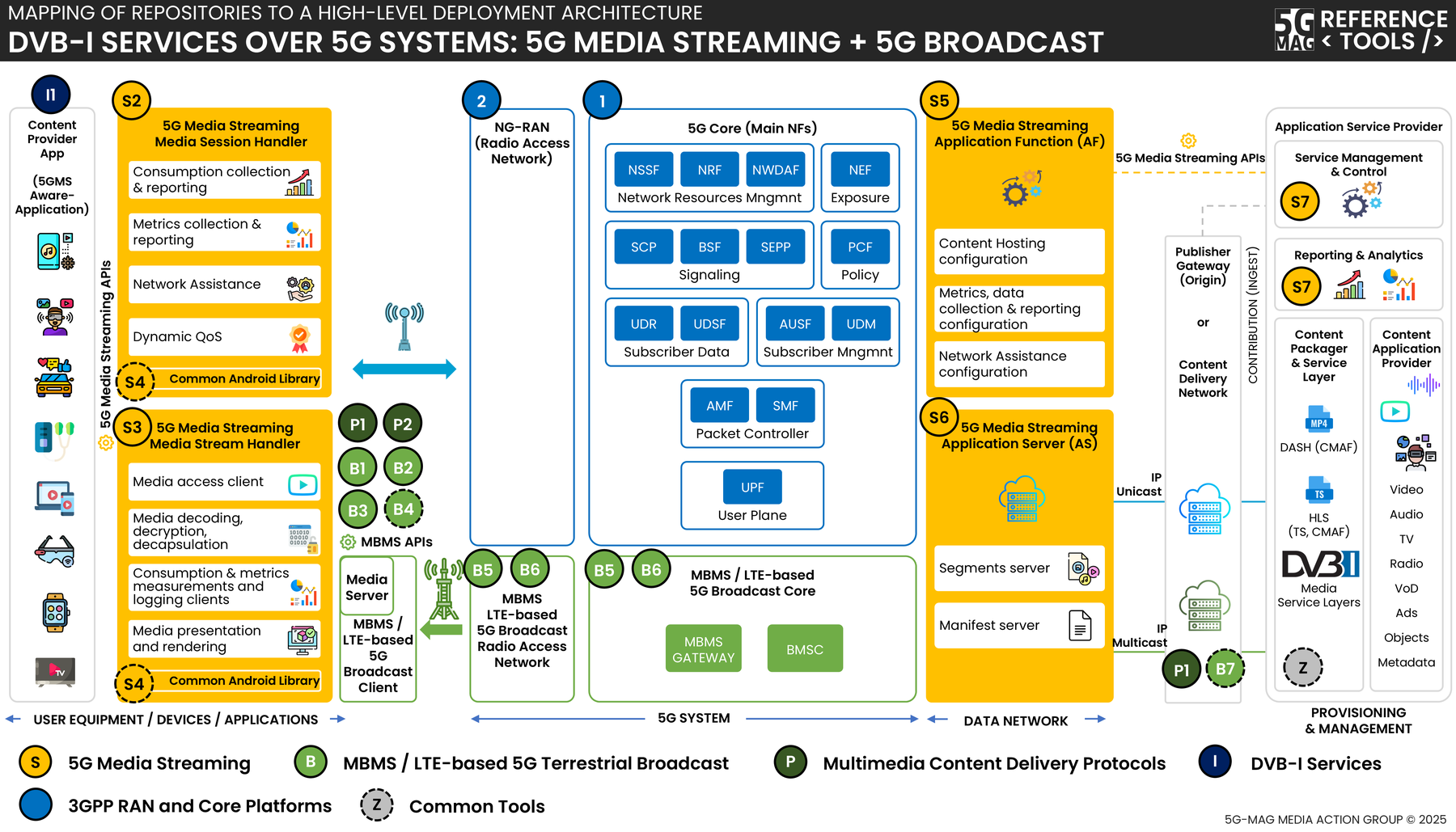
- 5G Media Streaming
- DVB-I Services
- 5G Broadcast
- Content Delivery Protocols
- 3GPP RAN and Core Platforms
- Common Tools
Reference tools
The reference tools cover DVB-I service discovery and selection, bootstrap procedures, and integration with both the 5GMS unicast path and the 5G Broadcast path, so that a hybrid broadcast and broadband TV experience can be demonstrated end to end. See Repositories & Releases on the project index for the available repositories and Developer Updates for planned work.
How the tools map to the standard
The DVB-I over 5G tools implement the discovery and selection layer and glue it to the transport that 5G-MAG's other reference tools provide:
- Service discovery and selection (DVB A177 / ETSI TS 103 770): fetching and parsing a service list, evaluating the service instances on each service, and choosing a delivery instance. This includes the bootstrap flow via a Service List Registry where one is used.
- Programme metadata: retrieving and presenting content-guide data for the selected services.
- Unicast delivery: handing a DVB-DASH service instance to the 5G Media Streaming client path. The 5GMS behaviour itself lives in the 5G Media Streaming reference tools.
- Broadcast delivery: acquiring a broadcast service instance over the LTE-based 5G Broadcast path. The receiver/modem behaviour lives in the 5G Broadcast reference tools.
- Concurrent / hybrid operation: presenting both instances for a service so the client can select or switch between broadcast and unicast.
This mapping mirrors the DVB-I-over-5G reference architecture in DVB A178 (ETSI TR 103 972): DVB-I stays the service layer, the DVB delivery formats (DVB-DASH, DVB-MABR) stay the media layer, and the 3GPP/ETSI systems stay the transport layer.
Getting Started
- Read the Standards: DVB-I Services over 5G Systems page for the specification landscape, and the Tech: DVB-I Services over 5G Systems page for the architecture and procedures.
- Review the reference architecture diagram above to see which component repositories provide each part of the chain.
- Pick a scenario (unicast via 5GMS, broadcast via 5G Broadcast, or concurrent/hybrid) and clone the relevant repositories from Repositories & Releases on the project index.
- Check the Tutorials page for demo videos and repository pointers, and Repositories & Releases for versioned builds.
Technical documentation providing context to this project can be found in the link below.
Tech: 5G Broadcast: TV, Radio and Emergency Alerts
A list of relevant specifications can be found in the link below.
Standards: DVB-I Services over 5G Systems
Related
- Repositories & Releases
- Slide deck: DVB-I Services over 5G Systems overview
- Implementation Blueprint: DVB-I service discovery bootstrap — the step-by-step procedure this tool implements
- Related project: 5G Broadcast - TV and Radio Services — the underlying broadcast transport
Refer to the DVB-I repositories on GitHub to use or contribute to these Reference Tools. See How to Contribute for the process.