The 5G Core (5GC) presents several Network Functions, each of which has its own set of service interfaces. This project hosts a collection of reusable service consumer libraries designed to talk to some of these functions. A "service consumer library" is a small library that implements the client (consumer) side of a 5G Core service API, so an application can call that function without re-implementing the protocol.
- PDU Session: the Packet Data Unit session that carries a device's IP traffic across the 5G network.
- QoS: Quality of Service, the network treatment (bandwidth, latency, priority) applied to that traffic.
- NRF: Network Repository Function, used to discover other network functions.
- PCF: Policy Control Function, which applies QoS and charging policy.
- BSF: Binding Support Function, which maps a PDU Session to the PCF serving it.
- MB-SMF: Multicast/Broadcast Session Management Function, which manages MBS sessions.
- TMGI: Temporary Mobile Group Identifier, the identifier for an MBS session.
This page is split into two domains, separated by a horizontal rule: first the Media Streaming QoS libraries (BSF and PCF), then the Multicast/Broadcast Services (MBS) library (MB-SMF).
Technical documentation providing context to this project can be found in the link below.
Tech: Streaming, Media Delivery & Data Collection
Tech: Multicast and Broadcast Services in 5G Networks
Relevant specifications are listed below: the BSF and PCF service-consumer interfaces are on the Standards: 5G Media Streaming page, and the MB-SMF service-consumer interface is on the Standards: 5G Multicast & Broadcast Services page.
What is being implemented?
A series of reusable service consumer libraries to invoke service operations on various 5GC network functions.
Media Streaming QoS (BSF and PCF)
Within the context of 5G Media Streaming (5GMS), the 5GMS Application Function (AF) needs to communicate with the 5G Core in order to manipulate network Quality of Service (QoS) for ongoing media streaming sessions.
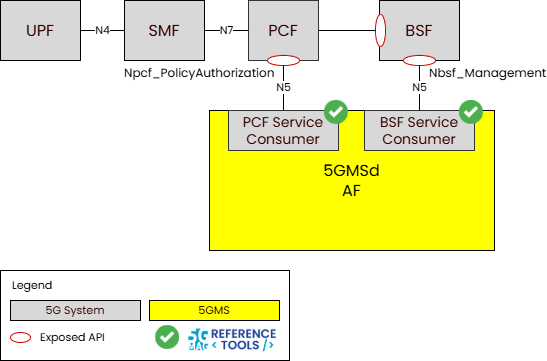
The following libraries are available:
- libscbsf - Binding Support Function (BSF) service consumer library
- libscpcf - Policy Control Function (PCF) service consumer library
libscbsf - Binding Support Function (BSF) service consumer library
- Responsible for maintaining a mapping between UE PDU Session and the PCF which is managing that PDU Session.
- The
libscbsflibrary aids in discovery of the BSF in the 5G Core (by interrogating the NRF) and subsequently looking up which PCF is managing the PDU Session for a UE, identified by its IP address. - This library implements the service consumer end of the following service-based APIs:
Nbsf_Management
libscpcf - Policy Control Function (PCF) service consumer library
- Responsible for applying charging and network policy to the PDU sessions of UEs. The
Npcf_PolicyAuthorizationservice API is used at reference point N5 by an Application Function (AF) to request policy changes to the PDU session on behalf of the UE, manipulating particular network QoS parameters for selected IP traffic flows within it. - The
libscpcflibrary allows an application to connect to a PCF and request anAppSessionContextwhich it can then use to manipulate the network routing policies for traffic passing across specific application flows within a UE's PDU Session. - This library implements the service consumer end of the following service-based APIs:
Npcf_PolicyAuthorization
Command line tool: pcf-policyauthorization
The pcf-policyauthorization tool manipulates the network Quality of Service parameters of Application Session Contexts in the PCF by using the PCF service consumer library to invoke operations on the Npcf_PolicyAuthorization service API.
The PCF address can be explicitly specified at the command line if this is already known. Alternatively, the tool can also use the BSF service consumer library to look up which PCF instance is managing the PDU Session of interest ( based on the IP address of a UE registered with the AMF).
Multicast/Broadcast Services (MB-SMF)
Within the context of 5G Multicast/Broadcast Services (MBS), the Multicast/Broadcast Session Management Function (MB-SMF) is responsible for allocating and deallocating Temporary Mobile Group Identities (TMGIs) and for the management of Multicast/Broadcast Services on the Multicast/Broadcast User Plane Function (MB-UPF).
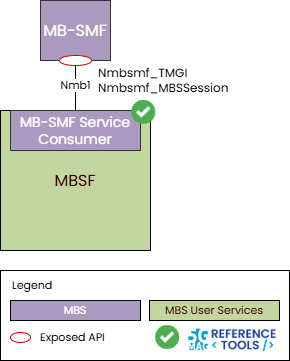
The following libraries are available:
- libscmbsmf - Multicast/Broadcast Session Management Function (MB-SMF) service consumer library
libscmbsmf - Multicast/Broadcast Session Management Function (MB-SMF) service consumer library
- Responsible for allocating and deallocating Temporary Mobile Group Identities (
TMGIs) and for the management of Multicast/Broadcast Services (MBS) on the Multicast/Broadcast User Plane Function (MB-UPF). - The
Nmbsmf_TMGIservice API is used at reference pointNmb1for the allocation and deallocation ofTMGIs, and theNmbsmf_MBSSessionservice API is used at reference pointNmb1for the creation, modification and destruction of MBS Sessions and for the management of notification subscriptions to events arising on those MBS Sessions. - The
libscmbsmflibrary provides a simple create/destroy interface forTMGImanagement and an MBS Session and notifications subscriptions model for management of MBS Sessions. - This library implements the service consumer end of the following service-based APIs:
Nmbsmf_TMGINmbsmf_MBSSession
Command line tool: tmgi-tool
The tmgi-tool provides a simple command line interface to either request the creation or destruction of a TMGI using the interfaces provided by the MB-SMF service consumer library to invoke operations on the Nmbsmf_TMGI service API.
Command line tool: mbs-service-tool
The mbs-service-tool can register an MBS Session and will then wait for notifications for that MBS Session. It does this by using the interfaces provided by the MB-SMF service consumer library to invoke operations on the Nmbsmf_MBSSession service API.
How to choose a library
The three libraries split by what you are trying to do:
- If you need to request network QoS for a unicast media session (the 5G Media Streaming case), use libscpcf to talk to the PCF via
Npcf_PolicyAuthorization. If you do not already know which PCF serves the UE, use libscbsf first to look it up from the UE's IP address; thepcf-policyauthorizationtool can do both in one step. - If you need to create and manage multicast/broadcast sessions (the MBS case), use libscmbsmf to talk to the MB-SMF via
Nmbsmf_TMGI(allocate/deallocate a TMGI) andNmbsmf_MBSSession(create, modify, release a session and subscribe to its events).
Each library implements only the consumer (client) side of its APIs, so it assumes a running 5G Core that produces those services. The libraries handle NRF-based discovery where relevant (for example, libscbsf discovers the BSF), which means an application usually only needs an entry point address and the session or UE identity, not the full topology of the core.
Getting started
See Tutorials to run the tools against a 5G Core, and Resources for the source code and releases.
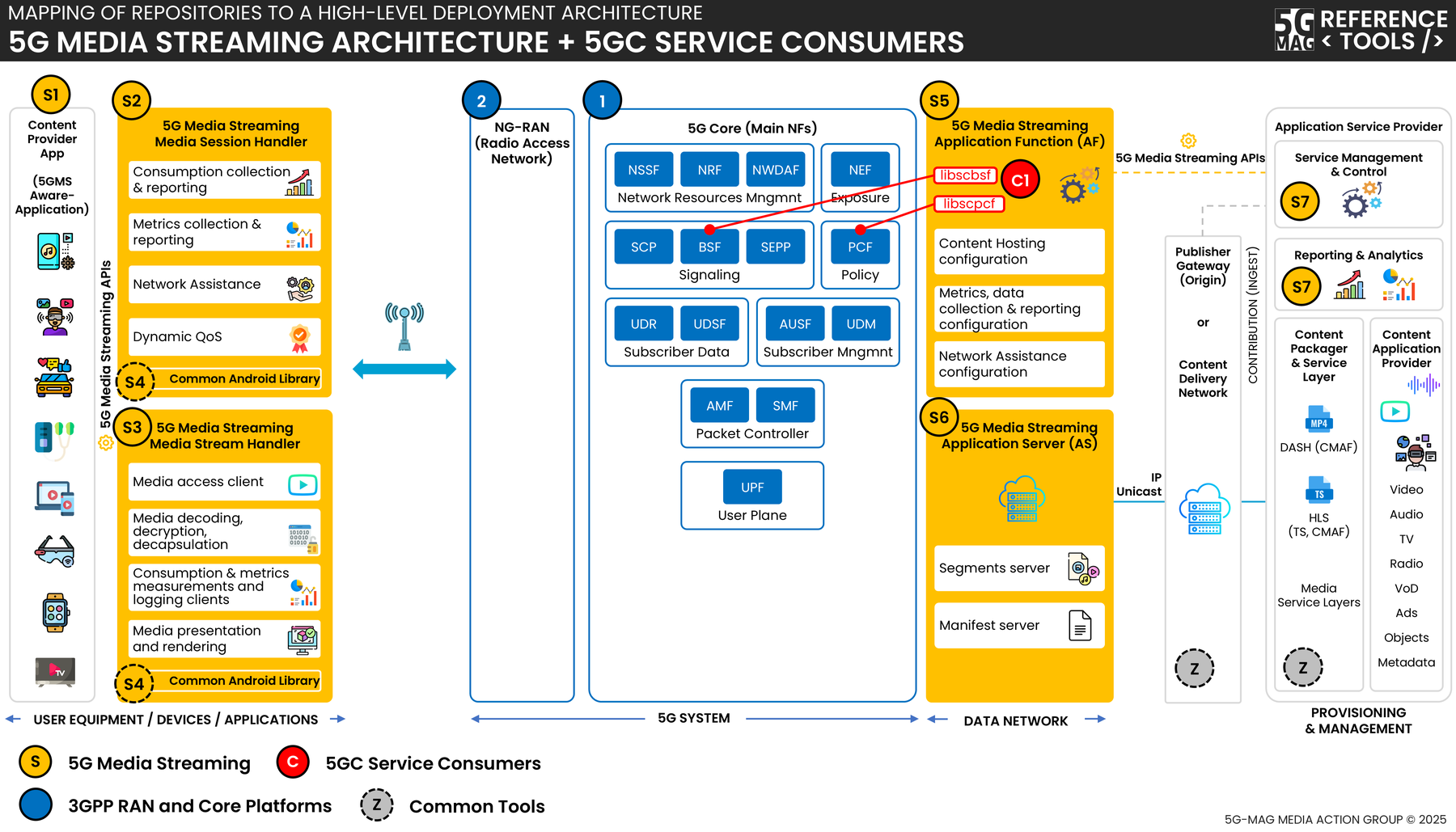
5G Downlink Media Streaming (5GMSd) with 5GC Service Consumers
The diagram below shows how the 5GMSd reference tools use the 5GC Service Consumer libraries (BSF and PCF) to request network QoS from the 5G Core.
5G Media Streaming: Resources 5GC Service Consumers: Resources 3GPP RAN and Core Platforms: Resources Common Tools: Repositories
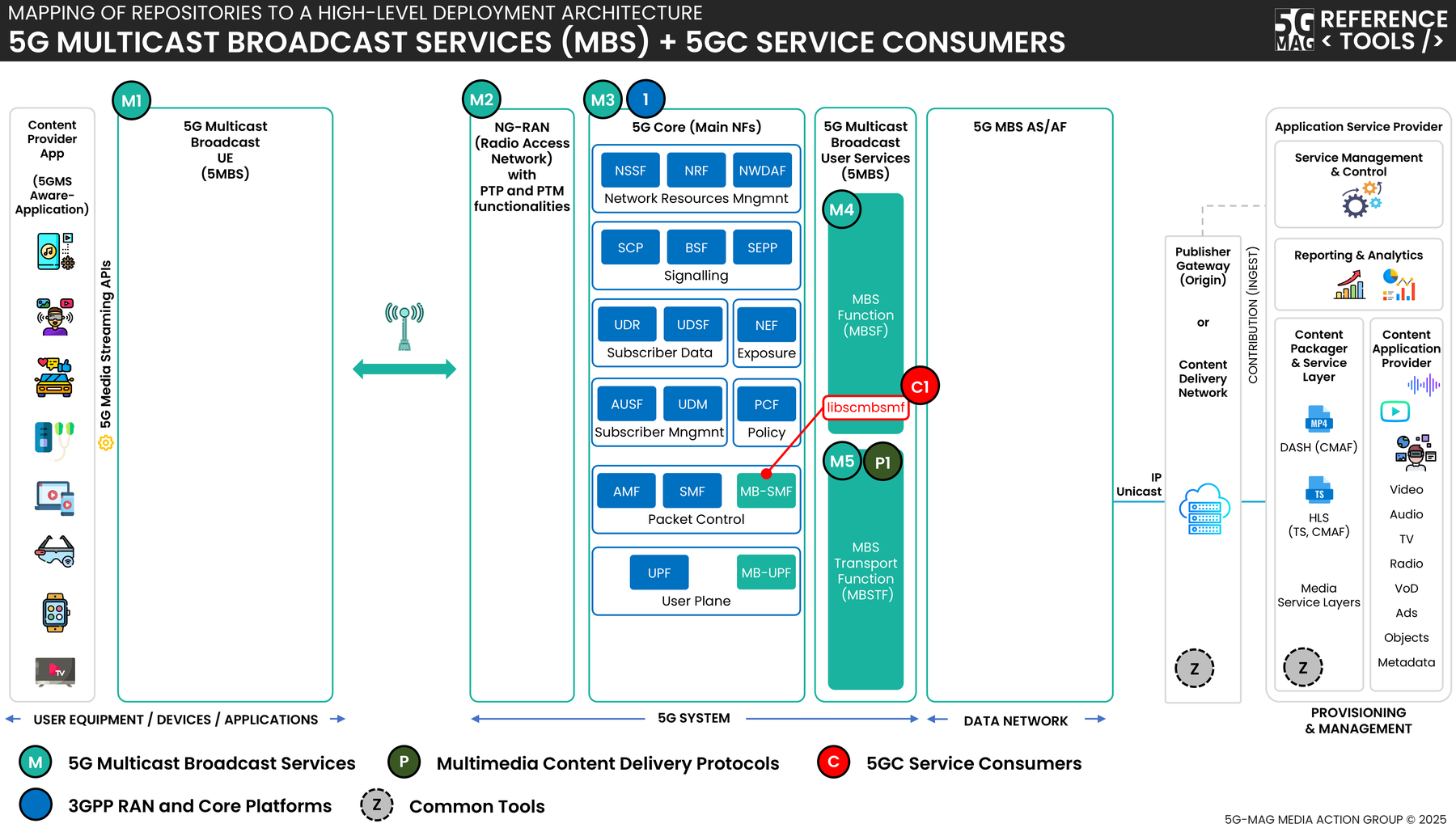
5G Multicast Broadcast Services (MBS) with 5GC Service Consumers
The diagram below shows how the MBS reference tools use the MB-SMF service consumer library to reach the 5G Core.
5G Multicast Broadcast Services: Resources Multimedia content delivery protocols: Resources 5GC Service Consumers: Resources 3GPP RAN and Core Platforms: Resources Common Tools: Repositories