This tutorial provides the required steps to test the reception of an HTTP Live Streaming (HLS) stream processed by the MBMS Modem.
More information about HLS can be found in the IETF HLS specification: RFC 8216 - HTTP Live Streaming
What you will build: a receiver chain (modem, middleware and web interface) that plays an HLS stream received over 5G Broadcast, using either an SDR or a recorded sample file as the source.
Prerequisites
Install the MBMS Modem, MBMS Middleware and Web User Interface (Step 1 below). You'll also need either an SDR and a live signal, or a downloaded HLS sample file — for hardware details see Requirements.
Basic workflow
This tutorial makes use of the rt-mbms-modem, rt-mbms-mw and a media player. The basic workflow of these components is illustrated in the Figure below:
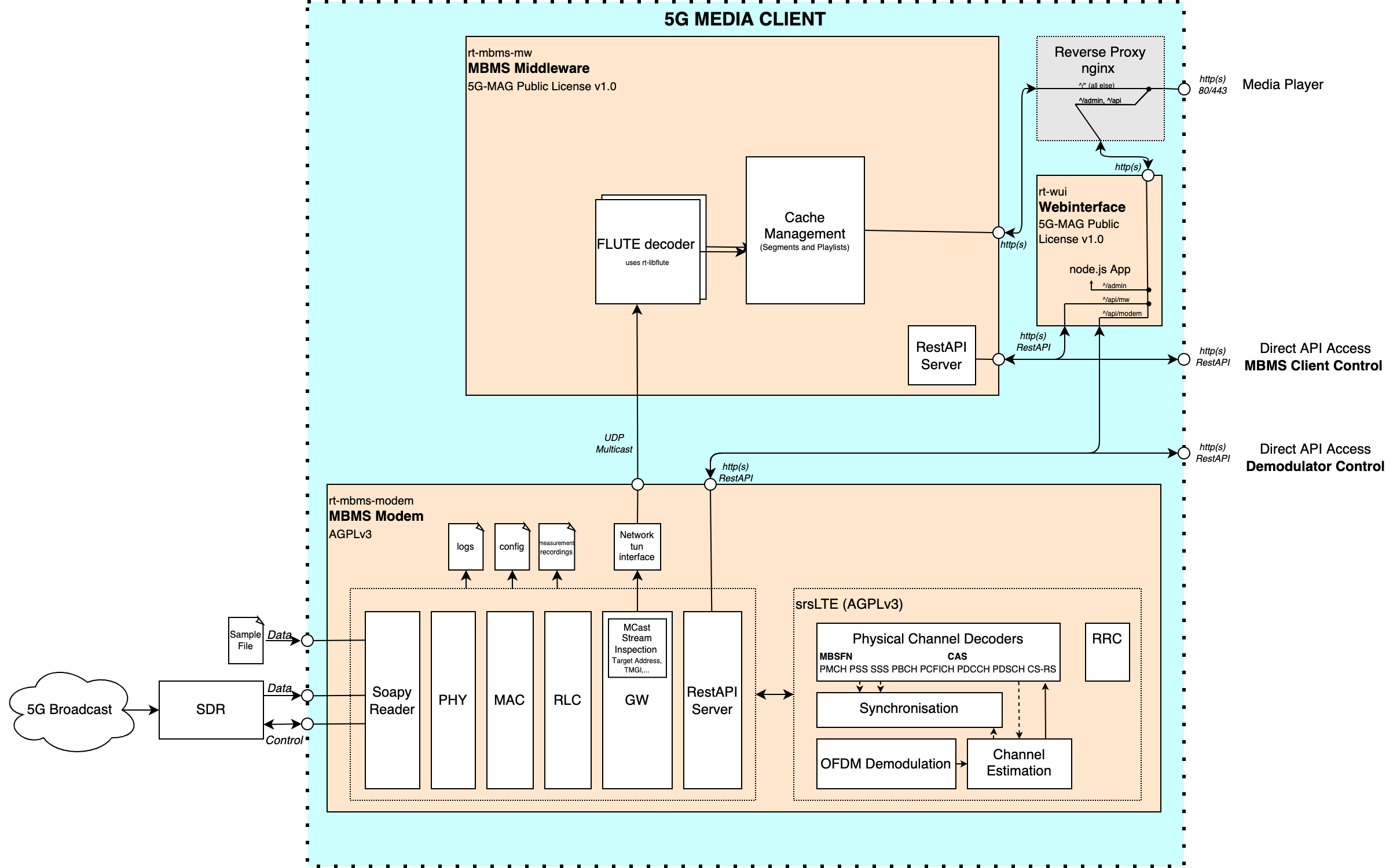
Figure: the receiver chain, from radio input through to the media player.
The output of the SDR or the sample file serves as the input for the MBMS Modem (also referred to as the Receive Process). The MBMS Modem exposes the FLUTE (File Delivery over Unidirectional Transport) encoded content via UDP multicast to the MBMS Middleware. The MBMS Middleware listens to the local tun interface. Received multicast packets from the modem are FLUTE-decoded using the Reference Tools FLUTE library. Once the manifest files and media segments are FLUTE-decoded they are cached in the middleware and made available to the media player via an Nginx proxy. The media player itself is not aware that the content is provided via broadcast.
Step 1: Installation
Also download an HLS sample file or set up an HLS live stream on your transmitting infrastructure.
Step 2: Configure multicast routing
Follow the detailed instructions on how to configure multicast routing provided here.
Start and then stop the MBMS Modem service. Starting it generates or updates the required configuration files; stopping it frees the modem so you can run it in the foreground against a sample file in the next step. This may be needed again after a reboot. - systemctl start 5gmag-rt-modem - systemctl stop 5gmag-rt-modem
Step 3: Start the MBMS Modem
Start the MBMS Modem with a sample as specified here. It is important to provide the right bandwidth to the MBMS Modem. Consequently, for a 5 MHz bandwidth sample file, the command looks like this:
cd rt-mbms-modem/build
sudo ./modem -f "PathToSample/5MHz_MCS16_1kHz25_HLS_q6a.raw" -b 5
The final output on the terminal should now look similar to the output below:
modem[7891]: 5g-mag-rt modem v1.1.1 starting up
modem[7891]: Initialising SDR
modem[7891]: Launching phy thread with realtime scheduling priority 10
modem[7891]: Launching phy thread with realtime scheduling priority 10
modem[7891]: Launching phy thread with realtime scheduling priority 10
modem[7891]: Launching phy thread with realtime scheduling priority 10
modem[7891]: Launching phy thread with realtime scheduling priority 10
modem[7891]: Raising main thread to realtime scheduling priority 20
modem[7891]: GPS data stream started
modem[7891]: TUN file descriptor 6
modem[7891]: Starting RESTful API handler at http://0.0.0.0:3010/modem-api/
modem[7891]: Phy: PSS/SSS detected: Mode FDD, PCI 333, CFO 0.18315084 KHz, CP Extended
modem[7891]: Phy: MIB Decoded. Mode FDD, PCI 333, PRB 25, Ports 1, CFO 0.18315084 KHz, SFN 0
modem[7891]: Decoded MIB at target sample rate, TTI is 120. Subframe synchronized.
modem[7891]: CINR 16.13 dB
modem[7891]: PDSCH: MCS 5, BLER 0.0, BER 0.0
modem[7891]: MCCH: MCS 2, BLER 0.0, BER 0.0
modem[7891]: MCH 0: MCS 16, BLER 0.0, BER 0.05661512027491409
modem[7891]:     MTCH 0: LCID 1, TMGI 0x00000009f165, 238.1.1.95:40085
modem[7891]:     MTCH 1: LCID 2, TMGI 0x00001009f165, 238.1.1.111:40101
modem[7891]: -----
To tell a healthy decode from a failing one, look for this sequence in the log: PSS/SSS detected (the modem found the signal), MIB Decoded and Subframe synchronized (it locked onto the frame structure), a reasonable CINR value in dB (signal quality; higher is better), and low BLER/BER on the PDSCH, MCCH and MCH lines (block/bit error rates; near 0.0 is good). The final MTCH lines list the received services with their TMGI (service identity) and the multicast address and port. If you do not see PSS/SSS detected or MIB Decoded, the modem is not receiving the signal (check the SDR, frequency, or the -b bandwidth for a sample file).
Step 4: Start the MBMS Middleware
In this example, the MBMS Middleware is started from the build folder to enable logging to the terminal.
Note: Depending on the format of the Service Announcement file you need to adjust the configuration in /etc/5gmag-rt.conf. Detailed information can be
found here.
Start the middleware:
cd rt-mbms-mw/build
sudo ./mw
The output should look like this, confirming the middleware has started a FLUTE receiver on the modem's multicast address:
mw[216090]: 5g-mag-rt mw v0.10.0 starting up
mw[216090]: Starting FLUTE receiver on 238.1.1.95:40085 for TSI 0
Step 5: Start the Web User Interface
The Web User Interface is used to monitor the MBMS Modem and the MBMS Middleware, and its hls.js integration plays back the final HLS stream. To run the Webinterface, perform the steps described here.
The Webinterface can also be started directly from its folder:
cd rt-wui
node app.js
In order to use the webinterface for playback perform the following steps:
- Navigate to
http://localhostin your browser - Click
Middlewareon the top right corner - Click on the play button below the stream information
- An instance of hls.js is initialized playing the HLS stream
The output for step 3 and step 4 should look similar to this:
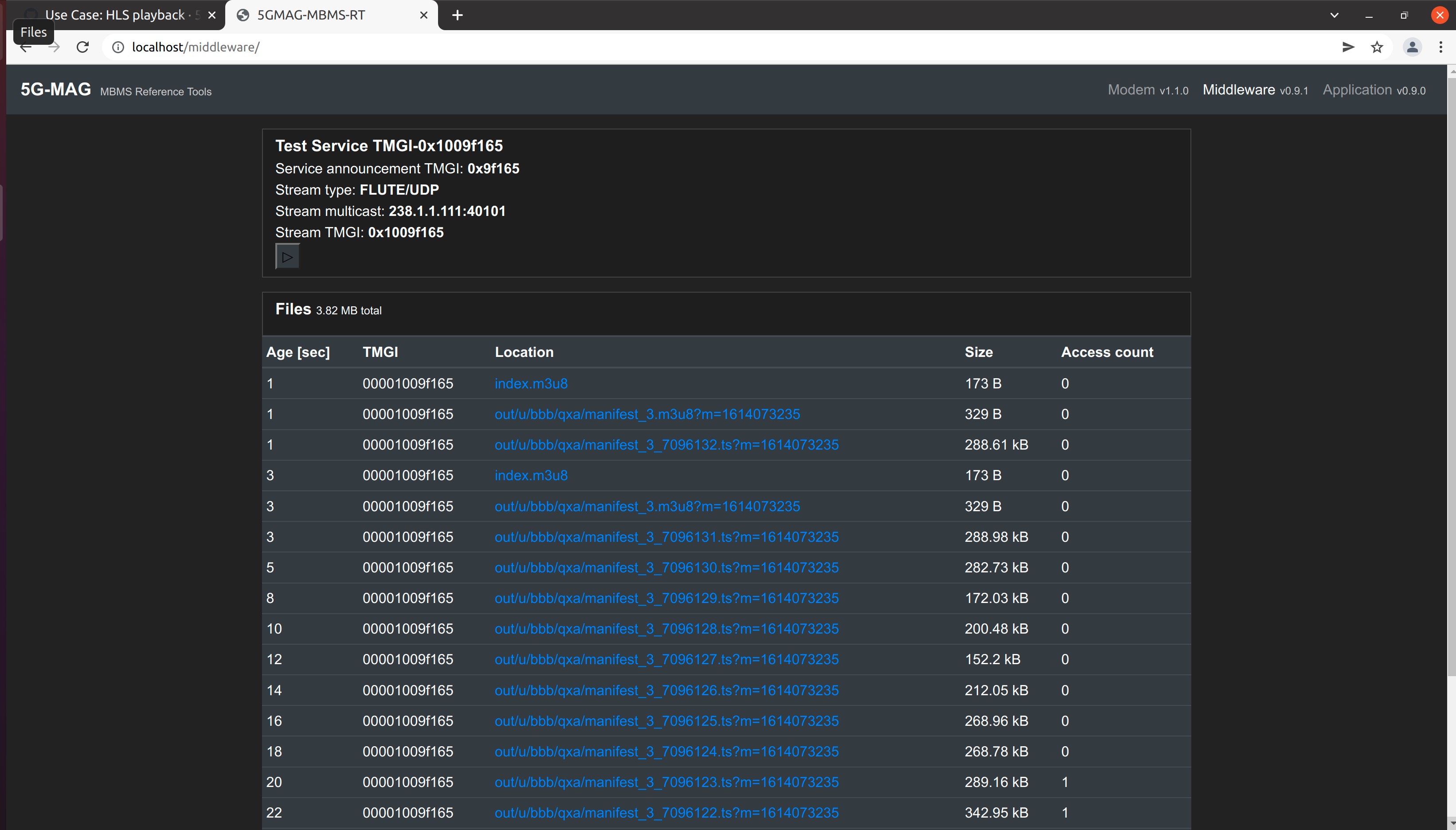
Figure: the Middleware tab of the Web User Interface, showing the received stream.
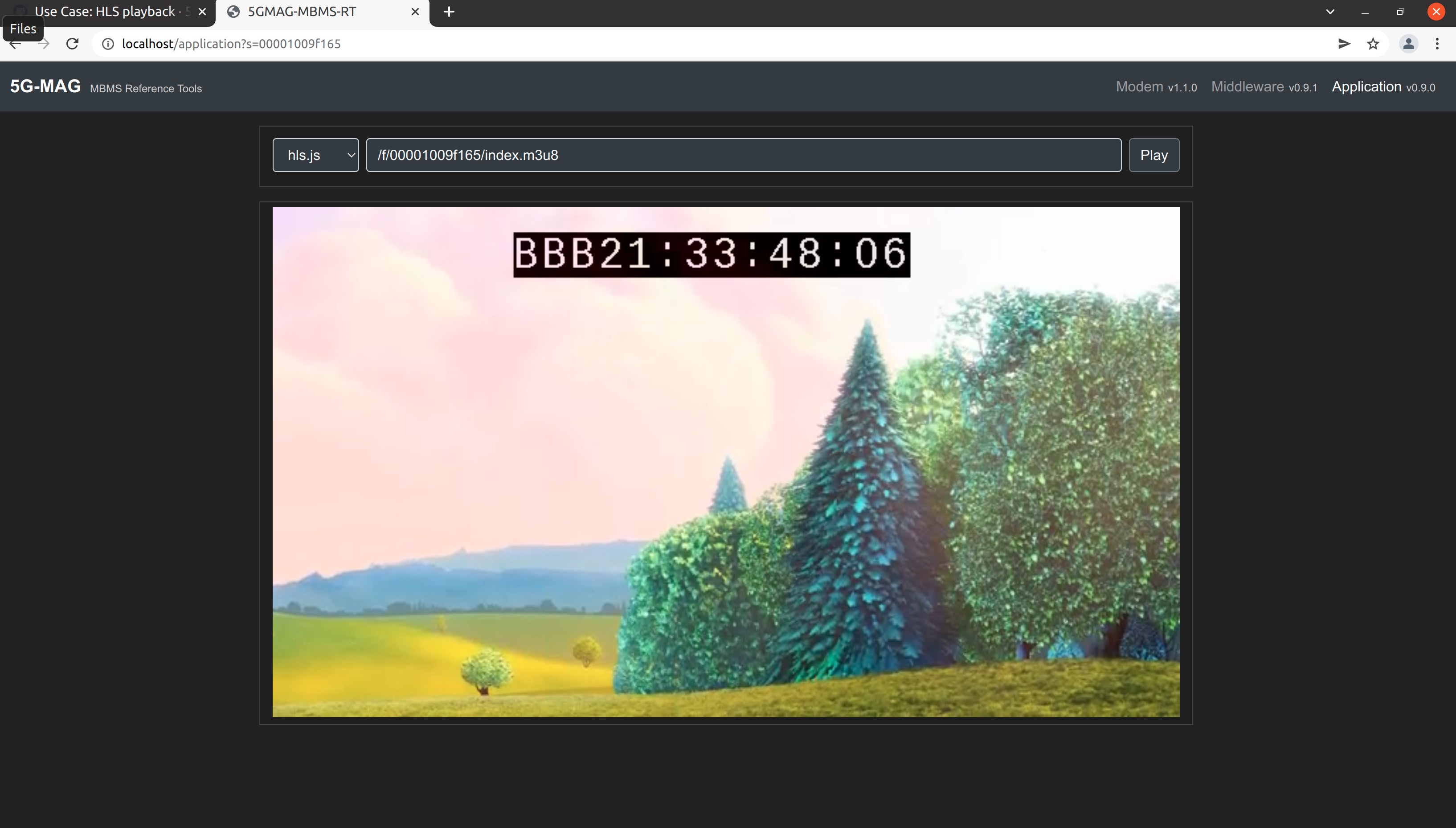
Figure: the HLS stream playing in the Web User Interface via hls.js.
At this point the stream received over 5G Broadcast is playing in the browser. It is also possible to use other players like VLC. Simply paste the url to the index.m3u8 into the VLC player. As an
example the URL can look the following: http://localhost/f/00001009f165/index.m3u8. Replace the localhost part with
the IP of the machine that is running the MBMS Middleware in order to access the stream from other machines in the same
network.
Next steps
- To receive an RTP stream instead, see SDR - RTP Playback over 5G Broadcast.
- To adjust the Service Announcement configuration, see Configuration of Service Announcement.
- Return to the Tutorials index.