Why Open Source, and Why Now
Media and network technologies move fast, and open source usually arrives only after a standard is frozen, with additional cost at every stage along the way. The Accelerator closes both gaps.
Early feedback and validation
Implementation evidence that informs specification development before standards are finalised.
Software projects & Dev community
A community of standards experts, developers and implementers, building software projects together.
No duplication and fast deployment
Shared reference implementations mean no one builds the same thing twice.
Open by design and IPR-friendly
IPR-friendly licensing, designed from the start for broad industry participation.
Enabling open-source software from the start of every project
A specification is only valuable once it can be implemented, tested and deployed. Open source is the mechanism that makes it work.
Duplicated prototypes. Each organisation builds its own to evaluate a draft; results differ and feedback is slow.
One shared baseline. Drafts are validated against running code before the freeze, while gaps are cheap to fix.
Late interop bugs. Testing starts from scratch at plugfests; errors, some in the specification, surface late.
Faster plugfests. Implementers start from the same code: shorter preparation, faster root-cause analysis.
Slow deployment. Years can pass from a frozen specification to production-ready code; early adopters carry the cost alone.
Earlier deployment. End-to-end demos and trials run before commercial products, and feed evidence back into the standard.
We make open-source software and evaluation platforms work-plan deliverables, not optional extras
- Work item launch1Plan it at launch
Define the open-source software and evaluation platform track from day one: where the code lives, its scope, the evaluation metrics. Reuse existing open platforms.
- Drafting2Engage implementers during drafting
Involve open-source communities while the specification is written, and invest in that development. Running code surfaces issues that text review cannot.
- Freeze and deployment3Make the value tangible
End-to-end demos and benchmark platforms show that the standard works. They lower cost for the whole ecosystem: members and non-members alike, start-ups, academia.
In one line, for every new work item“Open-source software and evaluation platform: home and scope identified at launch.”
What the programme builds
Open-source software and tools built from the specifications, kind by kind.
The programme
The community and the process behind the software: how to join, contribute, licence and get early access.
Growing community of developers
Organisations contributing to the Media Connectivity Software Accelerator.














All the tools, by kind
Every tool of the programme, in one list.
Reference Tools
Testbeds and Evaluation Frameworks
Software Accelerator in numbers
Counted daily from the project pages and GitHub.
Projects across media and connectivity
19Project repositories, public and early access
7048 public, 22 early accessClones: developers pulling the code
26,703Developers' Public Call and rolling releases
MonthlyLicense Model
Protecting IPR. Enabling industry collaboration.
What is the License Model?
- The 5G-MAG Public License v1.0 is a modified version of Apache 2.0 which allows:
- Free Non-Commercial Use: freely use, copy, modify, and distribute the code for non-commercial purposes, including study, academic research, testing, and validation.
- Commercial Exploitation: use the reference tools and software within commercial services, trials, and live deployments, but with FRAND Patent Licensing: if used commercially, the built-in patent clause ensures that any essential contributor patents are made available under FRAND (Fair, Reasonable, and Non-Discriminatory) terms.
- Repositories with software derived from other licenses keep their own license according to their own terms.
How to Contribute?
- Sign an Individual or Corporate Contributor License Agreement (CLA).
- Anybody can become a contributor (no need to be a 5G-MAG member to contribute code).
- 5G-MAG members get priority in support from the 5G-MAG Project Office, and additional development resources may be provided. 5G-MAG members define priorities and where to dedicate resources.
- Membership of 5G-MAG remains open to the industry, to boost and scale your software project by joining forces.
Early Access
Selected projects are set to private. Request access below; every request is reviewed manually, case by case.
Request Early Access →Our work in the field
Reference Tools running on real hardware, at real events, and recent demos and tutorials from the developer community.
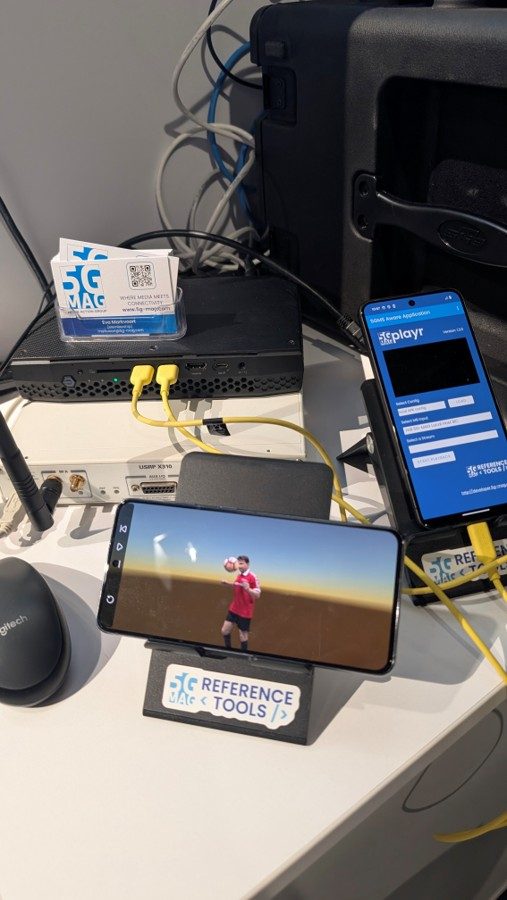
A Reference Tools demo rig: SDR hardware and phones running live 5GMS and volumetric video demos.
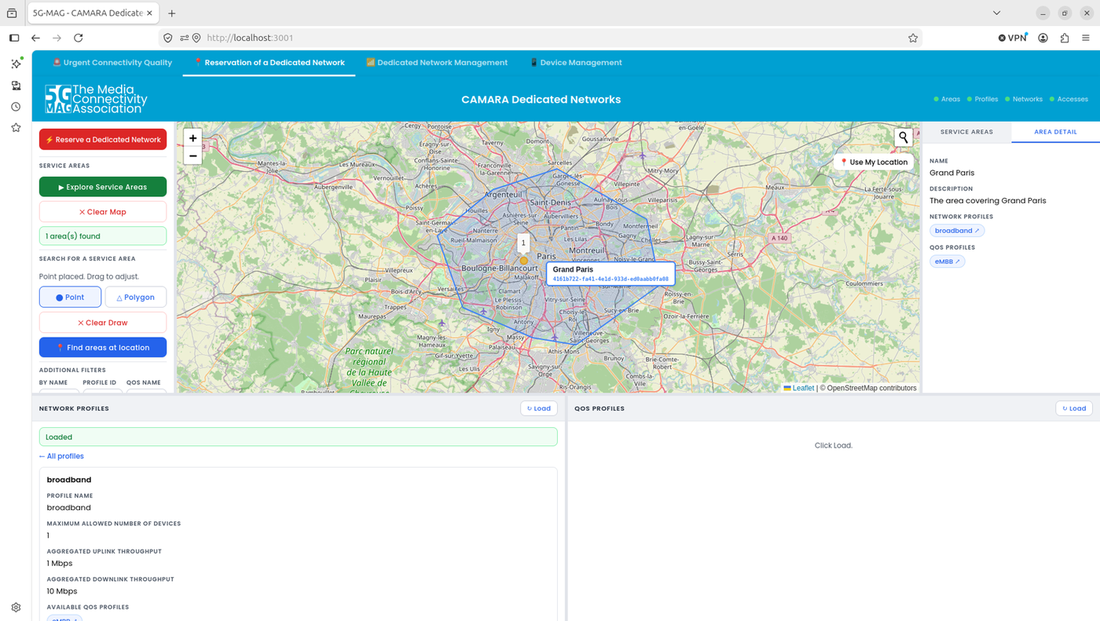
The CAMARA Dedicated Networks reference tool, reserving a network area on a live map.
Connecting MBSTF to the MBS System
Introducing the Avatar Real-Time Communication Project
5G Media Streaming - Latest Additions
MBS User Services for 5G MBS (Release 18) - Updates
All Repositories
Every real code repository across every Reference Tools and Testbeds project, in one place. Know the name of a specific tool but not which project it belongs to? Search for it here.
Reference Tools: This repository is related to "Conversational Avatar Real-Time Communications"
Reference Tools: This repository is related to "Conversational Avatar Real-Time Communications"
Content provider portal: provisions xMB (TS 26.348) services and sessions on the BM-SC, and drives the transmitter's and MBMS Gateway's own control interfaces.
This repository holds an extension of an MBMS-enabled eNodeB tailored to operate as a 5G Broadcast transmitter compatible with Qualcomm Reference Design (QRD) and QRC devices. In addition, System Information Blocks relevant for Emergency Alerts (e.g. SIB12) can be transmitted.
This repository holds an extension of an MBMS-enabled eNodeB tailored to operate as a 5G Broadcast transmitter compatible with Qualcomm Reference Design (QRD) and QRC devices. In addition, System Information Blocks relevant for Emergency Alerts (e.g. SIB12) can be transmitted.
This repository contains a collection of reusable service consumer libraries designed to interact with the 5GC Network Functions using service interfaces.
This repository contains a collection of reusable service consumer libraries designed to interact with the 5GC Network Functions using service interfaces.
This repository contains a collection of reusable service consumer libraries designed to interact with the 5GC Network Functions using service interfaces.
5G-MAG maintains a fork of open5gs for the development and adaptation of 5GC network functions to support other Reference Tools.
5G-MAG maintains a fork of open5gs for the development and adaptation of 5GC network functions to support other Reference Tools.
Fork of the discontinued srsRAN suite, kept for reference. Superseded by srsRAN_4G for LTE and by rt-srsRAN_Project for 5G NR.
5G-MAG maintains a fork of srsRAN_Project for the development and adaptation of NG-RAN procedures to support other Reference Tools.
5G-MAG maintains a fork of srsRAN_4G for the development and adaptation of NG-RAN procedures to support other Reference Tools.
The 5GMS Application Function (AF) is a Network Function that forms part of the 5G Media Services framework as defined in ETSI TS 126.501.
This repository provides multiple tools to interact with the 5GMS Application Function: Command Line Interface Tool; Management UI; Postman Collection; QoE Metrics Reporting UI.
The 5GMS Application Server (AS) is a Network Function that forms part of the 5G Media Streaming framework as defined in ETSI TS 126.501.
The 5GMS Common Library is an Android library that includes models and helper classes used within the different client-side Android applications such as the 5GMSd-Aware Application, 5GMSd Media Stream Handler and the 5GMSd Media Session Handler.
The 5GMS Media Session Handler is a 5GMS Client component that forms part of the 5G Media Services framework as defined in ETSI TS 126.501.
The 5GMS Media Stream Handler is a 5GMS client component that forms part of the 5G Media Services framework as defined in ETSI TS 126.501.
This repository holds example projects that make use of other 5G-MAG repositories or provide additional functionalities to test and implement new features for 5GMS: 5G Media Streaming - Docker Compose Setup; Express Mock AF.
This repository holds applications that can be used to test and demonstrate other 5G-MAG Reference Tools related to 5GMS. Current applications available include: 5GMSd-Aware Application; Exo DVB-I Player.
This repository holds applications that can be used to test and demonstrate other 5G-MAG Reference Tools related to 5GMS. Current applications available include: 5GMSd-Aware Application; Exo DVB-I Player.
A framework for measuring and analyzing AI/LLM service traffic patterns under various network conditions, designed to support 3GPP SA4 6G Media Study contributions.
This repository holds code related to the implementation of the AI/ML evaluation framework as defined in 3GPP SA4 TR 26.847 (Release 19).
This repository supports the development of a reference framework for avatar communication. The goal is to demonstrate WebRTC communication using the MPEG ARF and related animation compression.
The Base Avatar Repository (BAR): the service that stores a user's base avatar models and releases them, scoped to what a call is entitled to see, following 3GPP TS 26.264 and TR 26.813.
This project holds code related to the evaluation framework for the Feasibility Study on Beyond 2D Video (FS_Beyond2D) in 3GPP TSG SA WG4 (SA4). This study is based on work item description (WID) SP-240479 New SID on Feasibility Study on Beyond 2D Video, and the study will result in technical report TR 26.956.
BM-SC for MBMS user services: ingests content over xMB (TS 26.348), announces it, and delivers it with FLUTE under the TS 26.346 profile.
This repository contains example files and tools in relation to the CAMARA Project
Cell Broadcast Centre for the Public Warning System: accepts a warning message from an alert originator and emits it to the MME over SBc-AP, so it reaches handsets as ETWS or CMAS. Independent of any MBMS bearer.
Tools to collect and analyse CMCD (Common Media Client Data) v2 locally and across different cloud providers.
Tools to collect and analyse CMCD (Common Media Client Data) v2 locally and across different cloud providers.
This repository holds reference MPEG ARF content for real time avatar communication.
This folder contains the files to configure and test the V3CImmersivePlatform - Unity Player application.
Tools for 5G-MAG members that support the transition of standards into deployments: tools, rules and working records for going from a specification to a working implementation.
A browser DVB-I client that discovers a service list, presents its channels with their content guide, and plays them, per ETSI TS 103 770.
Publishes a DVB-I service list and its content guide, and gives an editor for maintaining them, per ETSI TS 103 770.
Runnable examples that bring the DVB-I repositories up together on one machine, publishing and playing a service list per ETSI TS 103 770.
A native Android DVB-I client: it discovers a service list, presents its channels with their content guide, and plays them with Media3 ExoPlayer, per ETSI TS 103 770.
Answers DVB-I client queries with a list of Service List Entry Points, per ETSI TS 103 770 V1.2.1 clause 5.1.3.2.
Tests a FLUTE implementation against the FLUTE profiles of RFC 3926, 3GPP TS 26.346 and 3GPP TS 26.517.
This repository provides a 5G Data Collection Service Provider library and AF. It can provide the interfaces R1-R6 as per 3GPP TS 26.531 (See Clause 4.2). The default Application Function implementation here implements some of the data reports and events defined in 3GPP TS 26.531, 3GPP TS 26.532 and 3GPP TS 29.517.
A fork of the MPEG Group's glTF Validator, a tool that checks glTF assets. The XR Reference Tools depend on it to validate scenes that use the MPEG extensions.
5G-MAG maintains a fork of srsRAN Project, adapted for 5G Multicast Broadcast Services (MBS) support.
This repository holds an implementation of the MBMS Middleware for Android.
MBMS client: reads the service announcement, reassembles FLUTE objects from the bearer, and republishes them to a local player as an HLS or DASH presentation. Supersedes rt-mbms-mw.
MBMS Gateway for an LTE-based 5G Terrestrial Broadcast deployment: takes content from the BM-SC and delivers it onto the M1-U bearer, driving the MBMS session lifecycle towards the MME over Sm (GTPv2-C).
This repository holds an MBMS Modem, which main task is to convert a 5G BC input signal (received either as live I/Q raw data from the SDR or as prerecorded SDR sample file) to multicast IP packets on the output.
This repository holds example projects that make use of other 5G-MAG repositories or provide additional functionalities to test and implement new features for MBMS: FLUTE ffmpeg.
A graphical web interface with a control display for the MBMS Modem and MBMS Middleware, with basic browser-based HLS playback of the manifest and segments provided by the middleware, using hls.js.
Receive-side web application: plays what the MBMS client received over the air, and shows the modem's radio state, the decoded system information and any cell broadcast warning. Supersedes rt-wui.
Receive-side web application: plays what the MBMS client received over the air, and shows the modem's radio state, the decoded system information and any cell broadcast warning. Supersedes rt-wui.
Web control portal playing the MBS Application Provider role (3GPP TS 26.502): provisions MBS User Services at Nmb10 towards the MBSF and pushes content at Nmb8 towards the MBSTF.
UE-side MBS Client (3GPP TS 26.502): receives the MBS-4-MC announcement carousel and FLUTE object delivery, and exposes the received services to applications over the MBS-6 and MBS-7 local APIs.
Reference Tools: This repository is related to "5G Multicast Broadcast Services"
Reference Tools: This repository is related to "5G Multicast Broadcast Services"
This repository is related to: 5G Multicast Broadcast Services
Dashboard playing the MBS-Aware Application role (3GPP TS 26.502) against rt-mbs-client: lists announced services, activates and deactivates reception, and inspects received objects.
A media origin server component for Content Delivery Protocols and Tools testing (JavaScript/TypeScript web application).
A media origin server component for Content Delivery Protocols and Tools testing (JavaScript/TypeScript web application).
A media origin server component for Content Delivery Protocols and Tools testing (JavaScript/TypeScript web application).
A media origin server component for Content Delivery Protocols and Tools testing (JavaScript/TypeScript web application).
A web dashboard and REST API for applying, creating and scheduling network impairment profiles (delay, jitter, loss, bandwidth caps) with the 6G-Testbed's netemu.
An Android test app and a laptop test rig that check every delivery method of rt-media-origin arrives on a phone and plays as configured.
5G-MAG maintains a fork of srsRAN_4G, adapted for 5G Multicast Broadcast Services (MBS) support.
Web-based decoder and player for Dynamic Mesh Coding (V-DMC) content.
This project contains the entrypoints for decoding and viewing MPEG Immersive Video (MIV) and Video Point Cloud Compression (V-PCC) related to the MPEG V3C Immersive Platform.
Example V3C content and helper files for testing the encoding, delivery and rendering pipeline.
This project provides a Unity package to decode and play V3C contents in Unity, using the MPEG V3C Immersive Platform - Decoder Plugin. Also provided in that repository are V-PCC and MIV synthesizers plugins needed for the rendering of the V3C contents.
Validates AVC and HEVC video bitstreams against the operation points of 3GPP TS 26.265 (VOPS)
This repository provides media pipelines implementations supporting the 5G-MAG Reference Tools XR Player Unity 3D project. Media pipelines are plugins for the XR Player's media player implementation of the Media Access Functions API (MAF) defined in ISO/IEC 23090-14.
The XR Unity Player is an interactive and XR-capable glTF scene viewer implemented in Unity3D. It supports glTF extensions specified in the MPEG-I Scene Description framework (ISO/IEC 23090-14).
This Blender add-on adds support for MPEG_* glTF extensions to the built-in glTF exporter.
This repository provides reference content for testing and demos with the XR Player.
Join the Effort
Help shape what connected media looks like next and scale your projects with the industry.